ISLAMABAD: A Pakistani court on Monday sentenced former Prime Minister Nawaz Sharif to seven years in prison for corrupt practices linked to the setting up of a steel mill, in a verdict that threatens to end the career of one of Pakistan’s most high-profile politicians of the last four decades.
The accountability court acquitted the three-time prime minister in a second corruption case involving an investment company.
“I’ve never committed corruption so my conscience is clear,” local media quoted Sharif as telling reporters present in the courtroom after the verdict was announced.
Hundreds of Sharif supporters gathered outside the accountability court as a judge ruled on two separate cases that investigated the source of funds to set up two companies, Al-Azizia and Hill Metal Establishment in Saudi Arabia and Flagship Investment in the United Kingdom.
Both companies were established in 2001 when Sharif lived in exile in Saudi Arabia after his government was ousted in a military coup in 1999. Investigations were hinged on the question of how the Sharif family was able to arrange the funds to set up the firms at a time when they were exiled and had no money or assets.
Sharif was taken into custody immediately after the judge read out the sentence and will be incarcerated at Lahore’s Kot Lakhpat Jail. His lawyers are expected to appeal the Al-Azizia verdict at the Islamabad High Court, while the National Accountability Bureau may move the court against Sharif’s acquittal in the Flagship Investment case.
“We have always respected past verdicts and we will respect this one too,” Shahid Khaqan Abbasi, a senior leader of Sharif’s Pakistan Muslim League-Nawaz (PML-N) party, said. “But neither history nor the nation will accept this verdict.”
“These verdicts will God willing be done away with; what will be left behind is Nawaz Sharif’s honesty,” Sharif’s daughter and political heir Maryam Nawaz Sharif tweeted minutes after the sentence was announced. “Remember, when injustice passes a certain limit, it is eliminated.”
Monday’s judgment ends a two-and-a-half-year-long saga of corruption cases involving accusations the Sharif family hid offshore accounts and engaged in money laundering and tax evasion. The cases stemmed from the 2016 Panama Papers’ leaks that first revealed the family had bought luxurious London apartments through offshore companies.
Sharif and his family have repeatedly called the corruption proceedings politically motivated and hinted at collusion between Pakistan’s all-powerful military and the courts to keep the ex-premier and his PMLN party out of politics. On the other hand, Sharif’s opponents have championed the court cases as a rare example of Pakistan’s power elite finally being held to account. The military denies any wrongdoing.
Sharif has served as prime minister thrice but been unable to complete his term all three times. He was removed by a presidential order in 1993 and in a military coup in 1999 after which he went into exile until 2007.
Sharif was elected as prime minister for the third time in a landmark general election in 2013 but his rule was cut short after the Supreme Court disqualified him from office in July 2017 for trying to conceal assets. The court also ordered the opening of three criminal investigations into the Sharif family.
In July 2018, less than two weeks before general elections, Sharif was sentenced to ten years in jail and subsequently arrested in a first case linked to the money trail for the purchase of upscale Avenfield London flats. His daughter Maryam was also jailed for seven years on corruption charges relating to the family’s acquisition of the flats.
Both father and daughter were released on bail after their sentences were suspended by the Islamabad High Court in September, almost two months after Sharif’s party lost elections to the party of new Prime Minister Imran Khan.
On Monday, the accountability court ruled on the last two cases, sending Sharif to jail for seven years.
On December 21, Sharif’s party had announced that an advisory council would run the party’s affairs if he were arrested but it is widely speculated that his daughter will be the real boss.
“The verdict definitely marks the end of hands-on control of the PMLN by Nawaz Sharif and any possibility of him holding office in Pakistan again,” political talk show host Mohammad Malick said.
Sharif’s brother Shehbaz Sharif, the leader of the opposition, is also currently facing cases involving alleged corruption in a low-cost housing scheme and other government projects. Sharif’s daughter Maryam is out on bail in the London apartments’ case but the National Accountability Court has filed an appeal against the suspension of the case. The court is yet to rule on that appeal.
“If Shehbaz [Sharif] is cleared of all cases, then he will take over the [PMLN] party; otherwise all eyes are on Maryam,” Malick said. “But if all three figures are convicted, then that is the end of the PMLN for all practical purposes, at least in its present shape and form.”


![]()

Nawaz Sharif, toppled prime minister and political survivor, gets 7 years jail
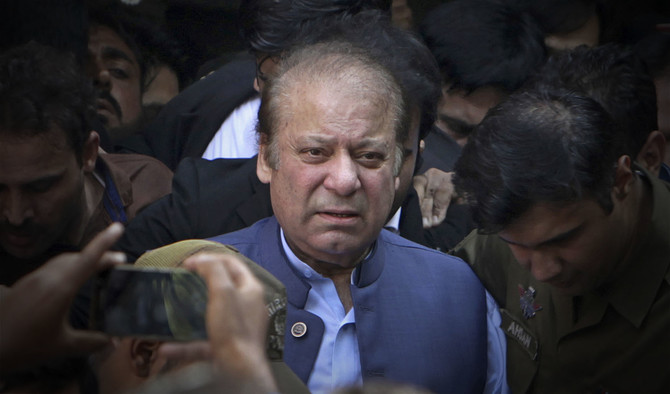
Nawaz Sharif, toppled prime minister and political survivor, gets 7 years jail
- Sentenced to prison in steel mill case, acquitted in investment company reference
- Verdict threatens end of career of one of Pakistan’s most high-profile politicians


Latest updates


© 2026 SAUDI RESEARCH & PUBLISHING COMPANY, All Rights Reserved And subject to Terms of Use Agreement.