

Few turn out for French ‘yellow vest’ protests, driver dies at road block

1 / 4
Gendarmes secure the traffic while the yellow vests protestor stand on the side of the road during a protest near highway access in Saint Saturnin, near Le Mans, northwestern France, on December 22, 2018. (AFP)
2 / 4
Protestors stand as police use a water cannon on the sidelines of a "Yellow Vest" (Gilets jaunes) anti-government protest on December 22, 2018, in Bordeaux, southwestern France, as part of a nationwide day of demonstrations. (AFP)
3 / 4
Demonstrators of the French "yellow vests" (gilets jaunes) throws tear gas canisters back as police disperse the end of a protest in central Paris on December 22, 2018 as the movement turned out in small numbers for a sixth Saturday of nationwide demonstrations. (AFP)
4 / 4
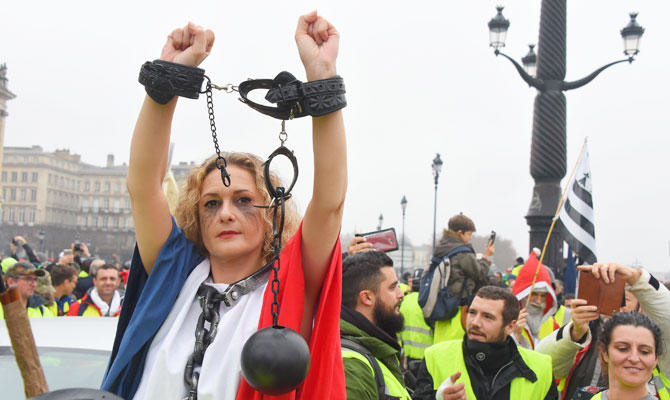
A protestor wrapped in a French flag and wearing a ball and chain costume attends during a "Yellow Vest" (Gilets jaunes) anti-government protest on December 22, 2018, in Bordeaux, southwestern France, as part of a nationwide day of demonstrations. (AFP)
Updated 23 December 2018
Follow

Few turn out for French ‘yellow vest’ protests, driver dies at road block

  • Late on Friday, a 36-year-old man died in Perpignan, southern France, when his car hit a truck at a road block erected by protesters
  • The “yellow vest” protesters began in mid-November to rally against fuel tax increases and subsequently against the wider liberal economic reform policy of Macron

TOULOUSE/PARIS, France: France’s anti-government “yellow vest” protest was losing steam on Saturday but caused traffic disruption through road blocks across the country, leading to the death of a 10th person since the start of the movement last month.
The turnout on the streets of Paris and other cities was smaller than in previous weekends, authorities said. No major damage or clashes had been reported between police and protesters as of mid-afternoon.
About 23,800 people were demonstrating at 1300 GMT, including fewer than 1,000 in Paris, the interior ministry said. This was down from a week ago at the same time when there were 33,500 protesters out on the streets, 2,200 of which were in Paris.
Authorities had expected a march in Versailles, whose castle is a symbol of French state power and one of Europe’s top tourist attractions.
But few “gilets jaunes” (yellow vest) protesters — so-called after the high-visibility jackets French motorists must carry in their cars — showed up in the formal royal city.
Dispersed groups of protesters were out on the streets of Paris near tourist landmarks such as the Sacre Coeur Basilica and the Galeries Lafayette department stores, singing La Marseillaise and calling for President Emmanuel Macron’s resignation.
Attendance was on the rise, however, in Lyon and Bordeaux, according to Reuters witnesses. Protesters also managed to block some of the big highways, including one leading to Spain.
Late on Friday, a 36-year-old man died in Perpignan, southern France, when his car hit a truck at a road block erected by protesters, raising the death toll linked to the demonstrations to 10.
On Saturday, police fired tear gas against protesters who gathered near Macron’s villa in the chic resort of Le Touquet in northern France.

ROAD ACCIDENTS
In the French capital, the police arrested 109 protesters, seven of whom were held in custody.
Three weeks ago the protests in Paris turned into some of the worst unrest seen in the capital since the student-led civil unrest of 1968. Cars were set on fire, bank and insurance offices’ windows smashed and street furniture was vandalized.
Of the ten deaths linked to the protests, most have been the result of road accidents.
The “yellow vest” protesters began in mid-November to rally against fuel tax increases and subsequently against the wider liberal economic reform policy of Macron, who made tax and salary concessions earlier this month.
But the movement has gradually lost steam in recent weeks.
Since he caved in to protesters in a TV address on Dec 10, Macron, who turned 41 on Friday, has largely kept out of the public eye, staying inside the Elysee palace for what his press team called internal meetings.
A recent poll showed France’s far-right party National Rally, formerly known as the National Front, confirmed it was so far the biggest political beneficiary of the protests.


Moderate candidate wins emphatically over a populist in Portugal’s presidential runoff

Updated 5 sec ago
Follow

Moderate candidate wins emphatically over a populist in Portugal’s presidential runoff

LISBON: Center-left Socialist candidate António José Seguro recorded a thumping victory over hard-right populist André Ventura in Portugal’s runoff presidential election Sunday, according to official results with 99 percent of votes counted.
Seguro won a five-year term in Lisbon’s riverside “pink palace” with 66.7 percent of votes, compared with 33.3 percent for Ventura.
The ballot was an opportunity to test the depth of support for Ventura’s brash style, which has struck a chord with voters and helped make his Chega (Enough) party the second-biggest in the Portuguese parliament, as well as gauge the public appetite for Europe’s increasing shift to the right in recent years.
European Commission President Ursula von der Leyen congratulated Seguro and said on social media that “Portugal’s voice for our shared European values remains strong.”
Seguro, a longstanding Socialist politician, positioned himself as a moderate candidate who will cooperate with Portugal’s center-right minority government, repudiating Ventura’s anti-establishment and anti-immigrant tirades.
He won the backing of other mainstream politicians on the left and right who want to halt the rising populist tide.
In Portugal, the president is largely a figurehead with no executive power. Traditionally, the head of state stands above the political fray, mediating disputes and defusing tensions.
However, the president is an influential voice and possesses some powerful tools, being able to veto legislation from parliament, although the veto can be overturned. The head of state also possesses what in Portuguese political jargon is called an “atomic bomb,” the power to dissolve parliament and call early elections.
In May, Portugal held its third general election in three years in the country’s worst bout of political instability for decades, and steadying the ship is a key challenge for the next president.
Ventura, an eloquent and theatrical politician, rejected political accommodation in favor of a more combative stance.
Ventura said he will keep working to bring about a political “transformation” in Portugal.
“I tried to show there’s a different way … that we needed a different kind of president,” he told reporters.
Making it through to the runoff was already a milestone for Ventura and his party, which have recalibrated Portuguese politics.
One of Ventura’s main targets has been what he calls excessive immigration, as foreign workers have become more conspicuous in Portugal in recent years.
“Portugal is ours,” he said.
During the campaign, Ventura put up billboards across the country saying, “This isn’t Bangladesh” and “Immigrants shouldn’t be allowed to live on welfare.”
Although he founded his party less than seven years ago, its surge in public support made it the second-largest party in Portugal’s parliament in the May 18 general election.
Seguro will next month replace center-right President Marcelo Rebelo de Sousa, who has served the constitutional limit of two five-year terms.