

Few turn out for French ‘yellow vest’ protests, driver dies at road block

1 / 4
Gendarmes secure the traffic while the yellow vests protestor stand on the side of the road during a protest near highway access in Saint Saturnin, near Le Mans, northwestern France, on December 22, 2018. (AFP)
2 / 4
Protestors stand as police use a water cannon on the sidelines of a "Yellow Vest" (Gilets jaunes) anti-government protest on December 22, 2018, in Bordeaux, southwestern France, as part of a nationwide day of demonstrations. (AFP)
3 / 4
Demonstrators of the French "yellow vests" (gilets jaunes) throws tear gas canisters back as police disperse the end of a protest in central Paris on December 22, 2018 as the movement turned out in small numbers for a sixth Saturday of nationwide demonstrations. (AFP)
4 / 4
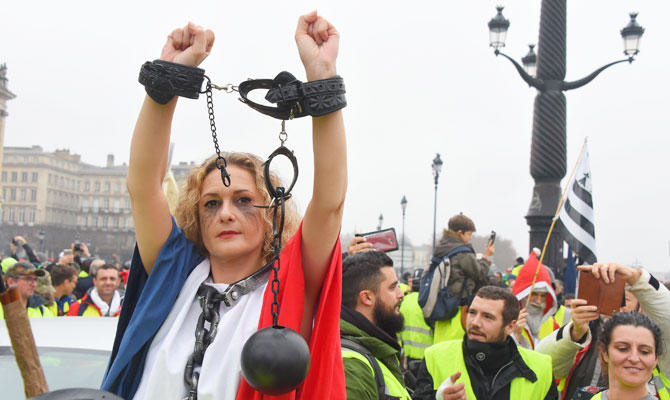
A protestor wrapped in a French flag and wearing a ball and chain costume attends during a "Yellow Vest" (Gilets jaunes) anti-government protest on December 22, 2018, in Bordeaux, southwestern France, as part of a nationwide day of demonstrations. (AFP)
Updated 23 December 2018
Follow

Few turn out for French ‘yellow vest’ protests, driver dies at road block

  • Late on Friday, a 36-year-old man died in Perpignan, southern France, when his car hit a truck at a road block erected by protesters
  • The “yellow vest” protesters began in mid-November to rally against fuel tax increases and subsequently against the wider liberal economic reform policy of Macron

TOULOUSE/PARIS, France: France’s anti-government “yellow vest” protest was losing steam on Saturday but caused traffic disruption through road blocks across the country, leading to the death of a 10th person since the start of the movement last month.
The turnout on the streets of Paris and other cities was smaller than in previous weekends, authorities said. No major damage or clashes had been reported between police and protesters as of mid-afternoon.
About 23,800 people were demonstrating at 1300 GMT, including fewer than 1,000 in Paris, the interior ministry said. This was down from a week ago at the same time when there were 33,500 protesters out on the streets, 2,200 of which were in Paris.
Authorities had expected a march in Versailles, whose castle is a symbol of French state power and one of Europe’s top tourist attractions.
But few “gilets jaunes” (yellow vest) protesters — so-called after the high-visibility jackets French motorists must carry in their cars — showed up in the formal royal city.
Dispersed groups of protesters were out on the streets of Paris near tourist landmarks such as the Sacre Coeur Basilica and the Galeries Lafayette department stores, singing La Marseillaise and calling for President Emmanuel Macron’s resignation.
Attendance was on the rise, however, in Lyon and Bordeaux, according to Reuters witnesses. Protesters also managed to block some of the big highways, including one leading to Spain.
Late on Friday, a 36-year-old man died in Perpignan, southern France, when his car hit a truck at a road block erected by protesters, raising the death toll linked to the demonstrations to 10.
On Saturday, police fired tear gas against protesters who gathered near Macron’s villa in the chic resort of Le Touquet in northern France.

ROAD ACCIDENTS
In the French capital, the police arrested 109 protesters, seven of whom were held in custody.
Three weeks ago the protests in Paris turned into some of the worst unrest seen in the capital since the student-led civil unrest of 1968. Cars were set on fire, bank and insurance offices’ windows smashed and street furniture was vandalized.
Of the ten deaths linked to the protests, most have been the result of road accidents.
The “yellow vest” protesters began in mid-November to rally against fuel tax increases and subsequently against the wider liberal economic reform policy of Macron, who made tax and salary concessions earlier this month.
But the movement has gradually lost steam in recent weeks.
Since he caved in to protesters in a TV address on Dec 10, Macron, who turned 41 on Friday, has largely kept out of the public eye, staying inside the Elysee palace for what his press team called internal meetings.
A recent poll showed France’s far-right party National Rally, formerly known as the National Front, confirmed it was so far the biggest political beneficiary of the protests.


Hundreds in London protest against Beijing ‘mega embassy’

Updated 3 sec ago
Follow

Hundreds in London protest against Beijing ‘mega embassy’

  • Protesters, their faces mostly covered with scarves or masks, chanted “No to Chinese embassy“
  • The latest protest came ahead of an expected decision this week

LONDON: Hundreds of people on Saturday rallied in London against Beijing’s controversial new “mega” embassy, days ahead of a decision on the plan.
Protesters, their faces mostly covered with scarves or masks, chanted “No to Chinese embassy” and waved flags reading “Free Hong Kong. Revolution now.”
Others held up placards with slogans such as “MI5 warned. Labour kneeled,” referring to the UK’s domestic intelligence agency and Prime Minister Keir Starmer’s ruling party.
Others read: “CCP (Chinese Communist Party) is watching you. Stop the mega embassy.”
China has for several years been trying to relocate its embassy, currently in the British capital’s upmarket Marylebone district, to the sprawling historic site in the shadow of the Tower of London.
The move has sparked fierce opposition from nearby residents, rights groups and critics of China’s ruling Communist Party.
The latest protest came ahead of an expected decision this week.
Benedict Rogers, head of the human rights group Hong Kong Watch said if it got the go-ahead it was “highly likely” that the site “will be used for espionage,” citing the sensitive underground communications cables close to the site.
He said China had already been “carrying out a campaign of transnational repression against different diaspora communities” and other critics and predicted that that would “increase and intensify.”

Beijing ‘operations base’ -

A protester who gave his name only as Brandon, for fear of reprisals, said the plans raised a “lot of concerns.”
The 23-year-old bank employee, originally from Hong Kong but now living near Manchester in northwestern England, said many Hong Kongers had moved to the UK “to avoid authoritarian rule in China.”
But they now found there could be an embassy in London serving as an “operations base” for Beijing.
“I don’t think it’s good for anyone except the Chinese government,” he said.
Another demonstrator, who did not to give her name, called on Starmer to “step back and stop it (the plan) because there is a high risk to the national security of the UK, not only Hong Kongers.”
The 60-year-old warehouse worker, also originally from Hong Kong and now living in Manchester, said the embassy would be a “spy center not only to watch the UK but the whole of Europe.”
Speakers at the rally throwing their weight behind the campaign to stop the embassy included Kemi Badenoch, leader of the main opposition Conservative Party.
British MPs voiced major security concerns earlier this week after a leading daily reported the site would house 208 secret rooms, including a “hidden chamber.”
The Daily Telegraph said it had obtained unredacted plans for the vast new building which would stand on the historical site of the former Royal Mint.
It showed that Beijing reportedly plans to construct a single “concealed chamber” among “secret rooms” underneath the embassy which would be placed alongside the underground communications cables.