UK retail sales boosted by Black Friday

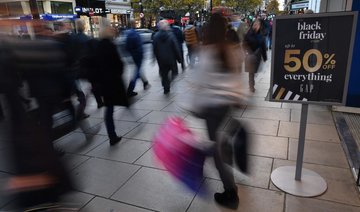
A shopper stands in the door of a shop advertising sale discounts on the main shopping district on Oxford Street in London. (AFP)
Updated 20 December 2018
Follow

UK retail sales boosted by Black Friday

  • Total sales jumped 1.4 percent compared to October

London: British retail sales rebounded strongly in November as shoppers bagged Black Friday bargains, official data showed on Thursday.
Total sales jumped 1.4 percent compared to October, the Office for National Statistics (ONS) calculated, with non-food items helped by heavy price discounts.
That beat analysts’ consensus forecast for a modest 0.3-percent increase.
“Retailers reported strong growth on the month due to Black Friday promotions in November,” the ONS said in a statement.
On so-called Black Friday, retailers slash the cost of certain items at the start of the festive period to try and add sparkle to their Christmas performance.
Black Friday took place this year on November 23.


Dubai inflation eases to 2.7% in November

Updated 5 sec ago
Follow

Dubai inflation eases to 2.7% in November

RIYADH: Dubai’s annual inflation rate slowed to 2.7 percent in November, down from 3.4 percent in the previous month, according to official data released by Dubai Statistical Center. 

The main cause of the slowdown was a decline in transport prices, which decreased by 1.9 percent month on month. 

On an annual basis, transport prices witnessed a moderate rise of 0.2 percent in November compared to a 4.2 percent increase the previous month.

The steady inflation rate aligns with the wider trend observed in the Gulf Cooperation Council region, where countries are successfully navigating price shocks by adopting effective economic policies. 

In November, Saudi Arabia witnessed an inflation rate of 1.9 percent, down from 2.2 percent observed in October. 

Commenting on Dubai’s inflation figure, Emirates NBD, a government-owned bank, commented: “The primary driver of the cooldown in inflation in November was the transport component, which accounts for around 9 percent of the CPI ( consumer price index) basket and has long been the primary driver of monthly inflation volatility in Dubai.” 

According to DSC, the housing and utilities sector, which accounts for 40.68 percent of the Emirates’ CPI basket, witnessed a 5.3 percent year-on-year rise in November. 

The prices for food and beverages, which make up 11.66 percent of the CPI basket, also increased by 0.7 percent in November compared to the same month in the previous year. 

Conversely, the prices of clothing and footwear declined by 0.8 percent year on year in November. 

“Annualized inflation has averaged 2.8 percent over January to November and is likely to come in just marginally higher than our long-held forecast for an average of 2.6 percent,” said Emirates NBD. 

It added: “We expect price growth to remain at a broadly similar level in 2026, forecasting an average of 2.5 percent over the course of the year.” 

In October, a report by the International Monetary Fund noted that inflation in the GCC region is expected to average at 1.7 percent in 2025 and 2 percent in 2026, underscoring the bloc’s resilience to global price pressures.