

Pakistan's 2,000-year-old Buddha statue on maiden trip to Switzerland

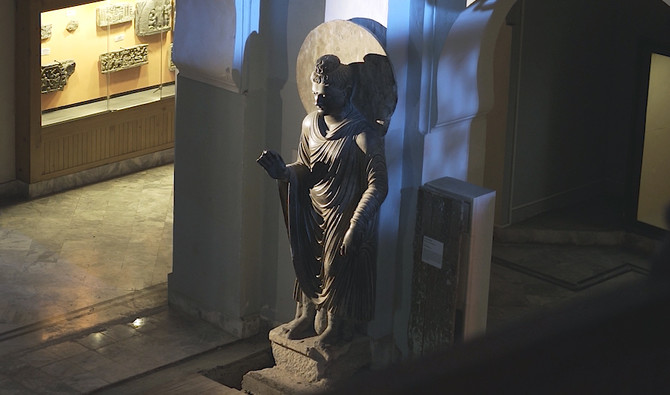
Buddha Shakyamuni at the Peshawar Museum. (Photo courtesy: Switzerland Embassy in Islamabad)
Updated 13 December 2018
Follow

Pakistan's 2,000-year-old Buddha statue on maiden trip to Switzerland

  • This is the first time that the sculpture has been sent out of country, Zurich officials say
  • Peshawar museum, where the artwork was kept, houses the most important and largest collection of Gandhara Art in the world

ISLAMABAD: Pakistan has loaned a 2,000-year-old Buddha statue from its Peshawar Museum to Switzerland for an exhibition, at the Rietberg Museum in Zurich, which began yesterday and will end on March 31, officials said on Thursday.
“This is the first time that this sculpture has been sent out of Pakistan,” the Switzerland embassy in Islamabad said in statement on Thursday.
The “Buddha Shakyamuni,” which stands tall at more than three and a half meters and weighs nearly two tons, will be the main highlight at the event titled "Next Stop Nirvana - Approaches to Buddhism", the statement added.
Estimated to have been built between the first and third century, the sculpture was excavated in 1909-10 from a small village named Sahri Bahlol, near the World Heritage site of Takht-i-Bhai in the Khyber Pakhtunkhwa province, and showcased at the Peshawar Museum ever since.
“Smaller objects from that era have been sent out of Pakistan for exhibition but this is the first time that a statue of this size has gone out of the country,” the statement said.

According to the statement, in 2017, the Switzerland embassy and the Swiss Agency for Development and Cooperation initiated contacts between the Rietberg Museum and the government of Pakistan, which resulted in the signing of a Memorandum of Understanding (MoU) between the two parties, in Zurich, in March this year.
Under the agreement, the Peshawar Museum will lend the statute to Rietberg for three and a half months.
“It strengthens the ties between Pakistan and Switzerland in a completely unconventional way,” Daniel Valenghi, Deputy Head of Cooperation at the Embassy of Switzerland, said. “It also shows that Pakistan has a very diverse cultural heritage, and for us this is a very important step for the development of Pakistan.”
Next year, Switzerland and Pakistan are going to celebrate the 70th anniversary of their diplomatic relations.
“The Peshawar Museum has the most important and largest collection of Gandhara Art in the world, including antiquities of Buddhist stone sculptures and panels, architectural elements, stucco, sculptures terracotta figurines, relic caskets, toiletry objects,” the Peshawar Museum states on its website.


Pakistan reports current account surplus in Jan. owing to improved trade, remittances

Updated 17 February 2026
Follow

Pakistan reports current account surplus in Jan. owing to improved trade, remittances

  • Pakistan’s exports crossed the $3 billion mark in Jan. as the country received $3.5 billion in remittances
  • Last month, IMF urged Pakistan to accelerate pace of structural reforms to strengthen economic growth

ISLAMABAD: Pakistan recorded a current account surplus of more than $120 million in January, the country’s finance adviser said on Tuesday, attributing it to improved trade balance and remittance inflows.

Pakistan’s exports rebounded in January 2026 after five months of weak performance, rising 3.73 percent year on year and surging 34.96 percent month on month, according to data released by the country’s statistics bureau.

Exports crossed the $3 billion mark for the first time in January to reach $3.061 billion, compared to $2.27 billion in Dec. 2025. The country received $3.5 billion in foreign remittances in Jan. 2026.

Khurram Schehzad, an adviser to the finance minister, said Pakistan reported a current account surplus of $121 million in Jan., compared to a current account deficit of $393 million in the same month last year.

“Improved trade balance in January 2026, strong remittance inflows, and sustained momentum in services exports (IT/Tech) continue to reinforce the country’s external account position,” he said on X.

Pakistan has undergone a difficult period of stabilization, marked by inflation, currency depreciation and financing gaps, and international rating agencies have acknowledged improvements after Islamabad began implementing reforms such as privatizing loss-making, state-owned enterprises (SOEs) and ending subsidies as part of a $7 billion International Monetary Fund (IMF) loan program.

Late last month, the IMF urged Pakistan to accelerate the pace of these structural reforms to strengthen economic growth.

Responding to questions from Arab News at a virtual media roundtable on emerging markets’ resilience, IMF’s director of the Middle East and Central Asia Jihad Azour said Islamabad’s implementation of the IMF requirements had been “strong” despite devastating floods that killed more than 1,000 people and devastated farmland, forcing the government to revise its 4.2 percent growth target to 3.9 percent.

“What is important going forward in order to strengthen growth and to maintain the level of macroeconomic stability is to accelerate the structural reforms,” he said at the meeting.

Azour underlined Pakistan’s plans to privatize some of the SOEs and improve financial management of important public entities, particularly power companies, as an important way for the country to boost its capacity to cater to the economy for additional exports.

“This comes in addition to the effort that the authorities have made in order to reform their tariffs, which will allow the private sector of Pakistan to become more competitive,” the IMF official said.