

Pakistan's 2,000-year-old Buddha statue on maiden trip to Switzerland

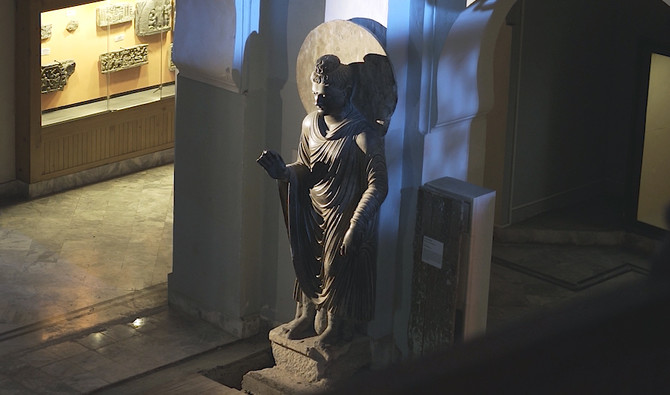
Buddha Shakyamuni at the Peshawar Museum. (Photo courtesy: Switzerland Embassy in Islamabad)
Updated 13 December 2018
Follow

Pakistan's 2,000-year-old Buddha statue on maiden trip to Switzerland

  • This is the first time that the sculpture has been sent out of country, Zurich officials say
  • Peshawar museum, where the artwork was kept, houses the most important and largest collection of Gandhara Art in the world

ISLAMABAD: Pakistan has loaned a 2,000-year-old Buddha statue from its Peshawar Museum to Switzerland for an exhibition, at the Rietberg Museum in Zurich, which began yesterday and will end on March 31, officials said on Thursday.
“This is the first time that this sculpture has been sent out of Pakistan,” the Switzerland embassy in Islamabad said in statement on Thursday.
The “Buddha Shakyamuni,” which stands tall at more than three and a half meters and weighs nearly two tons, will be the main highlight at the event titled "Next Stop Nirvana - Approaches to Buddhism", the statement added.
Estimated to have been built between the first and third century, the sculpture was excavated in 1909-10 from a small village named Sahri Bahlol, near the World Heritage site of Takht-i-Bhai in the Khyber Pakhtunkhwa province, and showcased at the Peshawar Museum ever since.
“Smaller objects from that era have been sent out of Pakistan for exhibition but this is the first time that a statue of this size has gone out of the country,” the statement said.

According to the statement, in 2017, the Switzerland embassy and the Swiss Agency for Development and Cooperation initiated contacts between the Rietberg Museum and the government of Pakistan, which resulted in the signing of a Memorandum of Understanding (MoU) between the two parties, in Zurich, in March this year.
Under the agreement, the Peshawar Museum will lend the statute to Rietberg for three and a half months.
“It strengthens the ties between Pakistan and Switzerland in a completely unconventional way,” Daniel Valenghi, Deputy Head of Cooperation at the Embassy of Switzerland, said. “It also shows that Pakistan has a very diverse cultural heritage, and for us this is a very important step for the development of Pakistan.”
Next year, Switzerland and Pakistan are going to celebrate the 70th anniversary of their diplomatic relations.
“The Peshawar Museum has the most important and largest collection of Gandhara Art in the world, including antiquities of Buddhist stone sculptures and panels, architectural elements, stucco, sculptures terracotta figurines, relic caskets, toiletry objects,” the Peshawar Museum states on its website.


Pakistan says PIA stake sale will trigger ‘greater investor interest’ for privatization of DISCOs

Updated 11 sec ago
Follow

Pakistan says PIA stake sale will trigger ‘greater investor interest’ for privatization of DISCOs

  • Pakistan to next focus on privatizing Islamabad, Gujranwala and Faisalabad electric supply companies, says state minister
  • Pakistan’s power sector has drained its public finances due to high losses, inefficiencies and mounting subsidies over the years

ISLAMABAD: State Minister for Finance Bilal Azhar Kayani this week said the government’s move to successfully sell its stake in the state-owned Pakistan International Airlines (PIA) will trigger greater investor interest in Islamabad’s privatization program. 

In December, a consortium led by the Arif Habib Group won the bid for a 75 percent controlling stake in Pakistan’s flag carrier by offering Rs 135 billion ($482 million).

Pakistan’s government has undertaken the drive to privatize or restructure its loss-making state-owned enterprises (SOEs) at the International Monetary Fund’s (IMF) insistence.

In an interview with the state-run Pakistan Digital on Thursday, Kayani said the government will next focus on privatizing electricity distribution companies (DISCOs) such as the Islamabad Electric Supply Company (IESCO), Gujranwala Electric Supply Company (GESCO) and Faisalabad Electric Supply Company (FESCO).

“The momentum created by the PIA deal will help generate greater investor and advisory interest going forward for the privatization program,” Kayani was quoted as saying by Pakistan Digital. 

“The next phase of privatization is focused on electricity distribution companies, including IESCO, GEPCO and FESCO.”

The power sector has drained Pakistan’s public finances due to high losses, inefficiencies and mounting subsidies, making it a central focus of Pakistan’s reform agenda under the IMF program.

Pakistan’s Privatization czar Muhammad Ali last month announced the government plans to issue Expressions of Interest (EoIs) for the privatization of state-owned DISCOs in January. 

Pakistan’s government owns or controls much of the power infrastructure. It is also grappling with ballooning “circular debt,” or unpaid bills and subsidies, that have choked the power sector and weighed on the economy.