Lebanon’s Aoun intervening in stalled effort to form government

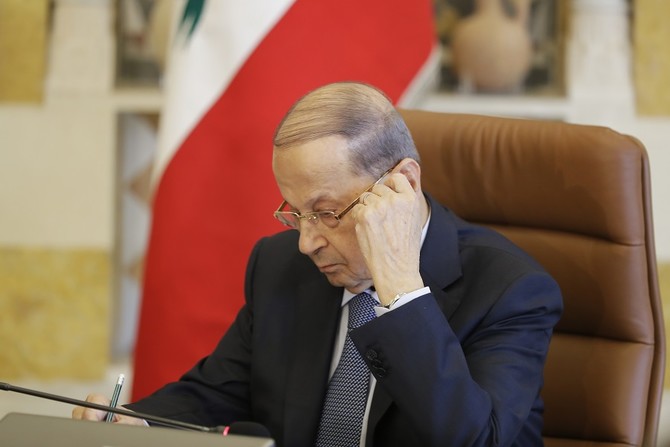
Lebanese President Aoun said on Tuesday he was intervening in stalled efforts to form a new national unity government, warning the country faced “catastrophe” if this failed. (File/AFP)
Updated 12 December 2018
Follow

Lebanon’s Aoun intervening in stalled effort to form government

  • More than six months since an election, efforts to form the new cabinet led by Prime Minister-designate Saad al-Hariri are still logjammed with rival groups vying for cabinet posts
  • Lebanon is in dire need of a government able to implement the economic reforms the IMF says are needed to put its public debt on a sustainable path

BEIRUT: Iran was accused on Tuesday of sabotaging the formation of a government in Lebanon as President Michel Aoun intervened to try to end the impasse.

Political negotiations have been deadlocked since elections in May, in a row over representation in the Cabinet for six Sunni members of Parliament allied with Hezbollah. The 30 ministerial posts are allocated according to a sectarian political system.

“The issue is associated with what Iran wants and what it is given, to agree to the formation of a government or to continue hampering it,” the Minister of Refugees Affairs, Moeen Al-Marabi, a member of Prime Minister Saad Hariri’s Future Movement parliamentary bloc, told Arab News.

President Aoun said: “We are launching an initiative ... and it has to succeed, because if it doesn’t ... there is a catastrophe, we want to say it with all frankness, and this is the reason for my intervention.” 

He has held meetings with Hariri, Parliament Speaker Nabih Berri and Hezbollah representative Mohammed Raad MP. 

Hariri left Lebanon on Tuesday to attend an economic forum in London on investment and structural reforms in Lebanon. “God willing, we will find solutions,” he said.

“There are those who wish to form a government while others do not. We must give the president the chance to conduct his consultations.

“Everyone will be held accountable if a solution is not reached, not only the president and me.”


Syrian government says it controls prison in Raqqa with Daesh-linked detainees

Updated 23 January 2026
Follow

Syrian government says it controls prison in Raqqa with Daesh-linked detainees

  • Prison holds detainees linked to Daesh, and witnessed ⁠clashes in its vicinity between advancing Syrian government forces and Kurdish fighters

Syria’s Interior Ministry said on Friday it had taken over Al-Aktan prison in the city of Raqqa ​in northeastern Syria, a facility that was formerly under the control of Kurdish-led Syrian Democratic Forces (SDF).

The prison has been holding detainees linked to the militant group Daesh, and witnessed clashes in its vicinity this week between advancing Syrian government forces and the SDF.

It ‌was not ‌immediately clear how many ‌Daesh ⁠detainees ​remain in Al-Aktan ‌prison as the US military has started transferring up to 7,000 prisoners linked to the militant Islamist group from Syrian jails to neighboring Iraq. US officials say the detainees are citizens of many countries, including in Europe.

“Specialized teams were ⁠formed from the counter-terrorism department and other relevant authorities to ‌take over the tasks of guarding ‍and securing the prison ‍and controlling the security situation inside it,” ‍the Interior Ministry said in a statement.

Under a sweeping integration deal agreed on Sunday, responsibility for prisons housing Daesh detainees was meant to be transferred to ​the Syrian government.

The SDF said on Monday it was battling Syrian government forces near ⁠Al-Aktan and that the seizure of the prison by the government forces “could have serious security repercussions that threaten stability and pave the way for a return to chaos and terrorism.”

The US transfer of Daesh prisoners follows the rapid collapse of Kurdish-led forces in northeast Syria. Concerns over prison security intensified after the escape on Tuesday of roughly 200 low-level Daesh fighters from Syria’s ‌Shaddadi prison. Syrian government forces later recaptured many of them.