Iraq marks anniversary of ‘victory’ over Daesh

1 / 2
The sign in Arabic reads: “Our neighbors are our friends but not our masters. Our decision is an Iraqi decision” Shiite cleric Moqtada Sadr ordered followers in prayer today in the mosques of Iraq in order to “speed up the formation of the Iraqi government away from the intervention of neighboring countries.” (AFP)
2 / 2
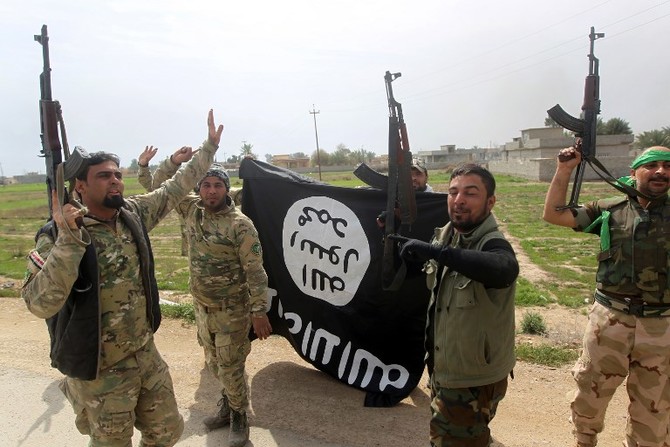
Members of the Iraqi paramilitary Popular Mobilisation units celebrate with a flag of the Islamic State (IS) group after retaking the village of Albu Ajil, near the city of Tikrit. (File/AFP)
Updated 11 December 2018
Follow

Iraq marks anniversary of ‘victory’ over Daesh

  • Five months after Baghdad declared its win, the country held legislative elections that did not produce a clear governing coalition
  • The ongoing power struggle among various parties has stymied efforts by new premier Adel Abdel Mahdi, widely seen as a weak consensus candidate, to form a government

BAGHDAD: Iraq on Monday celebrated the anniversary of its costly victory over Daesh, which has lost virtually all the territory it once held but still carries out sporadic attacks to hang on to its last enclave in Syria near the Iraqi border.
The government declared victory last December after a grueling three-year war in which tens of thousands of people were killed and hundreds of thousands displaced. Entire towns and neighborhoods were reduced to rubble in the fighting.
The government declared Monday a national holiday, and a moment of silence is planned for later in the day. Checkpoints in the capital were decorated with Iraqi flags and balloons, as security forces patrolled the streets playing patriotic music.
As part of the celebrations, authorities plan to reopen parts of Baghdad’s fortified Green Zone — home to key government offices and embassies — to the public. The move is billed as an act of transparency following protests against corruption and poor public services.
The celebrations come as political infighting has hindered the formation of the government and setting next year’s budget amid an acute economic situation.

Addressing a group of Iraqi military officers, Prime Minister Adel Abdul-Mahdi said it was a “proud day for all of us when our brave country defeated the enemies of life, dignity, freedom and peace.”
He commended the security forces as well as Iraq’s top Shiite cleric, Grand Ayatollah Ali Sistani, who issued a fatwa, or religious edict, mobilizing volunteers after the armed forces collapsed in the face of the Daesh onslaught in 2014. Tens of thousands of volunteers joined an array of state-sanctioned militias, many of them backed by Iran.
“That fatwa will be a bright spot in the history of this country and the people, from whom the decisive response started, laying the foundations of the victory,” Abdul-Mahdi said.
He called on Iraqis to renounce their differences and to come together for a better future. “The time has come to leave behind all the past mistakes and conspiracies to open the doors of hope for our children for a better future,” he said, vowing to rebuilt the demolished areas and help displaced people return to their homes.
“This war has restored Iraq’s dignity,” said Baghdad resident Qassim Al-Fatlawi. “All Iraqis took part in this fight, those who couldn’t take up arms fought with words and donations,” added Al-Fatlawi, 29, who organized fundraising initiatives for the paramilitaries.
Popular songs praising the paramilitaries, also known as the Popular Mobilization Forces, blared out from his small accessories shop cosmetic in a narrow alley in Baghdad’s Shiite-dominated Karrada area, which today is adorned with rows of Iraqi flags. He said he planned to put out a large tray of free sweets for customers later in the day.
“That victory and the relative stability in security is a golden opportunity for the government to rebuild the country and to meet the needs of its people,” said Sameer Al-Obaidi, who led an initiative in the capital’s Sunni-dominated northern Azamiyah neighborhood to distribute flowers to security forces at checkpoints. “It is important to treat all Iraqis equally so that they feel that their sacrifices are appreciated,” Al-Obaidi added.
Daesh, which traces its roots back to the insurgency that followed the 2003 US-led invasion, swept into Iraq from neighboring Syria in the summer of 2014. It carved out a self-styled caliphate across a third of both countries, imposing a brutal form of Islamic rule and massacring its opponents. The group abducted thousands of women and girls from the Yazidi religious minority and forced them into sexual slavery.
Iraqi forces aided by a US-led coalition eventually drove the group from all the territory it once held in Iraq, including in the climactic battle for Mosul, the country’s second-largest city. These days, Daesh is still fighting to hold onto a small pocket of territory in Syria, near the Iraqi border.
Iraq is still grappling with the legacy of the extremist group’s brutal rule.
More than 1.8 million Iraqis remain displaced across the country, and a staggering 8 million require some form of humanitarian aid, according to the Norwegian Refugee Council. Those with suspected links to Daesh have been rejected by their communities, while thousands of children fathered by Daesh militants — including those born to enslaved Yazidi women — are still unrecognized by the state.
Nearly two-thirds of displaced people say they are unwilling or unable to return home in the next year, with more than half saying their homes were damaged or destroyed, said the aid group.
“If this is what ‘victory’ looks like, then there is little to celebrate for millions of Iraqis still haunted by the crimes of the Daesh and the long war to eliminate it,” said Norwegian Refugee Council Secretary General Jan Egeland. “They have largely been forgotten by their own government and the international community.”​


Aidarous Al-Zubaidi: Fugitive at large

Updated 6 sec ago
Follow

Aidarous Al-Zubaidi: Fugitive at large

  • Yemen appoints committee to probe allegations against former STC leader after the group’s collapse and his reported flight from the country
  • Preliminary findings accuse Al-Zubaidi of exploiting public office for personal gain, fueling political division and instability in south

LONDON: A special committee formed on presidential authority by Yemen’s public prosecutor’s office has made a series of findings against Maj. Gen. Aidarous Al-Zubaidi, the sacked vice-president of the country’s Presidential Leadership Council (PLC).
Al-Zubaidi, who is accused of high treason and other crimes against the state, is currently on the run.
Arab News has seen a copy of preliminary findings by the committee which reveal that Al-Zubaidi is accused of abuses of power including corruption, land grabbing and oil trading for personal gain.
On Jan. 7, the PLC issued a decree revoking Al-Zubaidi’s membership of the PLC and accusing him of high treason and other serious crimes, including forming an armed gang, killing military officers and soldiers, and undermining the country’s sovereignty.
At the same time it authorized the public prosecutor’s office to form a special committee to investigate allegations against Al-Zubaidi, empowering it to summon and arrest individuals, gather evidence and take necessary actions according to the law, with a mandate to complete the investigation quickly and to provide periodic reports to the PLC.
The committee’s preliminary findings identify a series of serious allegations against Al-Zubaidi, who is said to be responsible for multiple abuses “which have contributed to creating a state of political and popular division in the southern governorates.”
Al-Zubaidi is the leader of the Southern Transitional Council (STC). On Jan. 7, Al-Zubaidi was due to attend talks in Riyadh with a 50-member delegation from the STC, but at the last minute, he fled instead.
The committee’s findings include allegations that Al-Zubaidi is alleged to have seized large plots of land, including in the Aden Free Zone, on Al-Ummal Island, in Bir Fadl and the Ras Omran area.
The committee has also uncovered allegations that pressure was exerted on the Yemen Petroleum Company and its director, Tareq Al-Walidi, to prevent the import of fuel except through a company affiliated with Al-Zubaidi’s brother-in-law, Jihad Al-Shoudhabi, and the Minister of Transport, Abdul Salam Humaid.
For nearly two years, it is claimed, Al-Shoudhabi has been the sole supplier, earning large profits that have gone to Al-Zubaidi’s treasury.
The report also identifies commercial companies owned by Al-Shoudhabi and, “behind him,” it is claimed, Al-Zubaidi. Two are named in the report: Alahlia Exchange &  Transfers Company and Arabian Furniture Center, one of Yemen’s largest furniture companies. Both are headquartered in Aden.
All these and other “deeply regrettable acts of seizure, plunder, and financial and administrative corruption,” the committee says, “have had serious repercussions in southern circles and were a direct cause of southern division and the emergence of many grievances.”
On Thursday, a spokesman for the Saudi-led coalition in Yemen said there was reliable intelligence indicating that on the night of Jan. 7, Al-Zubaidi had departed from Aden on a ship bound for Somaliland — probably the port of Berbera, 260 kilometers south across the Gulf of Aden.
From there he is believed to have been flown on a cargo aircraft to Abu Dhabi, capital of the UAE, via Mogadishu, the coastal capital of Somalia, a flight of about 2,600 km.
Some of the crimes of which Al-Zubaidi is accused relate to the largescale military offensive launched by STC forces across southern Yemen in December.
“We know that the Southern Transitional Council worked to storm the eastern cities militarily,” a source close to the Yemeni government told Arab News.
“The pattern and scale of grave human-rights violations and acts of security and military escalation witnessed by the eastern cities in the south of the homeland — Hadhramout, Al-Mahra and Shabwah — as a result of the military incursion by the forces of the Transitional Council during the monitoring period extending from Dec. 3, are considered heinous crimes against the Yemeni people.”
According to the Yemeni Ministry of Legal Affairs and Human Rights, a total of 2,358 individual offences have been identified, including cases of extrajudicial killing and physical injuries, arbitrary arrests and captivity, enforced disappearance and displacement, and the destruction and looting of public and private property.
Backed by Saudi airstrikes, in the first week of January, the Yemeni government quickly regained the captured territories, Al-Zubaidi was sacked from the PLC and charged with treason, and the UAE announced it would withdraw its remaining troops from the country.
Following Al-Zubaidi’s disappearance on the eve of the planned talks in Riyadh, Saudi Arabia has accused the UAE of helping to smuggle the wanted man out of the country.
The same source told Arab News there is evidence that Al-Zubaidi “was receiving YER 10 billion ($42 million) monthly … deducted from the aid that Yemen was receiving.
“While Al-Zubaidi was receiving those funds, Yemeni citizens had not been receiving their lawful salaries for years, including the diplomatic corps.”
Last Thursday, Mohammed Al-Jaber, the Saudi ambassador to Yemen, announced that the Kingdom would assume responsibility for the salaries of Yemeni state employees, including military personnel, giving $90 million to cover salaries for two months.
On Friday evening, Al-Zubaidi, his whereabouts still unconfirmed, made his first public statement since his disappearance 10 days ago.
“We will no longer accept any solutions that diminish our rights or impose an unacceptable reality upon us,” he wrote in a social media post that left no doubt about his determination to undermine the internationally recognized government of Yemen.
He added: “I pledge to you ... that we will continue together until we achieve the desired national goal.
“With your determination, we will prevail. With your unity, the South will be protected, and with your will, the future state will be established.”