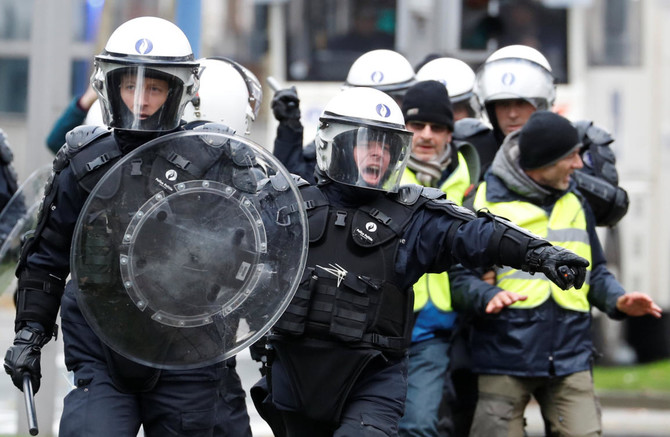
BRUSSELS: Belgian police fired tear gas and water cannons at yellow-vested protesters calling for the resignation of Prime Minister Charles Michel after they tried to breach a riot barricade, as the movement that started in France made its mark Saturday in Belgium and the Netherlands.
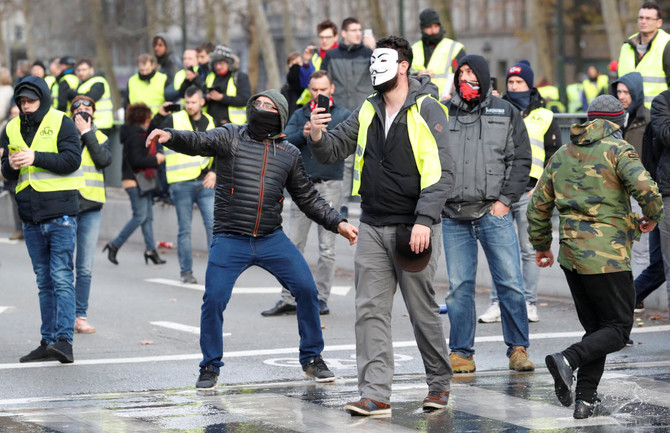
Protesters in Brussels threw paving stones, road signs, fireworks, flares and other objects at police blocking their entry to an area where Michel's offices, other government buildings and the parliament are located.
Brussels police spokeswoman Ilse Van de Keere said that around 400 protesters were gathered in the area.
About 100 were detained, many for carrying dangerous objects like fireworks or clothing that could be used as protection in clashes with police.
The reasons for the protests are not entirely clear. Neither Belgium nor the Netherlands has proposed a hike in fuel tax — the catalyst for the massive and destructive demonstrations in France in recent weeks.
Instead, protesters appeared to hail at least in part from a populist movement that is angry at government policy in general and what it sees as the widening gulf between mainstream politicians and the voters who put them in power. Some in Belgium appeared intent only on confronting police.
Earlier in Brussels, police used pepper spray and scuffled with a small group of protesters who tried to break through a barricade blocking access to the European Parliament and the European Union's other main institutions.
The rallies, which started at different locations around the city and converged on the European quarter, disrupted road and rail traffic on one of the busiest Christmas shopping days of the year.
Walking behind a banner reading "social winter is coming," the protesters chanted "Macron, Michel resign."
Dozens of people were searched as they arrived, and police warned people to stay away from the area.
Several hundred police officers were mobilized. Last week, yellow vest protesters clashed with police and torched two police vehicles in the same area. More than 70 people were detained.
In the Dutch city of Rotterdam, a few hundred protesters in the high-visibility vests that have become a symbol of the movement walked peacefully across the downtown Erasmus Bridge singing a song about the Netherlands and handing flowers to passers-by.
Sisters Beb and Ieneke Lambermont, aged 76 and 67 respectively, were among them.
"Our children are hard-working people but they have to pay taxes everywhere. You can't get housing anymore. It is not going well in Dutch society," Ieneke said. "The social welfare net we grew up with is gone," she said.
"The government is not there for the people. It is there to protect its own interests," she said.
About 100 protesters gathered in a peaceful demonstration outside the Dutch parliament in The Hague. At least two protesters were detained by police in central Amsterdam.
Jan Dijkgraaf, the editor of a Dutch "resistance newspaper" had called for peaceful protests in Amsterdam and Rotterdam.
Dijkgraaf said people are yearning for a past, more socially equitable, era of Dutch history, describing it as "a feeling of unity, but also looking after asylum-seekers well, taking good care of one another."
Other protesters appear more extreme — at a small and non-violent rally last week in The Hague one protester waved a historic Dutch flag that has become an emblem for the far right — and Dijkgraaf said some demonstrators are unhappy at his moderate plans.
But he said violence like that seen last week in France and to a lesser extent Belgium does not work in the Netherlands.
"The Netherlands is not like France — you light 100 cars on fire and you get what you want," he said in a phone interview this week. "If you torch 100 cars here you are never allowed to demonstrate again and nothing more happens."


Clashes as yellow vest protests grow in Belgium, Netherlands


Clashes as yellow vest protests grow in Belgium, Netherlands
- Protesters appeared to hail at least in part from a populist movement that is angry at government policy in general
- Last week, yellow vest protesters clashed with police and torched two police vehicles in the same area


US Republicans back Trump on Iran strikes, block bid to rein in war powers
- Republicans blocked prior efforts to curb Trump’s war powers
- Prolonged war could affect November mid-term elections
WASHINGTON: US Senate Republicans backed President Donald Trump’s military campaign against Iran on Wednesday, voting to block a bipartisan resolution aiming to stop the air war and require that any hostilities against Iran be authorized by Congress.
As voting continued, the tally in the 100-member Senate was 52 to 47 not to advance the resolution, largely along party lines, with almost every Republican voting against the procedural motion and almost every Democrat supporting it.
The latest effort by Democrats and a few Republicans to rein in President Donald Trump’s repeated foreign troop deployments, sponsors described the war powers resolution as a bid to take back Congress’ responsibility to declare war, as spelled out in the US Constitution.
Opponents rejected this, insisting that Trump’s action was legal and within his right as commander in chief to protect the United States by ordering limited strikes.
“This is not a forever war, indeed not even close to it. This is going to end very quickly,” Republican Senator Jim Risch of Idaho, chairman of the Senate Foreign Relations Committee, said in a speech against the resolution.
The measure had not been expected to succeed. Trump’s fellow Republicans hold slim majorities in both the Senate and House of Representatives, and have blocked previous resolutions seeking to curb his war powers.
US Senator Ted Cruz speaks to reporters on Capitol Hill in Washington, DC, on March 4, 2026, ahead of the vote on a resolution aimed at curbing President Donald Trump's authority to continue military strikes on Iran. (AFP)


