



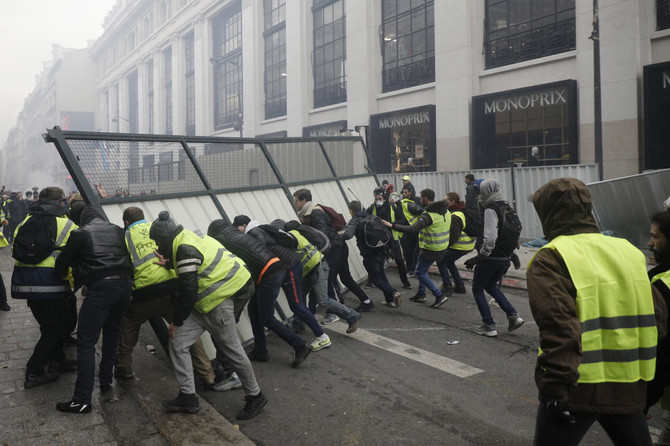

PARIS: A total of 1,723 people were arrested across France during the latest round of "yellow vest" protests, in which demonstrators clashed with riot police, the interior ministry said Sunday.
Of these, 1,220 were ordered held in custody, it said. Some 136,000 people took part Saturday's protests, around the same number as on December 1.
France’s Interior Minister Christophe Castaner said Saturday evening that the “yellow vest” demonstrations are now under control, and that a high level of police presence will continue on Sunday if necessary.
Earlier on Saturday, police fired tear gas and arrested hundreds of people in Paris as the French capital went on lockdown for the latest “yellow vest” protests against President Emmanuel Macron.
Shouts of “Macron, resign” mingled with the tear gas near the famous Champs-Elysees avenue, the scene last Saturday of the worst rioting in Paris for decades.
A forklift truck driver who gave his name as Denis said he was planning, like others, to march on Macron’s presidential palace in anger against a leader who they say only looks out for the rich.
“I’m here for my son,” said the 30-year-old, who had traveled down to Paris from the Normandy port of Caen.
“I can’t let him live in a country where the poor are exploited.”
The protests began on November 17 with road blockades against rising fuel prices but have since ballooned into a mass movement against Macron’s policies and top-down style of governing.
#GiletsJaunes #8Decembre #Bruxelles #YellowVest #YellowJacket #Paris pic.twitter.com/sKno94D9ym
— rasim yaman (@rasimymn) December 8, 2018
Coordinated “yellow vest” protests were taking place across the country on Saturday, including on numerous motorways, causing havoc on the national road network.
Prime Minister Edouard Philippe said 481 people had been detained in Paris as police carried out checks on people arriving at train stations and at protest hotspots such as the Champs-Elysees and Bastille monument.
Among them were dozens arrested for carrying masks, hammers, slingshots and rocks that could be used to attack police.

Shops, museums, the Eiffel Tower and many metro stations were closed, while top-flight football matches and concerts have been canceled.
Last weekend’s violence, which saw some 200 cars torched and the Arc de Triomphe vandalized, shook France and plunged Macron’s government into its deepest crisis so far.
“These past three weeks have produced a monster that its creators no longer control,” Interior Minister Castaner said on Friday, vowing “zero tolerance” toward those aiming to wreak further destruction.
Philippe on Friday evening met a delegation of self-described “moderate” yellow vests who urged people not to join the protests.
A spokesman from the movement, Christophe Chalencon, said Philippe had “listened to us and promised to take our demands to the president.”
“Now we await Mr.Macron. I hope he will speak to the people of France as a father, with love and respect and that he will take strong decisions,” he said.
Philippe said some 89,000 police were being mobilized for protests nationwide, including 8,000 police in Paris, where a dozen armored vehicles were being deployed for the first time in decades.

Shops around the Champs-Elysees boarded up their windows and emptied them of merchandise on Friday, while the Louvre, Musee d’Orsay and other museums were shut.
Department stores were also closed due to the risk of looting on what would normally be a busy shopping weekend in the run-up to Christmas.
Foreign governments are watching developments closely in one of the world’s most visited cities.
The US embassy issued a warning to Americans in Paris to “keep a low profile and avoid crowds,” while Belgium, Portugal and the Czech Republic advised citizens to postpone any planned visits.
Tensions on the rise in Brussels.
Yellow Vest protestors trying to storm the European Parliament.pic.twitter.com/kngIZNlY8X
— Xavi Ruiz (@xruiztru) December 8, 2018
In a warning of impending violence, an MP for Macron’s party, Benoit Potterie, received a bullet in the post on Friday with the words: “Next time it will be between your eyes.”
Macron this week gave in to some of the protesters’ demands for measures to help the poor and struggling middle classes, including scrapping a planned increase in fuel taxes and freezing electricity and gas prices in 2019.
But the “yellow vests,” some of whom who have become increasingly radicalized, are holding out for more.
Protests at dozens of schools over university reforms, and a call by farmers for demonstrations next week, have added to a sense of general revolt.
The hard-line CGT union, hoping to capitalize on the movement, has called for rail and metro strikes next Friday to demand immediate wage and pension increases.
Macron’s decision early in his presidency to slash taxes on France’s wealthiest is particularly unpopular with the protesters.
Arguing that such a move was necessary in order to boost investment and create jobs, the former investment banker has so far ruled out re-imposing the “fortune tax.”
But the policy, along with hikes on pensioners’ taxes, cuts in housing allowances and a string of comments deemed insensitive to ordinary workers, has led critics to label him a “president of the rich.”
Macron had previously vowed to stay the course in his bid to shake up the French economy and not be swayed by mass protests that have forced previous presidents to back down.
The climbdown on higher fuel taxes — which were intended to help France transition to a greener economy — marked a major departure for the centrist president.


