Eiffel tower, Louvre among Paris tourism sites to close on Saturday

1 / 2
File photo showing Eiffel Tower. (AP)
2 / 2
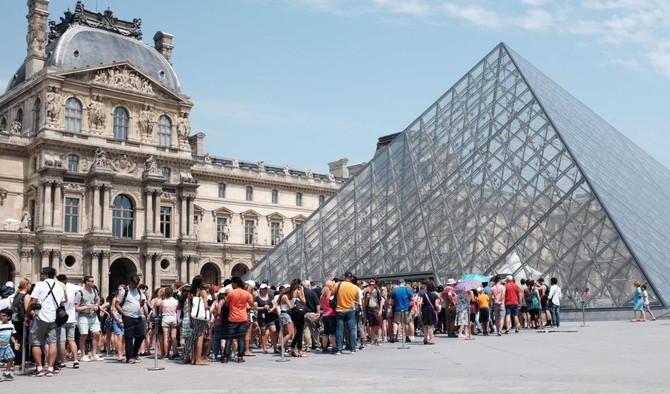
File photo showing tourists and visitors queue outside the Louvre Pyramid. (AFP)
Updated 06 December 2018
Follow

Eiffel tower, Louvre among Paris tourism sites to close on Saturday

  • French authorities will close dozens of museums, tourism sites and shops on Saturday
  • The Eiffel Tower will also be closed on Saturday due to the protests

PARIS: French authorities will close dozens of museums, tourism sites and shops on Saturday, including the Eiffel Tower and Louvre, fearing a recurrence of last week’s violence in Paris, officials said on Thursday.
“We cannot take the risk when we know the threat,” Culture Minister Franck Riester told RTL radio, adding that far-right and far-left agitators were planning to hijack rallies by “yellow vest” protesters in Paris.
He said the Louvre museum, Orsay museum, the two operas, and the Grand Palais were among the sites that would be closed a week after rioters looted and defaced the Arc de Triomphe.
The Eiffel Tower will also be closed on Saturday due to the protests, the site’s operator SETE said, warning that it could not ensure security for visitors.
With protesters calling on social media for “Act IV” — a fourth weekend of protest — Prime Minister Edouard Philippe said 65,000 police would be drafted in to stop a repeat of last Saturday’s mayhem in Paris, when rioters torched cars and looted shops off the Champs Elysees boulevard.
At least four of the weekend’s first division football matches have been canceled.
Paris police asked dozens of shop and restaurant owners around the Champs Elysees and Bastille areas to close on Saturday and requested local authorities in 15 areas around the capital to remove anything in the streets that could be used as projectiles.
The government is also considering using troops currently deployed on anti-terrorism patrols to protect public buildings.


More than 1,700 Africans fighting for Russia, Ukraine says

Updated 4 sec ago
Follow

More than 1,700 Africans fighting for Russia, Ukraine says

  • “We clearly see that Russia is trying to drag African citizens into a deadly war,” Sybiha said
  • The African fighters came from 36 different countries spread across the continent

KYIV: More than 1,700 Africans are fighting for Russia in its war in Ukraine, Ukrainian Foreign Minister Andrii Sybiha said on Wednesday, adding that Moscow was using deception to trick them into fighting.
Speaking alongside his counterpart from Ghana, Sybiha said that discussions were taking place with governments across Africa to prevent their citizens from being drawn into such schemes. Ghana will chair the African Union regional bloc next year.
“We clearly see that Russia is trying to drag African citizens into a deadly war,” Sybiha told a ⁠news conference. “According to ⁠our data, there are currently over 1,780 citizens from the African continent fighting in the Russian army.”
The African fighters came from 36 different countries spread across the continent, he added.
Russian authorities have denied illegally recruiting African citizens to fight in the armed forces.
However, ⁠reports of African men being lured into Russia with promises of jobs and ending up on Ukraine’s front line have become more frequent in recent months, creating tensions between Moscow and some of the countries involved.
Ghana’s Foreign Minister Samuel Okudzeto Ablakwa said that many of the Africans fighting for Russia were victims of deception, lured on the dark web with the promise of ordinary jobs.
“They have no security background. They have no military background. ⁠They ⁠have not been trained,” Ablakwa said. “They were just lured and deceived, and then put on the frontlines.”
Ablakwa expressed solidarity with Ukraine and called for a ceasefire to end the war, which marked its fourth anniversary on Tuesday. He said that he would ask Ukrainian President Volodymyr Zelensky to release two Ghanaian prisoners of war, who were captured fighting for Russia.
Ghana would promote schemes to raise public awareness about trafficking networks deceptively recruiting for Russian forces during its presidency of the African Union, Ablakwa said.