PARIS: French President Emmanuel Macron on Sunday surveyed the damage from a day of riots across Paris and led crisis talks that ended with a call for further talks with anti-government activists who have staged two weeks of protests.
Macron held crisis talks with the prime minister, interior minister and top security service officials to forge a response to the violence that left hundreds injured nationwide.
Prime Minister Edouard Philippe has been asked to meet protest organizers and party leaders as part of a “constant wish for dialogue,” the Elysee Palace said.
Environment Minister Francois de Rugy met representatives of the “yellow vests” last week but failed to convince them to end the protests.
The government has not ruled out imposing a state of emergency to combat the protests, which began over fuel taxes but have grown into wider anger over Macron’s agenda.
The president earlier assessed the damage at the Arc de Triomphe, the massive monument to France’s war dead at the top of the famous Champs Elysees avenue, where rioters scrawled graffiti and ransacked the ticketing and reception areas.
Inside, rioters smashed in the iconic face of a sculpture, a partial reproduction of the victory allegory “La Marseillaise” by Francois Rude.
Macron also saw the wreckage of burnt-out cars and damaged buildings from rioting at other sites, where he praised the police but was also booed by sections of the crowd.
Paris police said 412 people were arrested on Saturday during the worst clashes for years in the capital and 378 remained in custody.
A total of 263 people were injured nationwide, with 133 injured in the capital, including 23 members of the security forces.
“I will never accept violence,” Macron said. “No cause justifies that authorities are attacked, that businesses are plundered, that passers-by or journalists are threatened or that the Arc du Triomphe is defiled.”
Overnight a motorist died after crashing a van into traffic which had built up due to a “yellow vest” demo in Arles, southern France, a local prosecutor said Sunday. Three people have now died in incidents linked to the protests.
The anti-government protests that have swept France were sparked initially by a rise in taxes on diesel.
In Paris on Sunday as groups of workers set about cleaning up the mess from the previous day, the scale of the destruction became clear.
Around famous areas including the Champs-Elysees, the Louvre museum, the Opera and Place Vendome, smashed shop windows, broken glass and the occasional burned-out car were testament to the violence.
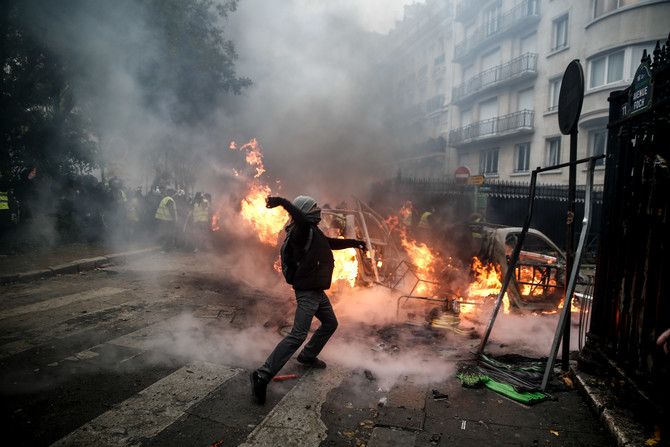
Dozens of cars were torched by the gangs of rioters, some of whom wore gas masks and ski goggles to lessen the effects of tear gas which was fired continually by police.
One person was in a critical condition after protesters pulled down one of the huge iron gates of the Tuileries garden by the Louvre, crushing several people.
Nearly 190 fires were put out and six buildings were set alight, the interior ministry said.
At the Arc de Triomphe graffiti had been daubed, with one slogan saying: “The yellow vests will win.”
Some 136,000 demonstrators, most of them peaceful, were counted across the country on Saturday, the interior ministry said Sunday.
The figure was well below the first day of protests on November 17, which attracted around 282,000 people, and also down on the revised figure of 166,000 who turned out last Saturday.
Interior Minister Castaner attributed the violence to “specialists in destruction.”
Referring to the possibility of imposing a state of emergency — a demand made by the police union Alliance — Castaner declared: “Nothing is taboo for me. I am prepared to examine everything.”
Over the last few weeks, the “yellow vest” movement has morphed into a broad opposition front to Macron, 40, a pro-business centrist elected in May 2017.
Violent anarchist and far-right groups have infiltrated it and are thought to be behind Saturday’s clashes.
Macron faces a dilemma in how to respond, not least because the “yellow vests” are a grassroots movement with no formal leaders and a wide range of demands.
“We have said that we won’t change course. Because the course is good,” government spokesman Benjamin Griveaux told BFM television defiantly on Sunday morning.
“It’s been 30 years that people change course every 18 months,” he added, referring to Macron’s predecessors who have often caved in to pressure from French street protests.
Macron has so far refused to roll back taxes on fuel, which he says are needed to fund the country’s transition to a low-emission economy.
And he remains a fervent defender of the tax cuts he has delivered for businesses and the wealthy, which he believes were necessary to lower chronic high unemployment.
Opposition politicians condemned the violence but also criticized the government’s response.
“The government is not entitled to a third black Saturday,” said Senate President Gerard Larcher, amid warnings that protests could resume in Paris next weekend.
Far-right and far-left leaders Marine Le Pen and Jean-Luc Melenchon called Sunday for new parliamentary elections.
Despite the violence, opinion polls suggest that two in three French people back the protests.


![]()
![]()
![]()
![]()

France's Macron surveys damage after Paris riots, calls for talks


France's Macron surveys damage after Paris riots, calls for talks
- When asked about imposing a state of emergency, he said the president, prime minister and interior minister would discuss all options available
- Groups of young men with faces masked, some carrying metal bars and axes, rioted on the streets of central Paris on Saturday


Latest updates




© 2026 SAUDI RESEARCH & PUBLISHING COMPANY, All Rights Reserved And subject to Terms of Use Agreement.