Murad Ebrahim: The commander of war and peace in southern Philippines

1 / 5
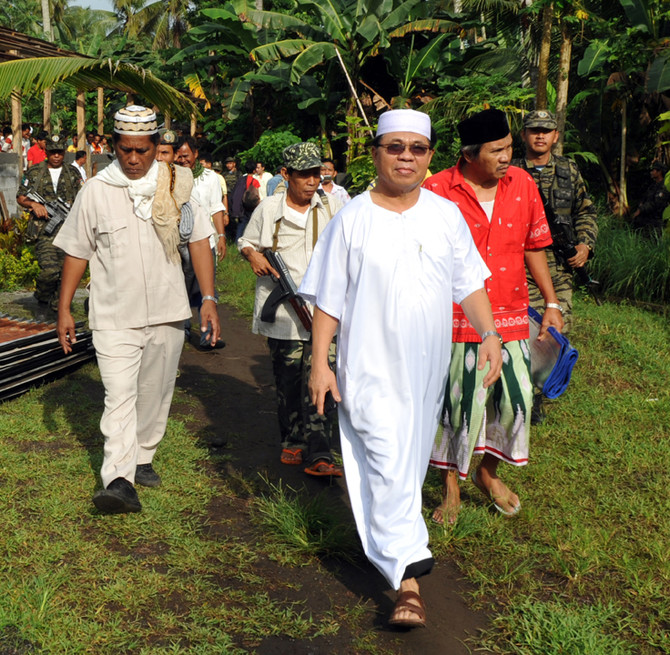
Al-Hajj Murad Ebrahim with soldiers of the Moro Islamic Liberation Front in Mindanao. (Supplied photo)
2 / 5
Al-Hajj Murad Ebrahim with supporters of the Moro Islamic Liberation Front in Mindanao. (Supplied photo)
3 / 5
Children participate in a peace rally in suburban Manila. (AFP file photo)
4 / 5
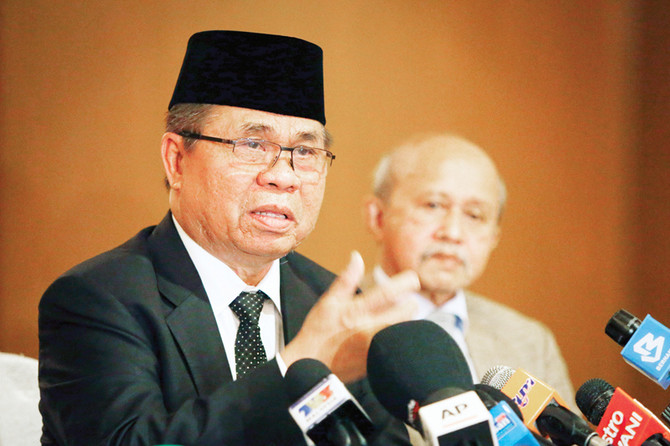
Al-Hajj Murad Ebrahim at a press conference in Manila. (File photo)
5 / 5
Updated 02 December 2018
Follow

Murad Ebrahim: The commander of war and peace in southern Philippines

  • Government and rebels hope an agreement that has been years in the making will soon draw a line under Mindanao’s bloody insurgency
  • Today there is a real chance to make peace. There is a sincere intention from both sides for peace in the south — Murad Ebrahim

MANILA: On Nov. 19, Al-Hajj Murad Ebrahim, a former rebel leader who was once one of the most wanted insurgents in the Philippines, was seen shaking hands with top military commanders at an army base in Manila.

Ebrahim, the chairman of the Moro Islamic Liberation Front (MILF), formerly the country’s largest rebel group, was welcomed at the headquarters of the Armed Forces of the Philippines by General Carlito Galvez Jr, the chief of staff, and other senior military commanders for what has been hailed as a historic and hugely symbolic meeting.

The moment was testament to the momentum behind the peace process and the desire to end a conflict that has killed about 120,000 people, displaced 2 million, and helped radical groups gain a foothold in the region.

Arab News contacted Ebrahim two days after his visit to the army HQ to find out what had changed to persuade him to visit military camps and bases that had previously been the main targets of his group’s attacks, and shake hands with men he had once aspired to kill and who had killed many of his comrades. 

He said that politics and diplomacy had emerged as the best options.
“The Philippine army has never been our enemy,” he said in an emailed response. 

“We are against injustice and aggression. Today there is a real chance to make peace. There is a sincere intention from both sides for peace in the south.”

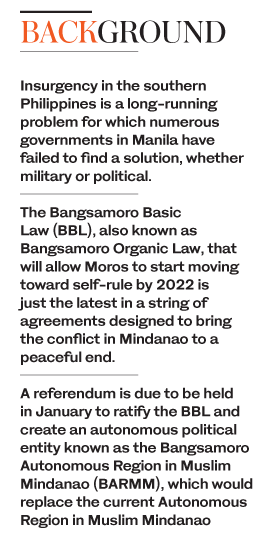
Ebrahim has visited the presidential palace, Malacanang, several times since the peace talks began and an agreement has been reached on the framework for the Bangsamoro Basic Law, a peace deal that will allow Muslims in the south to start moving toward achieving self-rule by 2022, in a bid to tackle extremism and end half a century of conflict.

That Ebrahim, after years of fighting, is now being welcomed with military honors at the headquarters of the Philippine army is a remarkable event. It is recognition by the armed forces that MILF is a major influence on both war and peace in Mindanao, the second-largest island of the Philippines, and a realization by the military leadership that the peace process deserves a chance.

After the Sept. 11 attacks on the US in 2001, when President George Bush’s “war on terror” reached the Philippines, MILF was mentioned in the US and the Philippines as a militant group that could pose a threat to US interests in the country and across Southeast Asia. The group was also accused of providing aid to suspected militants from Al-Qaeda and the Indonesia-based Jemaah Islamiyah.

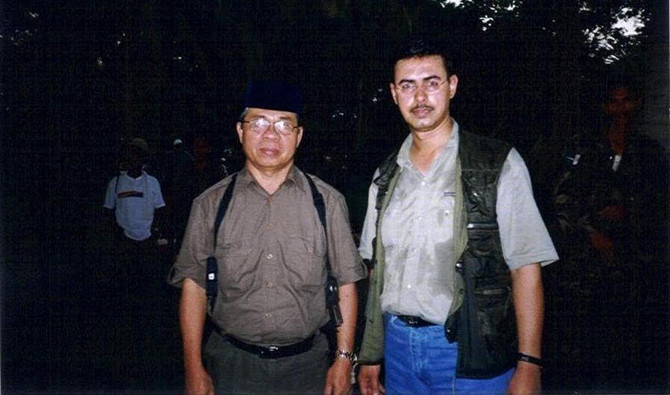
I visited the Philippines twice between 2002 and 2004. I met Ebrahim on both occasions and each time he stressed two points: That his group had no interest in targeting American forces and did not consider the US to be an enemy, but also that his fight would continue until there was a declaration of an autonomous region for the Muslims of the southern Philippines.

In January 2004, when Ebrahim was labeled one of the most-wanted men by the Philippine army, I contacted MILF requesting an interview with him. Unlike previous visits, when I had traveled directly to Cotabato city, the main stronghold of MILF in the south, this time I was asked to fly into in the city of General Santos, a well-known tourist resort in the southern Philippines.

I was told by the man assigned to take me to Cotabato that the MILF security team would not allow my Filipino cameraman to accompany me to Ebrahim’s hideout “for security reasons.” It took us almost a day to travel across the jungles between Marawi and Cotabato before we reached our destination. Even then, I had to wait several hours before Ebrahim appeared with his security team.

Throughout that interview, he stressed that he did not feel tired despite being on the run, and that he was sure Muslims in the south would gain autonomy.

Last week, after 40 years of armed conflict with the Philippine military, Ebrahim took a step closer to realizing his dream as he entered the headquarters of the Philippine army and was greeted by top generals as a partner in peace.

In the 14 years between these two moments — Ebrahim in the jungles of Mindanao carrying arms and planning attacks, and Ebrahim the politician confidently shaking hands with his erstwhile foes — many transformations have taken place but also many challenges persist.

“We are now transformed from enmity to partnership,” Murad said. 

“We have confidence in each other now and we have seen good intentions from the government toward making peace in the south.”

But this peace process has come at a price, not least splits within Ebrahim’s group and the emergence of new armed groups from within the ranks of MILF itself. These include the Bangsamoro Islamic Freedom Fighters, who have rejected the peace agreement and declared war on both MILF and the Philippine army.

In a dangerous development, many of these new groups are cooperating with Daesh, a newcomer whose influence is expanding in the Philippines, most notably in their devastating occupation of Marawi city last year.

It is not only breakaway armed groups that oppose the peace agreement, however. There are also forces within state institutions in the Philippines, civilian and military, that are clearly inimical to the idea. For instance, Philippine legislators have delayed writing the peace agreement into law for several months. Even when it does become law, challenges are expected from the Supreme Court.

Perhaps the biggest challenge facing the peace agreement, however, is one of mentality. Soldiers from the Western Mindanao Command have told me that many of the troops secretly whisper the belief that peace in the south is a far-fetched idea. The military option remains the only solution, they say.

As long as this thinking persists, the hope for peace in the southern Philippines might well remain just that.


Bill Clinton says he ‘did nothing wrong’ with Epstein as he faces grilling over their relationship

Updated 58 min 18 sec ago
Follow

Bill Clinton says he ‘did nothing wrong’ with Epstein as he faces grilling over their relationship

  • “I saw nothing, and I did nothing wrong,” the former Democratic president said
  • The closed-door deposition in Chappaqua, New York, marks the first time a former president has been compelled to testify to Congress

WASHINGTON: Former President Bill Clinton told members of Congress on Friday that he “did nothing wrong” in his relationship with Jeffrey Epstein and saw no signs of Epstein’s sexual abuse as he faced hours of grilling from lawmakers over his connections to the disgraced financier from more than two decades ago.
“I saw nothing, and I did nothing wrong,” the former Democratic president said in an opening statement he shared on social media at the outset of the deposition.
The closed-door deposition in Chappaqua, New York, marks the first time a former president has been compelled to testify to Congress. It came a day after Clinton’s wife, former Secretary of State Hillary Clinton, sat with lawmakers for her own deposition.


Bill Clinton has also not been accused of any wrongdoing. Yet lawmakers are grappling with what accountability in the United States looks like at a time when men around the world have been toppled from their high-powered posts for maintaining their connections with Epstein after he pleaded guilty in 2008 to state charges in Florida for soliciting prostitution from an underage girl.
“Men — and women for that matter — of great power and great wealth from all across the world have been able to get away with a lot of heinous crimes and they haven’t been held accountable and they have not even had to answer questions,” said Republican Rep. James Comer, the chair of the House Oversight Committee, before the deposition began Friday.
Hillary Clinton told lawmakers Thursday that she had no knowledge of how Epstein had sexually abused underage girls and had no recollection of even meeting him. But Bill Clinton will have to answer questions on a well-documented relationship with Epstein and his former girlfriend Ghislaine Maxwell, even if it was from the late 1990s and early 2000s.
Bill Clinton in his opening statement said that he would likely often tell the committee that he did not recall the specifics of events from more than 20 years ago. But he also expressed certainty that he had not witnessed signs of Epstein’s abuse.
During a break after two hours of questioning, Democratic lawmakers said that Bill Clinton had tried to answer every question and had not invoked his Fifth Amendment right against self-incrimination.
Still, Republicans were relishing the opportunity to scrutinize the former Democratic president under oath.
“No one’s accusing anyone of any wrongdoing, but I think the American people have a lot of questions,” Comer said.
Republicans finally get a chance to question Bill Clinton
Republicans have wanted to question Bill Clinton about Epstein for years, especially as conspiracy theories arose following Epstein’s 2019 suicide in a New York jail cell while he faced sex trafficking charges.
Those calls reached a fever pitch late last year when several photos of the former president surfaced in the Department of Justice’s first release of case files on Epstein and Maxwell, a British socialite who was convicted of sex trafficking in December 2021 but maintains she’s innocent. Bill Clinton was photographed on a plane seated alongside a woman, whose face is redacted, with his arm around her. Another photo showed Clinton and Maxwell in a pool with another person whose face was redacted.
Epstein also visited the White House several times during Clinton’s presidency, and the pair later made several international trips together for their humanitarian work. Comer claimed the committee has collected evidence that Epstein visited the White House 17 times and that Bill Clinton flew on Epstein’s airplane 27 times.
Democratic lawmakers said they also posed tough questions to Bill Clinton about his relationship with Epstein and Maxwell.
“We are only here because he hid it from everyone so well for so long,” Bill Clinton said in his opening statement. “And by the time it came to light with his 2008 guilty plea, I had long stopped associating with him.”
Comer pledged extensive questioning of the former president. He claimed that Hillary Clinton had repeatedly deferred questions about Epstein to her husband.
Bill Clinton went after Comer for calling his wife before the committee, telling him that “including her was simply not right.”
The committee was working to quickly publish a transcript and video recording of her deposition.
Has a precedent been set?
Democrats, who have supported the push to get answers from Bill Clinton, are arguing that it sets a precedent that should also apply to President Donald Trump, a Republican who had his own relationship with Epstein.
“I think that President Trump needs to man up, get in front of this committee and answer the questions and stop calling this investigation a hoax,” said Rep. Robert Garcia, the top Democrat on the committee, on Friday.
Comer has pushed back on that idea, saying that Trump has answered questions on Epstein from the press.
Trump on Friday expressed remorse at Bill Clinton being forced to testify. “I like Bill Clinton, and I don’t like seeing him deposed,” he told reporters as he departed the White House en route to Corpus Christi, Texas.
Democrats are also calling for the resignation of Trump’s Commerce Secretary Howard Lutnick. Lutnick was a longtime neighbor of Epstein in New York City but said on a podcast that he severed ties with Epstein following a 2005 tour of Epstein’s home that disturbed Lutnick and his wife.
The public release of case files showed that Lutnick actually had two engagements with Epstein years later. He attended a 2011 event at Epstein’s home, and in 2012 his family had lunch with Epstein on his private island.
“He should be removed from office and at a minimum should come before the committee,” Garcia said of Lutnick.
Republican Rep. Nancy Mace questioned Hillary Clinton about Lutnick’s relationship to Epstein during the deposition on Thursday. On Friday morning, Mace joined in calling for the commerce secretary to come before the committee.
“I believe we will have the votes to subpoena him,” Democratic Rep. Ro Khanna said.