

Chinese consulate honors Pakistani policemen killed in the line of duty

Updated 29 November 2018
Follow

Chinese consulate honors Pakistani policemen killed in the line of duty

  • Duo died while trying to foil a terror attack on November 23
  • Beijing to provide financial compensation to families of the deceased

ISLAMABAD: China’s government has said it plans to compensate the two policemen who lost their lives while trying to protect the Chinese consulate during a recent terror attack in Karachi by providing Rs6 million each to the families of the deceased, officials from Sindh Police tweeted on Thursday. 

The announcement came soon after a ceremony held at the Central Police Office in the city where Chinese Consul General Wang Yu was the chief guest.

Yu praised the bravery of the two policemen and said that the people and government of China would never forget their sacrifice. He added that Chinese nationals were also collecting funds for the families of the deceased and were full of gratitude for the province’s police force. 
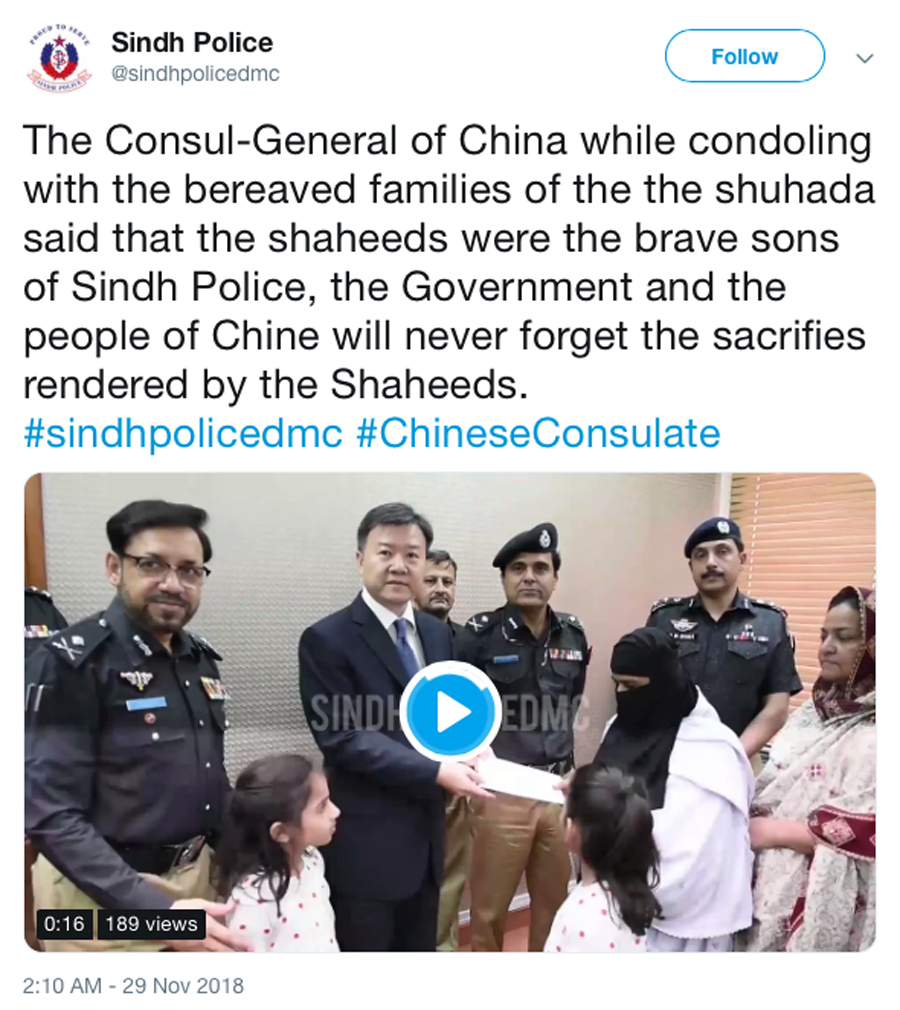
Staff members from the Chinese consulate, along with high-ranking officials of the Sindh Police, also attended the ceremony.    

A group of armed men attacked the Chinese consulate in Karachi on November 23. The attack, which was carried out by the Baloch Liberation Army (BLA), claimed four lives. Two of the victims were ASI Ashraf Dawood and police constable Amir. However, none of the Chinese nationals working at the diplomatic facility were impacted in the attack. 
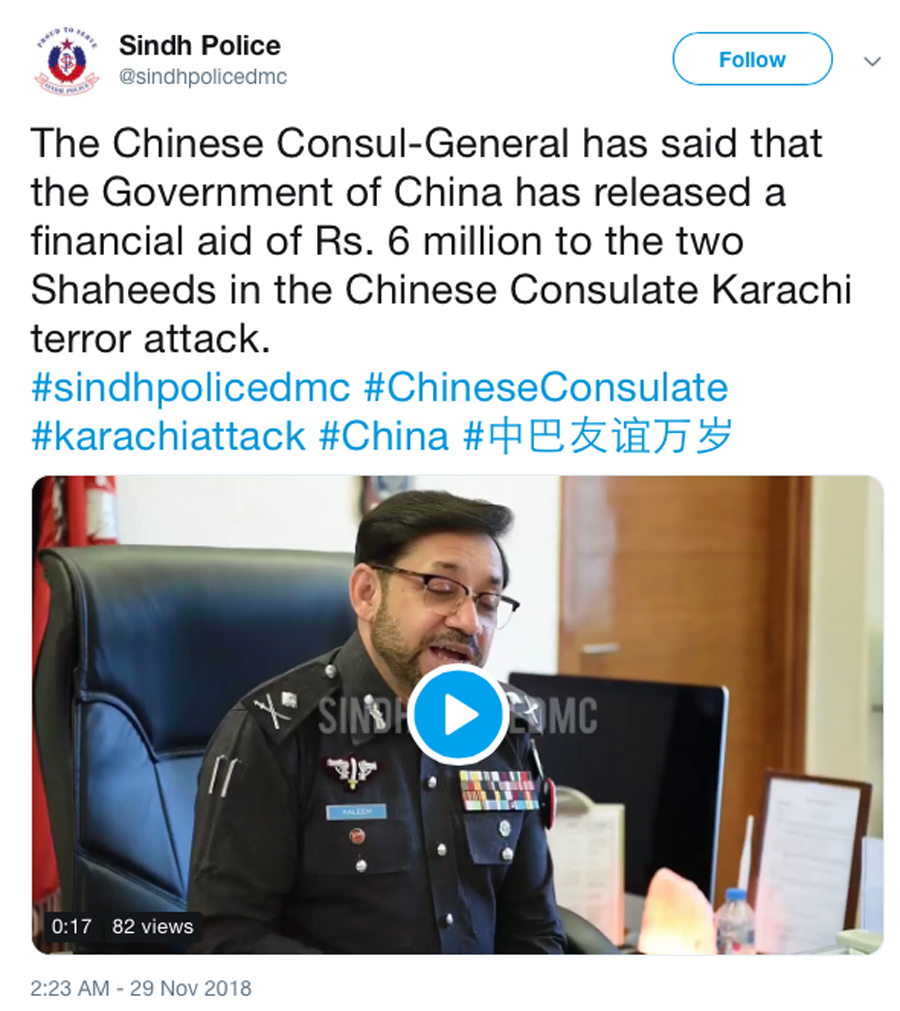
Inspector General Police, Kaleem Imam who arranged the gathering, praised the slain policemen who served under his command, adding that they had become a symbol of professional excellence and were a source of pride for the entire police force. 

Apart from the Chinese diplomat and the province’s top cop, several other prominent officials and family members of the two police constables were also present at the ceremony.


Pakistan’s finance chief says country shifting from aid to trade, investment with Gulf nations

Updated 5 sec ago
Follow

Pakistan’s finance chief says country shifting from aid to trade, investment with Gulf nations

  • Aurangzeb says remittances from the GCC topped $38 billion last fiscal year, projected at $42 billion this time
  • He tells an international media outlet discussions on a free trade agreement with the GCC are at an advanced stage

ISLAMABAD: Pakistan is no longer seeking aid-based support and is instead pivoting toward trade- and investment-led partnerships, Finance Minister Muhammad Aurangzeb said in an interview with an international media outlet circulated by the finance division on Monday, acknowledging longstanding economic backing from Gulf countries.

Aurangzeb spoke to CNN Business Arabia at a time when Pakistan seeks to consolidate macroeconomic stability after a prolonged crisis marked by soaring inflation, currency pressure and external financing gaps.

Aurangzeb said the government’s economic direction, articulated by Prime Minister Shehbaz Sharif, aims to replace reliance on external assistance with sustainable growth driven by investment and exports, particularly from partners in the Gulf Cooperation Council (GCC), which includes Saudi Arabia, the United Arab Emirates, Qatar, Kuwait, Oman and Bahrain.

“We are not looking for aid flows anymore,” he said. “For us, we are very clear ... that going forward is really trade and investment, which is going to bring sustainability and be win-win for our longstanding bilateral partners in GCC and for Pakistan.”

“This FDI [foreign direct investment] is going to help us in terms of GDP growth [and] more employment opportunities as we go forward,” he continued. “So, you know, all hands are on deck at this point in time to make this materialize.”

Aurangzeb said Pakistan’s shift was underpinned by improving macroeconomic indicators following an 18-month stabilization program.

He noted that inflation, which peaked at 38 percent in 2023, has fallen to single-digit levels, while the country has posted primary fiscal surpluses and kept the current account deficit within targeted limits, adding that foreign exchange reserves now cover about 2.5 months of imports.

The finance chief described recent international assessments as external validation of the government’s reform path.

“All three international credit rating agencies are now aligned in terms of their upgrades and outlook for Pakistan this year,” he said, adding that the successful completion of the second review under the International Monetary Fund’s loan program, approved by the lending agency’s executive board, reinforced confidence in Pakistan’s economic management.

The finance minister said reforms across taxation, energy, state-owned enterprises, public finance and privatization were central to consolidating stability and supporting growth.

He pointed out Pakistan’s tax-to-GDP ratio had risen to about 10.3 percent from 8.8 percent at the start of the reform program and is on track to reach 11 percent, driven by efforts to widen the tax base to include under-taxed sectors such as real estate, agriculture and wholesale and retail trade, while tightening compliance through technology-based monitoring.

Aurangzeb also highlighted the role of the GCC in supporting Pakistan’s external position, particularly through remittances.

He said inflows reached about $38 billion last fiscal year and are projected to rise to nearly $42 billion this time, with more than half originating from GCC states, reflecting the contribution of Pakistani nationals working in the region.

The finance chief said Pakistan was actively engaging Gulf partners to attract investment in sectors including energy, oil and gas, mining, artificial intelligence, digital infrastructure, pharmaceuticals and agriculture, while discussions on a free trade agreement with the GCC were at an advanced stage.