

Vision 2030 has helped Saudi economy’s accelerating pace of reforms, conference told

Governor of the Saudi Arabian Investment Authority (SAGIA) Ibrahim Al-Omar said the Kingdom was demonstrating mobility. (Arab News)
Updated 01 December 2018
Follow

Vision 2030 has helped Saudi economy’s accelerating pace of reforms, conference told

JEDDAH: Saudi Arabia’s Vision 2030 has contributed to the accelerating pace of reforms and improving competitiveness, the governor of the Saudi Arabian Investment Authority (SAGIA) told a meeting.

Speaking at the annual meeting of the OECD Working Group for the Middle East and North Africa, Ibrahim Al-Omar said the Kingdom was demonstrating “great mobility as it rapidly develops and modernizes the country’s investment systems and procedures, a process that will enhance its position on the international investment map and increase the competitiveness of the Saudi economy.”

He said Saudi Arabia had many advantages in international trade and investment, “such as its important strategic location linking three continents and forming an ideal bridge between East and West, as well as the presence of diverse natural resources and a youthful workforce, nourished with generous government support of education and training.”

He said the government’s efforts in education would raise the level of young national talent and equip them with the skills necessary to meet the challenges faced with global competition.

Referring to reports issued by organizations such as the World Bank that placed the Kingdom fourth among the Group of 20 countries (G-20) in terms of the scope of economic reforms.

He said the reforms had advanced the country’s investment environment and “generated positive expectations by the International Monetary Fund on the Saudi economy and its growth rates over the next few years.”

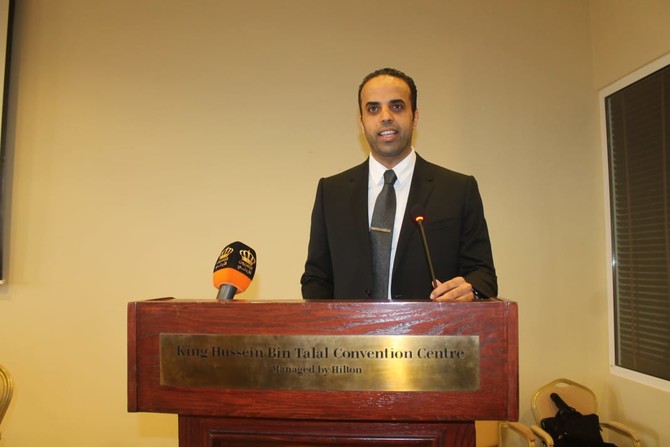
Meanwhile Mohannad Shehadeh, Minister of State for Jordanian Investment, told the annual meeting that the Middle East and North Africa region was facing challenges  in providing job opportunities to a large and growing number of  job seekers.

Shehadeh said that the essential next steps would involve investing in the world, integrating global value chains, stimulating local investment, and expanding partnerships with the private sector.

He said this was especially the case given that the region holds “one of the most important keys to global trade through the rich resources and immense potential created by its geographical location bridging Eastern and Western markets.”

He said it was important to be optimistic about the commercial and investment capabilities of the MENA region.

And he said he was confident that the region would progress quickly towards a comprehensive and sustainable future, with good job opportunities and conditions for young people.

Speaking at a later discussion focused on investment regulations and policies, Deputy Governor of Investment Climate, Dr Ayed bin Hadi Al-Otaibi, said Saudi Arabia had submitted a new model for a unified agreement for Arab capital investment, which had been unanimously approved.

He said the role of government was central in providing the legislative structure and legal frameworks that contributed to the growth in inter-regional investments of the region’s countries.

Al-Otaibi said governments needed to intensify bilateral discussions between the business sector and other institutions in the region.

He said joint business councils needed to expand to help target private sector investments towards areas that would enable economic integration between countries, leveraging each country’s comparative advantage.


Global investors commit more than $3bn to King Salman Park as Saudi giga-project secures new deals

Updated 10 March 2026
Follow

Global investors commit more than $3bn to King Salman Park as Saudi giga-project secures new deals

RIYADH: The King Salman Park Foundation has secured more than $3.8 billion in new private-sector commitments at the MIPIM 2026 real estate conference, including a landmark $3 billion fund backed by international investors to develop a major mixed-use district in the heart of Riyadh.

According to a press release, the announcements bring total committed investment in the 17.2 sq. kilometers urban regeneration project to over $5.3 billion across five major packages.

Launched in 2019 under Saudi Vision 2030, the development is designed to be the world’s largest city park and aims to boost green space, improve quality of life, and feature over 1 million trees and extensive leisure facilities.

A $3 billion metro-connected district

The largest of the two packages, designated Package 5, will see a consortium led by Kolaghassi Development Co. deliver a residential-led district with a total built-up area exceeding 1 million sq. meters. 

It will provide approximately 3,700 residential units, a K–12 school, around 300 hospitality keys and more than 100,000 sq m of Grade A office space alongside a wide variety of retail and dining offerings.

The development is supported by a Saudi-domiciled, Capital Market Authority-regulated fund managed by Mulkia Investment Co. that has attracted leading investors from the Kingdom and across the world.

Kolaghassi Development Co. will lead the project alongside Al Othaim Investment, one of the Kingdom’s real estate players, and RXR, a New York-headquartered real estate investor and operator.

“Securing investment of this scale, supported by international capital and expertise, is an important milestone for King Salman Park,” said George Tanasijevich, CEO of King Salman Park Foundation. 

$850 million cultural district package

In a separate announcement, the Foundation confirmed the award of Package 4 to a consortium led by Retal Urban Development Co., with support from a fund managed by SAB Invest.

The project has a total value exceeding $850 million and will host more than 600 residential units, over 140 hotel keys, and almost 50,000 sq m of Grade A office space, alongside curated retail and food and beverage experiences.

“This opportunity reflects the maturity of Saudi Arabia’s real estate investment landscape and our confidence in culture-led, mixed-use urban destinations as a driver of sustainable returns,” said Abdullah Al-Braikan, CEO and founder of Retal Urban Development Co.

Ali Al-Mansour, CEO of SAB Invest, said the fund structure brings together “long-term capital, experienced development partners, and a shared commitment to place-making excellence” while contributing to Riyadh’s cultural vibrancy and the Kingdom’s quality-of-life ambitions under Vision 2030.