

Global big-hitters arrive in Argentina for G20 summit

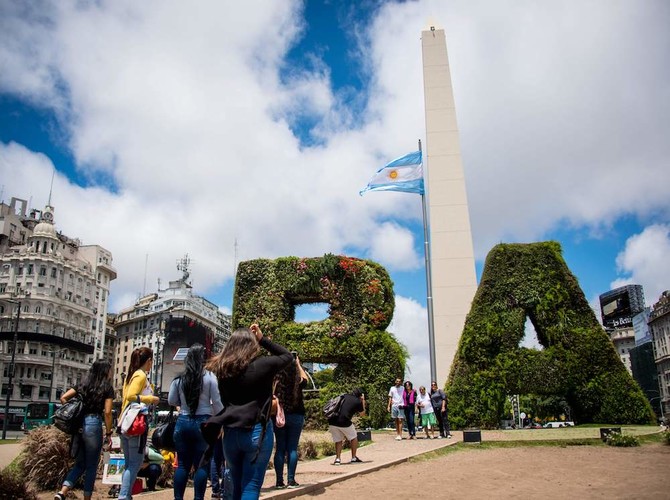
Tourists pose for pictures at the Obelisk along 9 de julio Avenue the in downtown Buenos ahead of the G20 Summit. (AFP)
Updated 29 November 2018
Follow

Global big-hitters arrive in Argentina for G20 summit


BUENOS AIRES: The Argentine capital began to go into security lockdown on Wednesday as leaders of the world’s biggest economies started to arrive for the G20 summit starting on Friday.

The two-day summit brings together the most important statesmen in the world, including US President Donald Trump, Chinese President Xi Jinping and Saudi Crown Prince Mohammed bin Salman, for top-level policy meetings and negotiations.

Finance ministers and “sherpas,” the government officials whose job it is to steer negotiations toward some kind of agreement, have been in Buenos Aires since the start of the week. 

Certain to be on their minds — although it is not mentioned formally on the summit agenda — is the looming prospect of a global trade war between the US and China. This is expected be discussed at a dinner on Friday evening between Trump and Xi.

The official mission statement is “Building consensus for fair and sustainable development” in areas such as the future of work, infrastructure, food and gender. If all goes to plan, there will be a joint communiqué of agreement announced on Saturday.

It is the first time a G20 meeting has been held in Latin America (Saudi Arabia is set to host it in 2020), and Argentina’s president Mauricio Macri is taking the opportunity to showcase the reforms that he has introduced in the past two years but which have run into economic problems recently.

The summit has regularly been the focus of organized protests, which have sometimes tuned violent, and Argentina is taking special measures to ensure a peaceful meeting.

Traffic was already being restricted in large areas of Buenos Aires Wednesday, with access limited to the Costa Salguero Center, the business and leisure area where the main summit meetings will be held.

There is also an extensive program of cultural and artistic activities planned to coincide with the event, with wives and partners of many of the leaders hosting events throughout the city.

By Friday, large parts of Buenos Aires will be closed to normal traffic. Much of the public transport network will be closed temporarily, and citizens have been given an extra public holiday on the opening day. They have been advised by the authorities to take a long weekend outside the city for the duration of the event.


Flash floods triggered by heavy rains in Afghanistan kill at least 17 people

Updated 9 sec ago
Follow

Flash floods triggered by heavy rains in Afghanistan kill at least 17 people

  • Afghanistan, like neighboring Pakistan and India, is highly vulnerable to extreme weather events, particularly flash floods following seasonal rains
  • Decades of conflict, poor infrastructure, deforestation, and the intensifying effects of climate change have amplified the impact of such disasters

KABUL: The season’s first heavy rains and snowfall ended a prolonged dry spell but triggered flash floods in several areas of Afghanistan, killing at least 17 people and injuring 11 others, a spokesman for Afghanistan’s national disaster management authority said Thursday.

The dead included five members of a family in a property where the roof collapsed on Thursday in Kabkan, a district in Herat province, according to Mohammad Yousaf Saeedi, spokesman for the Herat governor. Two of the victims were children.

Most of the casualties have occurred since Monday in districts hit by flooding, and the severe weather also disrupted daily life across central, northern, southern, and western regions, according to Mohammad Yousaf Hammad, a spokesman for Afghanistan’s National Disaster Management Authority.

Hammad said the floods also damaged infrastructure in the affected districts, killed livestock, and affected 1,800 families, worsening conditions in already vulnerable urban and rural communities.

Hammad said the agency has sent assessment teams to the worst-affected areas, with surveys ongoing to determine further needs.

Afghanistan, like neighboring Pakistan and India, is highly vulnerable to extreme weather events, particularly flash floods following seasonal rains.

Decades of conflict, poor infrastructure, deforestation, and the intensifying effects of climate change have amplified the impact of such disasters, especially in remote areas where many homes are made of mud and offer limited protection against sudden deluges.

The United Nations and other aid agencies this week warned that Afghanistan is expected to remain one of the world’s largest humanitarian crises in 2026. The UN and its humanitarian partners launched a $1.7 billion appeal on Tuesday to assist nearly 18 million people in urgent need in the country.