

A history of Saudi royals' official visits to Egypt

2016 Saudi King Salman, left, and Egypt’s President Abdel Fattah El-Sisi, right. (Reuters)
Updated 26 November 2018
Follow

A history of Saudi royals' official visits to Egypt

  • The prosperous Saudi-Egyptian relationship was etched in stone on Jan. 10, 1946, during the first official visit to Egypt by King Abdul Aziz
  • King Salman’s official visit in 2016 consolidated the two nations’ historical ties

JEDDAH: When Crown Prince Mohammed bin Salman arrives in Cairo on Monday, he will be continuing a tradition of deep-rooted historical relations that span several decades, dating back to the days of Saudi Arabia’s founder, King Abdul Aziz.

The prosperous relationship was etched in stone on Jan. 10, 1946, which marked the first official visit to Egypt by King Abdul Aziz. 

The only other time he left the Arabian Peninsula was to visit US President Franklin D. Roosevelt aboard the USS Quincy in the Suez Canal.

Egypt’s King Farouk sent his royal yacht, El-Mahroosa, to pick up King Abdul Aziz in Jeddah. 
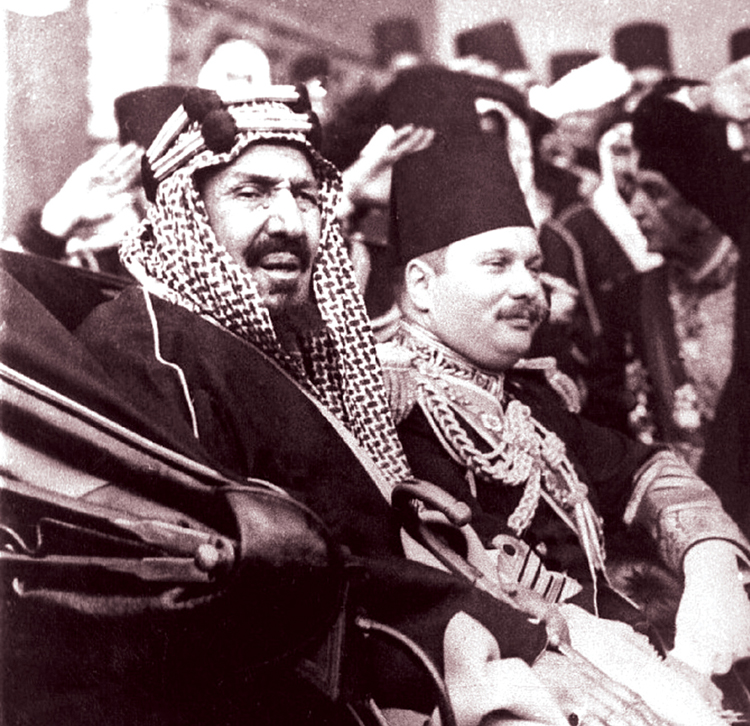


1946 Saudi Arabia’s King Abdul Aziz, left, and Egypt’s King Farouk, right. (Supplied)

After welcoming him in Suez, they boarded a royal train toward Cairo, where they held talks in Abdeen Palace.

Over the years, the ties between Saudi Arabia and Egypt were defined by the times.

Saudi King Faisal’s rule was one of tenacity and craft. He was a prime supporter of Egypt and its people, and visited the country seven times during his rule, starting with his first official visit on Sept. 8, 1965. 

Egypt supported King Faisal’s oil embargo in protest against Western support for Israel during the 1973 Arab-Israeli War. 
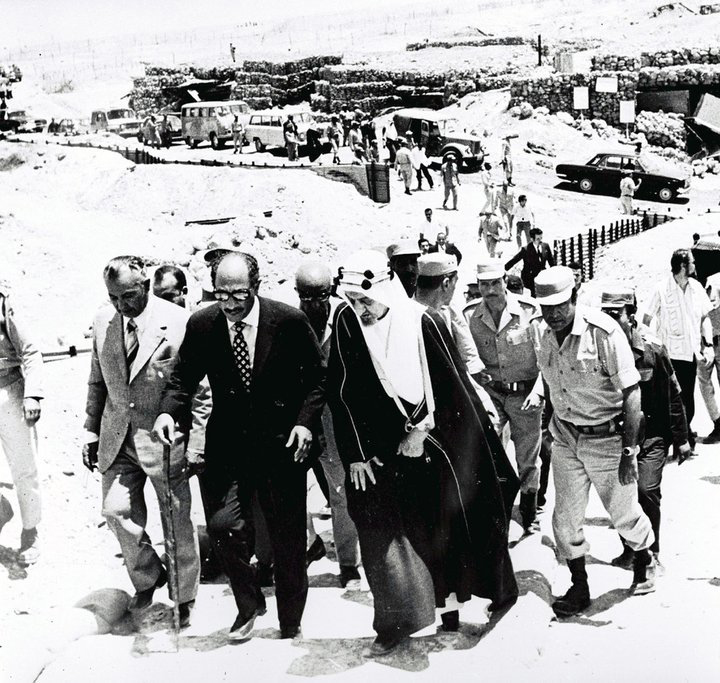


1974 Saudi King Faisal, center right, and Egyptian President Anwar Sadat, center left. (Supplied)

The resulting oil crisis helped undeveloped oil-rich states flourish and boosted their social development plans.

King Faisal’s eight-day visit to Cairo in 1974 cemented future Saudi-Egyptian relations. He toured several cities, with thousands of Egyptians coming out to greet him.

Saudi King Fahd made three trips to Egypt during his rule, the most important one on Aug. 9, 1990, after Iraq’s invasion of Kuwait. 

The emergency Arab League Summit was crucial as it determined the unified commitment to free Kuwait from Iraqi occupation.



1989 Saudi King Fahd, left, and Egyptian President Hosni Mubarak, right. (Supplied)

King Abdullah continued Saudi Arabia’s strong relationship with Egypt. His first visit as king was to Sharm El-Sheikh in 2008, during which he focused on regional issues, including the conflict in Iraq and the threat from Iran’s nuclear program. 

His second visit, in 2014, although short, was vital in showing Saudi support for the Egyptian government of President Abdel Fattah El-Sisi following the overthrow of his predecessor Mohamed Morsi in 2013.

King Salman’s official visit in 2016 consolidated the two nations’ historical ties. He was named the “Great Guest of Egypt in Cairo,” and was granted the Collar of the Nile, the country’s highest state honor. 

The five-day visit resulted in the signing of 17 agreements, many of them aimed at boosting commerce and trade. 

They included cooperation on peaceful nuclear energy, the development of King Salman University in Egypt’s Sinai Peninsula, and the building of a bridge connecting the two countries. Nothing could be more representative of the bilateral relationship than that.


Saudi initiative to host ‘dialogue’ between southern Yemeni factions widely welcomed

Updated 59 min 19 sec ago
Follow

Saudi initiative to host ‘dialogue’ between southern Yemeni factions widely welcomed

  • Conference in Saudi capital requested by Rashad Al-Alimi, president of the Yemeni Presidential Leadership Council
  • Kingdom urged all factions to participate “to develop a comprehensive vision” that would fulfill the aspirations of the southern people

RIYADH: The Saudi Foreign Ministry’s move to invite factions in South Yemen to hold a dialogue in Riyadh has been widely welcomed.

A statement by the ministry said the conference in the Saudi capital had been requested by Rashad Al-Alimi, president of the Yemeni Presidential Leadership Council, and the Kingdom urged all factions to participate “to develop a comprehensive vision” that would fulfill the aspirations of the southern people.

Arab League Secretary-General Ahmed Aboul Gheit welcomed Al-Alimi’s call to convene a comprehensive conference to discuss just solutions to the southern issue. 

He also expressed his appreciation for Saudi Arabia’s swift response to the request and its readiness to host and sponsor the conference with the participation of southern factions.

The situation in southern Yemen, Aboul Gheit said, has “well-known historical dimensions and includes legitimate issues that must be addressed at the negotiating table within a comprehensive Yemeni framework.” 

He stressed that attempts to impose a fait accompli did not serve the southern cause but instead caused serious harm by exposing the country to further fragmentation and disintegration.

He reiterated the Arab League’s consistent position, as reflected in its repeated resolutions on the Yemeni crisis, which is based on full commitment to Yemen’s unity and the preservation of its territorial integrity.

Commending the Saudi announcement, Sheikh Dr. Mohammed bin Abdulkarim Al-Issa,  the Muslim World League’s secretary-general, said that the step “reflected the Kingdom’s steadfast and sincere approach to supporting the Yemeni people in all their diversity.”

It also highlights the Kingdom’s continued efforts to preserve peace and stability in Yemen by addressing the southern issue through inclusive dialogue among all parties, Al-Issa added.

Meanwhile, Qatar has expressed its appreciation for Saudi Arabia’s hosting of the inclusive conference to explore fair solutions to the southern issue.

In a statement, Qatar’s Foreign Ministry welcomed the efforts exerted by the legitimate Yemeni government to support the Yemeni dialogue track and address the southern issue.

The ministry underlined the importance of the constructive participation of all southern stakeholders, prioritizing the interests of the Yemeni people at the anticipated conference in Riyadh.

It emphasized adherence to the outcomes of the national dialogue as the consensual framework and comprehensive mechanism for reaching an inclusive political solution that meets the aspirations of the Yemeni people in all their segments and preserves Yemen’s unity, sovereignty, and territorial integrity.

The ministry warned that unilateral declarations and measures taken without consultation and consensus among Yemeni parties, and without engaging in serious and responsible dialogue, could lead to a descent into chaos, harming the interests of the Yemeni people and undermining prospects for reaching a sustainable political settlement.

The ministry reaffirmed Qatar’s full support for all regional and international efforts aimed at advancing the political process, contributing to ending the Yemeni crisis through dialogue and peaceful means.