BOSRA, Syria: Mobile phone in hand, student Abdelaziz Al-Aswad bounds up the steps of an UNESCO-listed Roman theater in southern Syria, elated that the heritage site has survived seven years of civil war.
The second-century theater stands tall in the ancient city of Bosra, which the United Nations cultural body designated as under threat after Syria’s conflict broke out.
Al-Aswad was among dozens to visit and take pictures of the theater under grey skies on Friday, as part of an organized trip to the area sanctioned by the tourism ministry.
“I traveled 700 kilometers (430 miles) from northern Syria to see the theater after hearing so much about it,” said the 23-year-old, who hails from the northern city of Aleppo.
Regime forces retook full control of the surrounding province of Daraa in July, for the first time in six years.
Rebels had overrun parts of Bosra in 2012, and then took it over completely in 2015.
“I thought I’d find it destroyed, but it seems to have survived this vicious war,” said Al-Aswad, dressed in a red hoody and matching headband, both bearing the words “I am Syrian.”
Dozens of visitors, including some armed with umbrellas to fend off drizzle, hiked up the dark stone steps of the semi-circular theater for a better view of the stage below.
Around them the ancient auditorium appeared largely unscathed, except for a hole blown into the steps, a small pit on the stage, and shell pockmarks on columns.
In ancient times, Bosra was the capital of the Roman province of Arabia, and an important stopover on the ancient caravan route to Makkah, UNESCO says.
The archaeological site — which was once a bustling city of some 80,000 people — also contains early Christian ruins and several mosques.
Khaled Nawaylati, one of the trip’s organizers, said he was overjoyed to find Bosra’s theater in one piece on his first visit in ten years.
“You can’t imagine my happiness after I saw the site was safe and sound,” he said.
According to Wafi Al-Dous, head of the local civil council, no more than five percent of the theater has been damaged.
Hundreds of archaeological sites have been destroyed, damaged or looted in Syria’s conflict, with all sides blamed for the pillaging.
Before the war, tourism was an essential source of foreign currency for Syria’s economy, second only to oil exports.
But after the brutal repression of anti-government protests in 2011 spiralled into civil war, the fighting kept foreign visitors at bay.
With clashes and bombardment raging across the country, internal tourism also plummeted.
“Internal tourism completely stopped in 2011, and visitors have since stayed away,” said Dous, who fled Bosra when the rebels fully overran it three years ago.
He has only recently returned, but with the government back in control, he is optimistic.
Restoration will soon get underway, Dous said, and a festival that once saw Lebanese singer Fairuz perform in the ancient city will be revived.
Syrians on the organized tour on Friday were delighted just to be able to visit a landmark of their country’s history.
In the middle of the Roman stage, 30-year-old Manal posed for a picture with her seven-month-old daughter after making the day trip with her husband from Damascus.
“We can’t travel outside Syria, so we’re starting to visit our own country again,” she said.
“There are so many beautiful places” to see, she added.


In southern Syria, Roman theater survives civil war intact
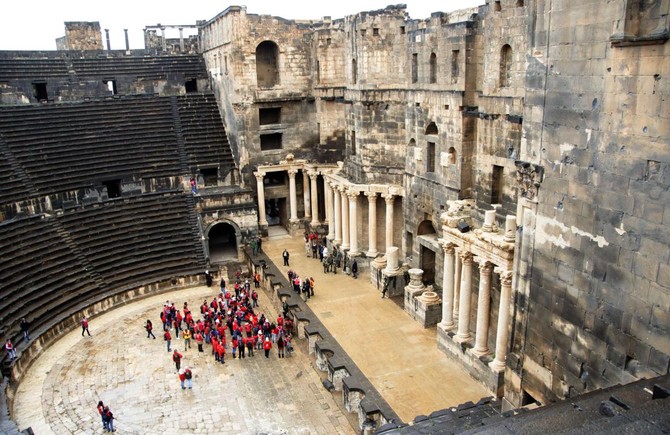

In southern Syria, Roman theater survives civil war intact


How science is reshaping early years education
DUBAI: As early years education comes under renewed scrutiny worldwide, one UAE-based provider is making the case that nurseries must align more closely with science.
Blossom Nursery & Preschool, which operates 32 locations across the UAE, is championing a science-backed model designed to close what it sees as a long-standing gap between research and classroom practice.
“For decades, early years education has been undervalued globally — even though science shows the first five years are the most critical for brain development,” said Lama Bechara-Jakins, CEO for the Middle East at Babilou Family and a founding figure behind Blossom’s regional growth, in an interview with Arab News.

She explained that the Sustainable Education Approach was created to address “a fundamental gap between what we know from science and what actually happens in nurseries.”
Developed by Babilou Family, the approach draws on independent analysis of research in neuroscience, epigenetics, and cognitive and social sciences, alongside established educational philosophies and feedback from educators and families across 10 countries. The result is a framework built around six pillars; emotional and physical security, natural curiosity, nature-based learning, inclusion, child rhythms, and partnering with parents.
Two research insights, Bechara-Jakins says, were particularly transformative. “Neuroscience shows that young children cannot learn until they feel safe,” she said, adding that stress and inconsistent caregiving can “literally alter the architecture of the developing brain.”
Equally significant was evidence around child rhythms, which confirmed that “pushing children academically too early is not just unhelpful — it can be counterproductive.”
Feedback from families and educators reinforced these findings. Across regions, common concerns emerged around pressure on young children, limited outdoor time and weak emotional connections in classrooms. What surprised her most was that “parents all sensed that something was missing, even if they couldn’t articulate the science behind it.”
At classroom level, the strongest body of evidence centres on secure relationships. Research shows that “secure attachments drive healthy brain development” and that children learn through trusted adults. At Blossom, this translates into practices such as assigning each child “one primary educator,” prioritising calm environments, and viewing behaviour through “a neuroscience lens — as stress signals, not misbehaviour.”
Bechara-Jakins believes curiosity and nature remain overlooked in many early years settings, despite strong evidence that both accelerate learning and reduce stress. In urban centres such as Dubai, she argues, nature-based learning is “not a luxury. It is a developmental need.”
For Blossom, this means daily outdoor time, natural materials, gardening, and sensory play — intentional choices aimed at giving children what science says they need to thrive.


