

Thousands evacuated as Guatemala volcano erupts again

1 / 3
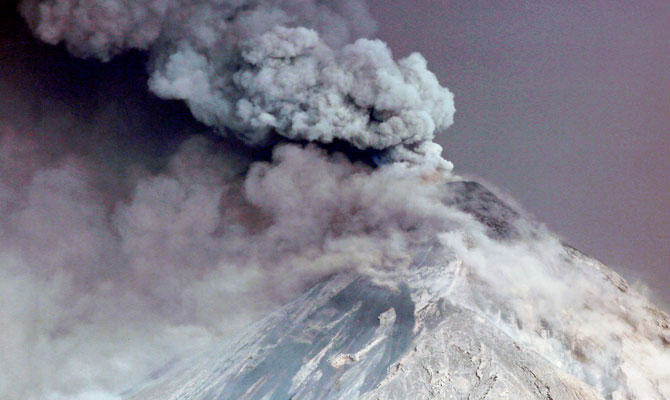
Steam rises from Fuego volcano (Volcano of Fire) as seen from San Juan Alotenango, outside of Guatemala City, Guatemala November 19, 2018. (REUTERS)
2 / 3
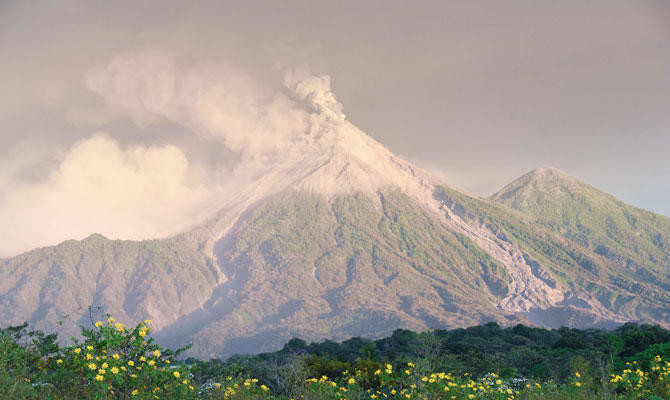
A view of the Fuego Volcano erupting, as seen from El Rodeo municipality, in Escuintla department, 45 km southwest of Guatemala City on November 19, 2018. (AFP)
3 / 3
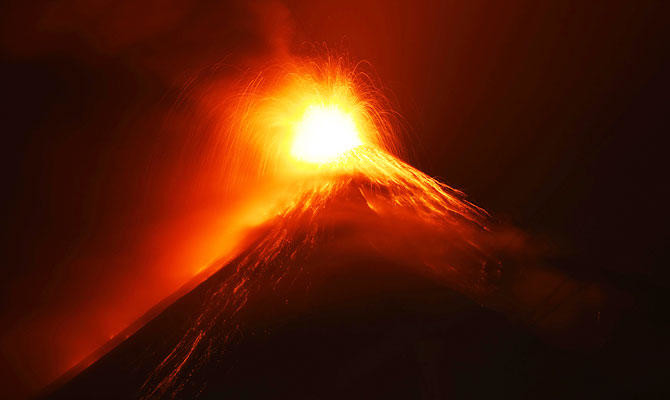
A view of the Fuego Volcano erupting, as seen from El Rodeo municipality, in Escuintla department, 45 km southwest of Guatemala City on November 19, 2018. (AFP)
Updated 20 November 2018
Follow

Thousands evacuated as Guatemala volcano erupts again

  • The Volcano of Fire is one of the most active in Central America and an eruption in June killed 194 people
  • Hundreds of families heeded the call of disaster coordination authorities to evacuate 10 communities, piling into yellow school buses for trips to shelters

GUATEMALA CITY: About 4,000 residents fled Guatemala’s Volcano of Fire Monday as red-hot rock and ash spewed into the sky and cascaded down the slopes toward an area devastated by a deadly eruption earlier this year.
Guatemala’s volcanology unit said that explosions from the 12,300-foot (3,763-meter) high mountain shook homes with “constant sounds similar to a train locomotive.”
Incandescent material burst as high as 1,000 meters (3,200 feet) above the crater and flows of hot rock and ash extended nearly 2 miles (3 kilometers) down one flank of the volcano. Hot blasts of pyroclastic material pushed down canyons on the slopes, while a column of ash rose nearly 23,000 feet (7,000 meters) above sea level and drifted toward Guatemala City to the east.
Hundreds of families heeded the call of disaster coordination authorities to evacuate 10 communities, piling into yellow school buses for trips to shelters. The national disaster commission said 3,925 people had been evacuated by early Monday.

The Volcano of Fire is one of the most active in Central America and an eruption in June killed 194 people. Another 234 are officially missing, although organizations supporting the communities have insisted there are thousands of missing persons.
It spewed more ash and hot rock in October, prompting warnings for the nearby communities.
The biggest danger from the volcano are lahars, a mixture of ash, rock, mud and debris, that can bury entire towns. However, by Monday, there had been no reports of such flows reaching populated areas, though authorities were taking no chances; they were harshly criticized for not calling for evacuations earlier in June.
Four shelters have been set up for evacuees. Dora Caal, 26, and five members of her family took refuge under a nylon tent at a sports stadium in the nearby town of Escuintla.
“Last night we heard the volcano roar, you could see fire, we couldn’t sleep,” said Caal, whose town of El Rodeo was largely evacuated.
“At dawn we said we’d better get out, we were afraid,” Caal said as the sun beat down fiercely at the improvised shelter. People like Caal are still reeling from the effects of the June eruption.
“Back then I lost my job at a farm that was on the slopes of the volcano. They closed it and we can’t work there anymore,” she said.
Enma Hernandez, 42, left her home in El Rodeo to evacuate, but her 20-year-old son stayed behind to protect the family home from looters. In fact, many men stayed behind in the town; there were mainly women and children at the shelter.


Women fleeing Mali’s conflict say they were sexually assaulted but silence hides many more

Updated 2 sec ago
Follow

Women fleeing Mali’s conflict say they were sexually assaulted but silence hides many more

DOUANKARA: The girl lay in a makeshift health clinic, her eyes glazed over and her mouth open, flies resting on her lips. Her chest barely moved. Drops of fevered sweat trickled down her forehead as medical workers hurried around her, attaching an IV drip.
It was the last moment to save her life, said Bethsabee Djoman Elidje, the women’s health manager, who led the clinic’s effort as the heart monitor beeped rapidly. The girl had an infection after a sexual assault, Elidje said, and had been in shock, untreated, for days.
Her family said the 14-year-old had been raped by Russian fighters who burst into their tent in Mali two weeks earlier. The Russians were members of Africa Corps, a new military unit under Russia’s defense ministry that replaced the Wagner mercenary group six months ago.
Men, women and children have been sexually assaulted by all sides during Mali’s decade-long conflict, the UN and aid workers say, with reports of gang rape and sexual slavery. But the real toll is hidden by a veil of shame that makes it difficult for women from conservative, patriarchal societies to seek help.
The silence that nearly killed the 14-year-old also hurts efforts to hold perpetrators accountable.
The AP learned of the alleged rape and four other alleged cases of sexual violence blamed on Africa Corps fighters, commonly described by Malians as the “white men,” while interviewing dozens of refugees at the border about other abuses such as beheadings and abductions.
Other combatants in Mali have been blamed for sexual assaults. The head of a women’s health clinic in the Mopti area told the AP it had treated 28 women in the last six months who said they had been assaulted by militants with the Al-Qaeda affiliated JNIM, the most powerful armed group in Mali.
The silence among Malian refugees has been striking.
In eastern Congo, which for decades has faced violence from dozens of armed groups, “we didn’t have to look for people,” said Mirjam Molenaar, the medical team leader in the border area for Doctors Without Borders, or MSF, who was stationed there last year. The women “came in huge numbers.”
It’s different here, she said: “People undergo these things and they live with it, and it shows in post-traumatic stress.”
Speechless after an assault
The aunt of the 14-year-old girl said the Africa Corps fighters marched everyone outside at gunpoint. The family couldn’t understand what they wanted. The men made them watch as they tied up the girl’s uncle and cut off his head.
Then two of the men took the 14-year-old into the tent as she tried to defend herself, and raped her. The family waited outside, unable to move.
“We were so scared that we were not even able to scream anymore,” the aunt recalled, as her mother sobbed quietly next to her. She, like other women, spoke on condition of anonymity for fear of retaliation, and the AP does not name victims of rape unless they agree to be named.
The girl emerged over a half-hour later, looking terrified. Then she saw her uncle’s body and screamed. She fainted. When she woke up, she had the eyes of someone “who was no longer there,” the aunt said.
The next morning, JNIM militants came and ordered the family to leave. They piled onto a donkey cart and set off toward the border. At any sound, they hid in the bushes, holding their breath.
The girl’s condition deteriorated during the three-day journey. When they arrived in Mauritania, she collapsed.
The AP came across her lying on the ground in the courtyard of a local family. Her family said they had not taken her to a clinic because they had no money.
“If you have nothing, how can you bring someone to a doctor?” the girl’s grandmother said between sobs. The AP took the family to a free clinic run by MSF. A doctor said the girl had signs of being raped.
The clinic had been functioning for barely a month and had seen three survivors of sexual violence, manager Elidje said.
“We are convinced that there are many cases like this,” she said. “But so far, very few patients come forward to seek treatment because it’s still a taboo subject here. It really takes time and patience for these women to open up and confide in someone so they can receive care. They only come when things have already become complicated, like the case we saw today.”
As Elidje tried to save the girl’s life, she asked the family to describe the incident. She did not speak Arabic and asked the local nurse to find out how many men carried out the assault. But the nurse was too ashamed to ask.
Scratch marks are part of story she could not tell
Thousands of new refugees from Mali, mostly women and children, have settled just inside Mauritania in recent weeks, in shelters made of fabric and branches. The nearest refugee camp is full, complicating efforts to treat and report sexual assaults.
Two recently arrived women discreetly pulled AP journalists aside, adjusting scarves over their faces. They said they had arrived a week ago after armed white men came to their village.
“They took everything from us. They burned our houses. They killed our husbands,” one said. “But that’s not all they did. They tried to rape us.”
The men entered the house where she was by herself and undressed her, she said, adding that she defended herself “by the grace of Allah.”
As she spoke, the second woman started crying and trembling. She had scratch marks on her neck. She was not capable of telling her story.
“We are still terrified by what we went through,” she said.
Separately, a third woman said that what the white men did to her in Mali last month when she was alone at home “stays between God and me.”
A fourth said she watched several armed white men drag her 18-year-old daughter into their house. She fled and has not seen her daughter again.
The women declined the suggestion to speak with aid workers, some of whom are locals. They said they were not ready to talk about it with anyone else.
Russia’s Defense Ministry did not respond to questions, but an information agency that the US State Department has called part of the “Kremlin’s disinformation campaign” called the AP’s investigation into Africa Corps fake news.
Wagner has a legacy of sexual abuse
Allegations of rapes and other sexual assaults were already occurring before Wagner transformed into Africa Corps.
One refugee told the AP she witnessed a mass rape in her village in March 2024.
“The Wagner group burned seven men alive in front of us with gasoline.” she said. Then they gathered the women and raped them, she said, including her 70-year-old mother.
“After my mother was raped, she couldn’t bear to live,” she said. Her mother died a month later.
In the worst-known case of sexual assault involving Russian fighters in Africa, the UN in a 2023 report said at least 58 women and girls had been raped or sexually assaulted in an attack on Moura village by Malian troops and others that witnesses described as “armed white men.”
In response, Mali’s government expelled the UN peacekeeping mission. Since then, gathering accurate data on the ground about conflict-related sexual violence has become nearly impossible.
The AP interviewed five of the women from Moura, who now stay in a displacement camp. They said they had been blindfolded and raped for hours by several men.
Three of the women said they hadn’t spoken about it to anyone apart from aid workers. The other two dared to tell their husbands, months later.
“I kept silent with my family for fear of being rejected or looked at differently. It’s shameful,” one said.
The 14-year-old whose family fled to Mauritania is recovering. She said she cannot remember anything since the attack. Her family and MSF said she is speaking to a psychiatrist — one of just six working in the country.
Aid workers are worried about others who never say a thing.
“It seems that conflict over the years gets worse and worse and worse. There is less regard for human life, whether it’s men, women or children,” said MSF’s Molenaar, and broke into tears. “It’s a battle.”