

From foes to allies: MILF teams up with Philippine troops to foster peace in Mindanao

1 / 5
MILF Chairman Al Hajj Ebrahim Murad.
2 / 5
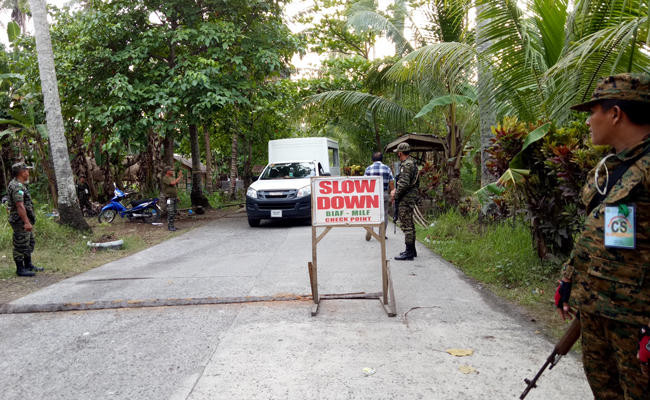
Checkpoint of the Bangsamoro Islamic Armed Forces — Moro Islamic LIberation Front in Camp Darapanan, Sultan Kudarat.
3 / 5
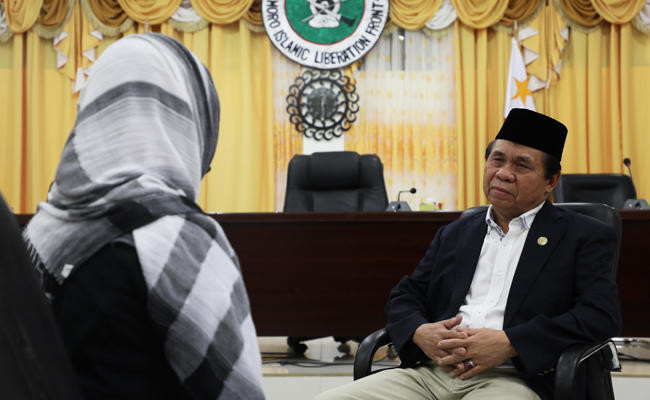
MILF Chairman Al Hajj Ebrahim Murad in an interview with Arab News in Camp Darapanan, Sultan Kudarat.
4 / 5
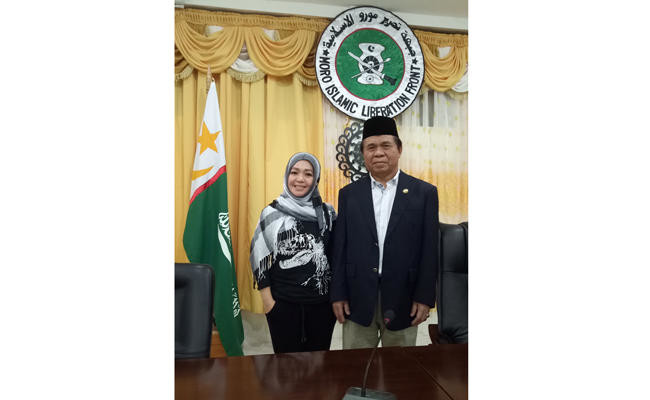
MILF Chairman Al Hajj Ebrahim Murad and Arab News correspondent Ellie Aben.
5 / 5
A peace landmark inside MILF base in Camp Darapanan, Sultan Kudarat.
Updated 09 April 2018
Follow

From foes to allies: MILF teams up with Philippine troops to foster peace in Mindanao

  • For five years now, there has been no incident or encounter between Philippine government forces and MILF fighters
  • Manila and the MILF are now working on the establishment of a 6,000-strong Joint Peace and Security Team

SULTAN KUDARAT, Philippines: For decades, the Moro Islamic Liberation Front (MILF) has waged war against the Philippine Government with the goal of winning independence for the country’s Muslim minority.
But for five years now, since the signing of the peace agreement in 2014, the MILF has managed to team up with government forces to help foster stability in southern Philippines.
And as both sides continue to work to end more than 40 years of conflict in Mindanao, a Joint Peace and Security Team (JPST) will be established composed of 6,000 combined government forces and members of the MILF — Bangsamoro Islamic Armed Forces (BIAF) to be deployed in conflict areas and conflict-vulnerable areas in Mindanao. The creation of the JPST is in line with the normalization aspect of the peace agreement between the Government of the Republic of the Philippines (GRP) and the MILF.
“Through the cease-fire committee and the International Monitoring Team (IMT), we manage to work side by side as partners in peace,” MILF Chairman Al Hajj Ebrahim Murad told Arab News when asked about their relationship with the Armed Forces of the Philippines (AFP).
“Even in cases where they are operating against drug syndicates, we can work together. So basically the relationship now is, say, there is partnership,” he added.
Murad notes that before the deployment of the IMT, “there is an off and on (fighting) on the ground.
“Sometimes there is fighting and then we resume at the negotiating table, then there will be another outbreak of fighting again. But after the deployment of the IMT, this gradually subsided,” he added. The IMT monitors and oversees the cease-fire process between the GPH and the MILF.
“So far, I think for about five years now, there is zero incident or encounter between the Armed Forces of the Philippines and our forces. Five years, yes,” Murad continued.
Eduardo Uy Guerra, chairman of the MILF committee on foreign affairs and co-chair of the Joint Normalization Committee (JNT), told Arab News that they are “very very careful because there’s potential spoilers of the agreement, especially when the decommissioning will start.” Guerra said this when asked what the MILF is doing to undermine radicalization in Mindanao.
“Of course we don’t like these things to happen ... that’s why we are now preparing for security,” he added.
“We are going to establish this Joint Peace and Security Team composed of 6,000 men to be deployed strategically in our areas to really safeguard the community. Three thousand on the side of the government (police and soldiers) and 3,000 on our side,” Guerra said.
“This is unique in the sense that we will be joining them in security and before we were enemies. It’s unique in the sense that before you become a policeman you need a college degree. For the Army, a minimum of secondary level is required. But for us (MILF), sometimes no 1,2,3, and no a,b,c but experience-wise we have a lot,” he continued.

Operating units
From the government side, Office of the Presidential Adviser on Peace Process (OPAPP) Assistant Secretary Dickson Hermoso, co-chair of the Joint Normalization Committee, explained that the JPST will have a total of 200 operating units, each composed of seven military, eight policemen, and 15 BIAF.
“They will be deployed in areas of conflict and vulnerable areas of conflict, in MILF communities. Because once the Bangsamoro Basic Law (BBL) is passed, the normalization process will go full blast. These 200 teams will fill the vacuum while we await the arrival of the Bangsamoro police,” he said.
Hermoso explained though that currently, there are already 30 small joint peace and security teams organized to help in the ceremonial decommissioning of MILF combatants in 2015.
“Right now, the GRP-MILF peace process is straddled until 2022. So the creation of these 200 peace and security teams is spread out until 2022, starting in the verification and then identification of combatants,” he said.
The OPAPP earlier said the JPST will be “part of the transitional mechanisms that will take key roles in the security aspect of the normalization process and will primarily be concerned with transforming conflict-affected areas into peaceful and sustainable communities.” The JPSTs will be deployed “in critical areas as agreed upon by both the government and the MILF to maintain peace and order.
Hermoso said the JPST will help address many issues in Mindanao, including extremism, private armed groups, warlords, and in the reduction and control of weapons and material. He expressed optimism that the creation of the JPST will be fulfilled as he looked forward to the signing of the BBL by May 31.
Murad, meanwhile, said the MILF is committed on working to address the issue of private armies in Mindanao. “Because we see that unless these private armies are disbanded, then there will be no real peace in the area. So we will work with the government,” he stressed.
He also emphasized the need to control the source of weapons in the region. One of the sources of these weapons, he said, is gun runners from neighboring countries.


Reference to Trump’s impeachments is removed from the display of his Smithsonian photo portrait

Updated 9 sec ago
Follow

Reference to Trump’s impeachments is removed from the display of his Smithsonian photo portrait

  • For now, references to Presidents Andrew Johnson and Bill Clinton being impeached in 1868 and 1998, respectively, remain as part of their portrait labels, as does President Richard Nixon’s 1974 resignation as a result of the Watergate scandal

WASHINGTON: President Donald Trump’s photo portrait display at the Smithsonian’s National Portrait Gallery has had references to his two impeachments removed, the latest apparent change at the collection of museums he has accused of bias as he asserts his influence over how official presentations document US history.
The wall text, which summarized Trump’s first presidency and noted his 2024 comeback victory, was part of the museum’s “American Presidents” exhibition. The description had been placed alongside a photograph of Trump taken during his first term. Now, a different photo appears without any accompanying text block, though the text was available online. Trump was the only president whose display in the gallery, as seen Sunday, did not include any extended text.
The White House did not say whether it sought any changes. Nor did a Smithsonian statement in response to Associated Press questions. But Trump ordered in August that Smithsonian officials review all exhibits before the nation celebrates the 250th anniversary of the Declaration of Independence on July 4. The Republican administration said the effort would “ensure alignment with the president’s directive to celebrate American exceptionalism, remove divisive or partisan narratives, and restore confidence in our shared cultural institutions.”
Trump’s original “portrait label,” as the Smithsonian calls it, notes Trump’s Supreme Court nominations and his administration’s development of COVID-19 vaccines. That section concludes: “Impeached twice, on charges of abuse of power and incitement of insurrection after supporters attacked the US Capitol on January 6, 2021, he was acquitted by the Senate in both trials.”
Then the text continues: “After losing to Joe Biden in 2020, Trump mounted a historic comeback in the 2024 election. He is the only president aside from Grover Cleveland (1837– 1908) to have won a nonconsecutive second term.”
Asked about the display, White House spokesman Davis Ingle celebrated the new photograph, which shows Trump, brow furrowed, leaning over his Oval Office desk. Ingle said it ensures Trump’s “unmatched aura ... will be felt throughout the halls of the National Portrait Gallery.”
The portrait was taken by White House photographer Daniel Torok, who is credited in the display that includes medallions noting Trump is the 45th and 47th president. Similar numerical medallions appear alongside other presidents’ painted portraits that also include the more extended biographical summaries such as what had been part of Trump’s display.
Sitting presidents are represented by photographs until their official paintings are commissioned and completed.
Ingle did not answer questions about whether Trump or a White House aide, on his behalf, asked for anything related to the portrait label.
The gallery said in a statement that it had previously rotated two photographs of Trump from its collection before putting up Torok’s work.
“The museum is beginning its planned update of the America’s Presidents gallery which will undergo a larger refresh this Spring,” the gallery statement said. “For some new exhibitions and displays, the museum has been exploring quotes or tombstone labels, which provide only general information, such as the artist’s name.”
For now, references to Presidents Andrew Johnson and Bill Clinton being impeached in 1868 and 1998, respectively, remain as part of their portrait labels, as does President Richard Nixon’s 1974 resignation as a result of the Watergate scandal.
And, the gallery statement noted, “The history of Presidential impeachments continues to be represented in our museums, including the National Museum of American History.”
Trump has made clear his intentions to shape how the federal government documents US history and culture. He has offered an especially harsh assessment of how the Smithsonian and other museums have featured chattel slavery as a seminal variable in the nation’s development but also taken steps to reshape how he and his contemporary rivals are depicted.
In the months before his order for a Smithsonian review, he fired the head archivist of the National Archives and said he was firing the National Portrait Gallery’s director, Kim Sajet, as part of his overhaul. Sajet maintained the backing of the Smithsonian’s governing board, but she ultimately resigned.
At the White House, Trump has designed a notably partisan and subjective “Presidential Walk of Fame” featuring gilded photographs of himself and his predecessors — with the exception of Biden, who is represented by an autopen — along with plaques describing their presidencies.
The White House said at the time that Trump himself was a primary author of the plaques. Notably, Trump’s two plaques praise the 45th and 47th president as a historically successful figure while those under Biden’s autopen stand-in describe the 46th executive as “by far, the worst President in American History” who “brought our Nation to the brink of destruction.”