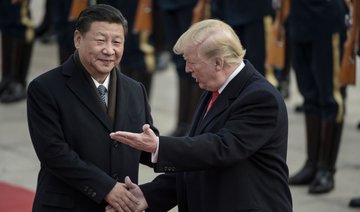
PORT MORESBY: Leaders from 21 Asia-Pacific nations battled to paper over gaping differences Sunday after an unusually sharp exchange of words between the group’s two most powerful members, the United States and China.
With just hours of the two-day summit remaining, officials were still scrambling to forge enough of a consensus to issue a formal joint statement and were admitting privately that it might not be possible, amid yawning differences on trade policy.
The annual gathering has been overshadowed by speeches on Saturday from Chinese President Xi Jinping and US Vice President Mike Pence, which appeared to represent competing bids for regional leadership.
Pence warned smaller countries not to be seduced by China’s massive Belt-and-Road infrastructure program, which sees Beijing offer money to poorer countries for construction and development projects.
The “opaque” loans come with strings attached and build up “staggering debt,” Pence charged, mocking the initiative as a “constricting belt” and a “one-way road.”
He urged nations instead to stick with the United States, which doesn’t “drown our partners in a sea of debt” or “coerce, corrupt or compromise your independence.”
In a speech to business leaders just minutes before Pence, Xi insisted the initiative was not a “trap” and there was no “hidden agenda” — amid criticism that it amounts to “chequebook diplomacy” in the region.
Xi also lashed out at “America First” trade protectionism, saying it was a “short-sighted approach” that was “doomed to failure.”
The feisty barbs on a gleaming white cruise ship moored in Port Moresby set the scene for a potentially fiery meeting between Xi and US President Donald Trump at the G20 summit in Argentina at the end of this month.
But Xi and Pence, who both wore shiny, red shirts provided by the Pacific island did hold talks on Saturday night at the leaders’ gala dinner.
Pence told reporters on Sunday: “I spoke to President Xi twice during the course of this conference. We had a candid conversation.”
He told him that the US is interested in a better relationship with China “but there has to be change” in Beijing’s trade policies.
With fears that a trade war between the two rivals could cripple the Pacific Rim economy, some attendees voiced concern about the growing rivalry for influence in the region.
“Business leaders do not want to speak out, but behind the scenes here, they are talking over dinner saying ‘how has this happened’?” said Denis O’Brien, the billionaire chairman of Digicel.
“It’s a very forced situation, one country is trying to force all the other countries to change tariffs agreed over years,” O’Brien told AFP.
Trump — and Russian President Vladimir Putin — both decided to skip the gathering, leaving the spotlight on Xi who arrived two days early to open a Chinese-funded school and road in Papua New Guinea’s dirt-poor capital Port Moresby.
Xi has been the star of the show, front and center at official photos whereas Pence has kept a lower profile, only deciding at the last minute to stay overnight in Port Moresby — shelving original plans to fly in and out from Cairns in Australia.
As if to counter Chinese largesse, the US, Australia, New Zealand and Japan on Sunday announced a project to boost electricity capacity in Papua New Guinea.
The project aims to raise the percentage of the PNG population with access to electricity from 13 percent to 70 percent.
And as the US and China vie for influence in the region, the statement dangled the prospect of similar projects for countries that “support principles and values which help maintain and promote a free, open, prosperous and rules-based region.”
With the official business of the summit relatively low-key, much of the focus has been on the unlikely venue of Port Moresby, which is hosting its first international event of this scale.
There were reports of an incident where police were called when Chinese officials attempted to “barge” into the office of Papua New Guinea’s foreign minister, it emerged Sunday, as APEC summit tensions boiled over.
The Chinese delegates “tried to barge in” to Rimbink Pato’s Port Moresby office Saturday, in an eleventh-hour bid to influence a summit draft communique, but were denied entry, three sources with knowledge of the situation told AFP.
“Police were posted outside the minister’s office after they tried to barge in,” one source privy to summit negotiations told AFP, requesting anonymity.
The diplomatic incident came with tensions already high at a summit of Asian-Pacific leaders that has been overshadowed by a spat between the United States and China.
Pato had refused to meet with the delegates, according to a source, who said: “It’s not appropriate for the minister to negotiate solo with the Chinese. The Chinese negotiating officials know this.”
The minister himself sought to downplay the incident, telling AFP: “There wasn't an issue.”
Asked about the incident, Chinese foreign ministry official Zhang Xiaolong told reporters: “It’s not true. It’s simply not true.”
The city is on lockdown with hundreds of police and military patrolling the streets of the notoriously crime-ridden capital.
Warships are stationed just off the coast to provide security for the leaders, and delegates and media have been housed in enormous cruise ships due to a dearth of hotel rooms.