

Archeologists discover pregnant woman with fetus in Ancient Egyptian burial site

1 / 3
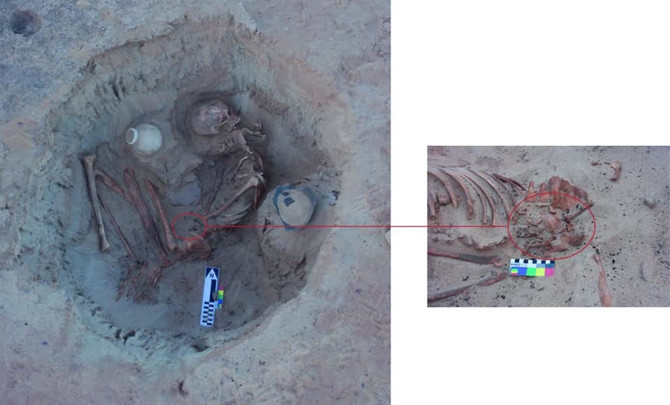
The skeleton of the woman and her unborn child found in Kom Ombo near Aswan. (Egyptian Ministry of Culture)
2 / 3
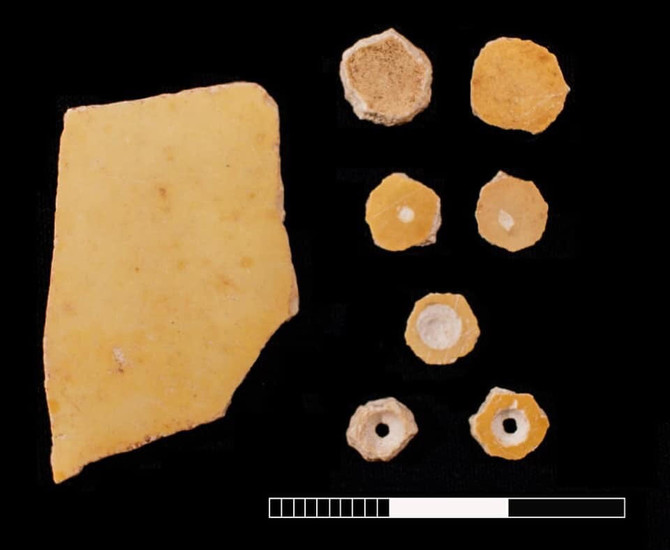
Pottery found in the grave in Kom Ombo near Aswan. (Egyptian Ministry of Culture)
3 / 3
Pottery found in the grave in Kom Ombo near Aswan. (Egyptian Ministry of Culture)
Updated 17 November 2018
Follow

Archeologists discover pregnant woman with fetus in Ancient Egyptian burial site

  • The woman was found in a grave-pit, inside a small cemetery, with the skeletal remains of the unborn baby still in her stomach
  • The grave in Kom Ombo, in Aswan province, is more than 3,500 years old

CAIRO: An Italian-American mission has discovered an ancient tomb containing a pregnant woman and her fetus during an archaeological dig in southern Egyp

The woman was found in a grave-pit, inside a small cemetery, with the skeletal remains of the unborn baby head facing down still in her stomach, the Egyptian Ministry of Antiquities said.

The grave in Kom Ombo, in Aswan province, is more than 3,500 years old, Dr. Mostafa Waziri, the General Secretary of the Supreme Council of Antiquities, said on Wednesday. 

The study found the woman was around 25 years old when she died, and her death could have been due to a problem with her pregnancy.

That the baby was positioned head-down, meant the team believed the mother and child could have died during childbirth.

“There’s something very poignant and quite sweet about it, but also very sad,” Nigel Hetherington, an Egypt-based archaeologist and heritage consultant said about the find.
The find was made by the Aswan-Kom Ombo Archaeological Project (AKAP), led by Yale University and University of Bologna. The project has investigated selected areas in the Aswan-Kom Ombo region since 2005.

Preliminary analysis of the mother’s corpse also revealed that the woman’s pelvis was misaligned, which could have been a fracture that hadn’t healed properly.

Waziri said the injury could have been the cause of the labor problems.

The skeleton in the grave pit was found wrapped in a leather burial shroud.

There were also two pottery vessels in the grave – one a small jar, the other a fine bowl that appeared to have once been polished in red on the outside, and black on the inside, a Nubian style; this kind of vessel was popular in nomadic communities. 

The vessels were presumed to be offerings carried into the woman’s afterlife. This was why ancient Egyptians tended to pray to female deities like Hathor, Taweret, and Bes.

The archaeological mission also found numerous unfinished ostrich eggshell beads and black fragments, which Dr. Waziri also speculated was an offering.

Scholars think that beads were being offered to the woman because she could have been a bead maker for a living.

“The beads were common, but they were for the burial for the poor, since they weren’t gold beads, it makes sense,” Ahmed Salah, an Egyptology graduate from the American University of Cairo, told Arab News.

Kom Ombo is about 48 kilometers north of Aswan, east of the Nile River.

Recently, three tombs of cats were also found at a pyramid complex in Saqqara, Egypt, as well as four other sarcophagi at Khufu-Imhat’s site.

Egypt Ministry of Antiquities has been revealing many ancient Egyptian discoveries recently.

Egypt is trying to boost tourism, which is on the rise after significantly dropping since the 2011 Arab Spring.


Palestinians evacuate homes in Silwan following collapse blamed on Israeli excavations

Updated 14 sec ago
Follow

Palestinians evacuate homes in Silwan following collapse blamed on Israeli excavations

  • Ground under 3 adjacent houses caves in resulting in severe structural cracks and the collapse of a room in one of the properties
  • Israel has been carrying out excavations beneath Silwan since 2007 to create an underground tourist attraction called ‘City of David’

LONDON: Palestinian residents were forced to evacuate three homes in Silwan, a neighborhood in the south of occupied East Jerusalem, on Monday after the ground beneath them caved in, reportedly as a result of decades of Israeli excavations in the area.

The Palestinian Authority’s Jerusalem Governorate said a retaining wall collapsed on Sunday and the ground beneath three adjacent homes belonging to the Abu Sbeih family gave way. This resulted in severe structural cracks and the collapse of a room in one of the houses.

Residents said they had repeatedly notified the Israeli Jerusalem Municipality about urgent safety concerns, but no preventive measures were taken to prevent a collapse, the Palestinian Wafa news agency reported.

Fawaz Abu Sbeih said cracks in the walls of his house were the result of Israeli excavations in the ground beneath and around the property. Since 2007, the Israel Antiquities Authority and settler group the Elad Association, also known as the Ir David Foundation, has been excavating under Silwan to create an underground tourist attraction called the “City of David.”

A recent storm and heavy rains in Jerusalem accelerated the collapse, said Abu Sbeih, who added that Israeli authorities require residents to obtain permits before maintenance work to reinforce building foundations can be carried out.

The excavations in Silwan have affected many residents, some of whom face eviction orders from Israeli authorities for building without permits.

Jerusalem Governorate described ground collapses in Silwan as part of Israel’s “systematic policy of forced displacement based on dangerous colonial excavations and the deliberate neglect of their impact on the homes of Jerusalemites, while simultaneously preventing Jerusalemite families from repairing or reinforcing their homes.”