NEW DELHI: A cyclone made landfall in the southern Indian state of Tamil Nadu on Friday, killing at least 11 people, uprooting trees and knocking down electricity poles after more than 80,000 people were moved out of its path to safety, officials said.
Cyclone "Gaja" made landfall in the early hours of Friday but then weakened as it moved inland, K. J. Ramesh, director general of the state-run India Meteorological Department, told Reuters.
Eleven people were known to have been killed, said an official from the Tamil Nadu State Disaster Management Authority.
The state government has set up more than 470 relief camps and had evacuated more than 80,000 people from their homes in vulnerable areas, said the official who declined to be identified as he is not authorised to speak to media.
Tamil Nadu Chief Minister Edappadi K Palaniswami announced compensation of 1 million rupees ($14,000) for the families of those killed.

Cyclone 'Gaja' makes landfall in south India, kills 11 people
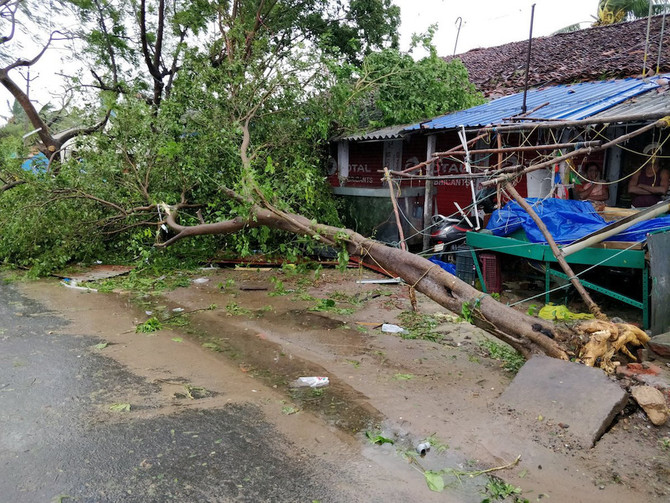
- Tamil Nadu Chief Minister Edappadi K Palaniswami announced compensation of 1 million rupees ($14,000) for the families of those killed
- The state government has set up more than 470 relief camps and had evacuated more than 80,000 people from their homes in vulnerable areas
Venezuela advances amnesty bill that could lead to mass release of political prisoners
- Such an amnesty is a central demand of the country’s opposition and human rights organizations with backing from the United States
CARACAS: Venezuela’s legislature on Thursday advanced an amnesty bill proposed by acting President Delcy Rodríguez that could lead to the release of hundreds of opposition leaders, journalists and human rights activists detained for political reasons.
Such an amnesty is a central demand of the country’s opposition and human rights organizations with backing from the United States. But the contents of the bill have not been released publicly, and rights groups have so far reacted with cautious optimism — and with demands for more information.
The bill, introduced just weeks after the US military captured then-President Nicolás Maduro, still requires a second debate that has yet to be scheduled. Once approved, it must be signed by Rodríguez before it can go into effect.
In announcing the bill late last month, Rodríguez told a gathering of justices, magistrates, ministers, military brass and other government leaders that the ruling party-controlled National Assembly would take up the legislation with urgency.
“May this law serve to heal the wounds left by the political confrontation fueled by violence and extremism,” she said in a pre-taped televised event. “May it serve to redirect justice in our country, and may it serve to redirect coexistence among Venezuelans.”
Rights groups, fearing some political detainees will be excluded, want more details about the requirements for amnesty before any final vote.
The Venezuelan Program for Education-Action in Human Rights, or PROVEA, issued a statement emphasizing that the bill must be made public urgently due to its potential impact on victims’ rights and broader Venezuelan society.
Based on what is known so far about the legislation, the amnesty would cover a broad timeline, spanning the administration of the late Hugo Chávez from 1999 to 2013 and that of his political heir, Maduro, until this year. It would exclude people convicted of murder, drug trafficking, and serious human rights violations, reports indicate.


