KARACHI: From thirty to three. That’s how many acres of land Aziz Sarpara is left with to cultivate his crops on.
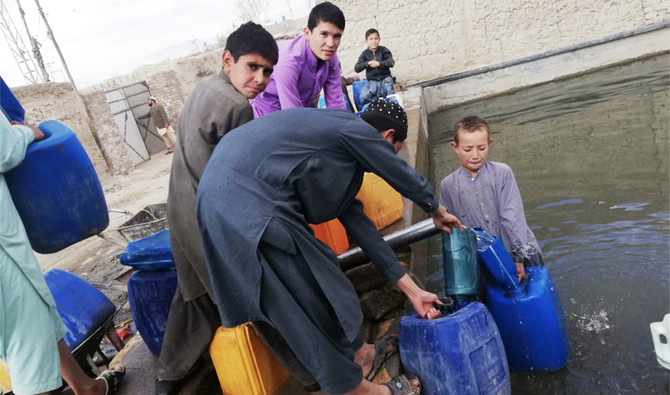
Reminiscing a time when, five years ago, there was ample rain in the province to ensure a healthy and abundant yield, Sarpara — a farmer from Mastung Balochistan — said that today, a lack of rain in the past several years has created a drought-like situation in the area, with residents struggling to find even a few drops of clean water for consumption.
And while Balochistan continues to dominate headlines for the multi-billion dollar China-Pakistan Economic Corridor project which is being constructed in the province, locals complained that the ground reality couldn’t be farther from the truth. “We are afraid if the droughts continue, the people of this province will find no drinking water in the near future. We are steadily going toward a waterless Balochistan,” Sarpara, who like other farmers in his community grows onions, tomatoes, wheat, and apples for a living, told Arab News.
If his predictions do come true, this wouldn’t be the first time that the province would be in dire straits. Between 1997 and 2002, Balochistan went through a drought which was termed as the worst in the history of the province, causing a loss of Rs25 billion to the national exchequer, according to data released by the Ministry of Finance for that period.
Senator Usman Kakar, who chairs the Senate’s committee for less-developed areas, said that the drought destroyed eight percent of the nearly 10,000 fruit gardens in the province which was home to nearly 10 million fruit trees.
“The drought also killed the livestock, which was Pakistan’s best in the Pashtun belt of Balochistan,” Kakar said, criticizing the government for its lack of planning in trying to avert a similar crisis. He added that more than 5,000 spring wells had also dried up in the area, even as forest cover was getting depleted by the day.
Analyzing the impact of the weather patterns on Balochistan, Sarpara said: “The climate of Balochistan started changing in 1997 but it was some five years ago when we started losing agricultural lands and livestock.” To make matters worse, he said if the current situation continues and the government doesn’t take immediate action, the province would soon be depleted of its drinking water sources.
Senator Kakar added that it was not just the agricultural sector or livestock which was being impacted, but people’s health conditions, too, with thousands — especially women and children — being diagnosed with Crimean Congo Hemorrhagic Fever, malnutrition, tuberculosis, and hepatitis.
Noting that those who had up to 100 goats were now keeping only two or three due to water scarcity and subsequent loss of land for the animals to graze on, Sarpara said he feared the day is not far when the “underground water would finish soon too”.
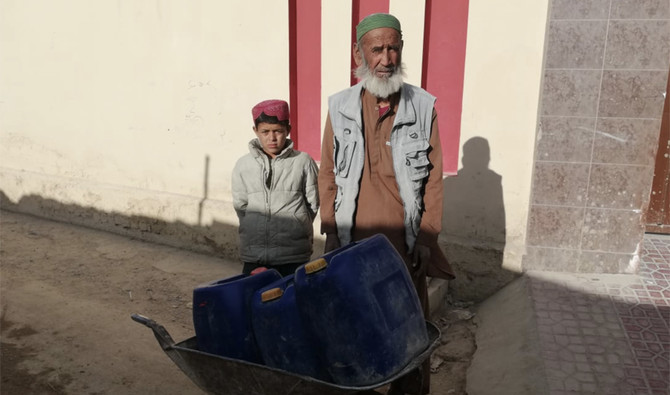
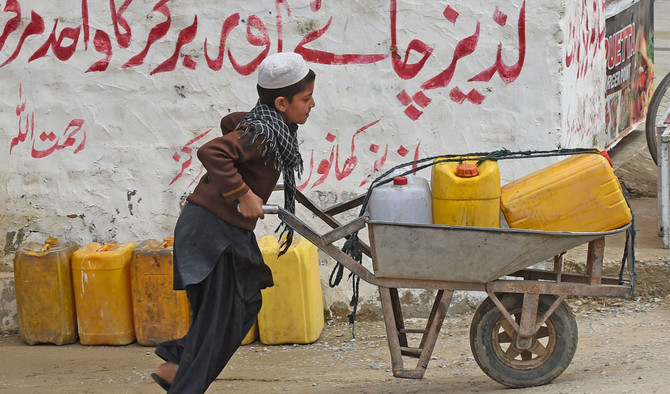
Ghulam Muhammad, a resident of Nawa Kili in Quetta, travels nearly four kilometers every day to source water for his family of 11. He said that drinking water has become scarce for residents of his neighborhood. “The water that we draw from the well is undrinkable so we have to travel miles away to get drinkable water,” he said.
According to the website of the province’s disaster management authority, the worst-hit areas of Balochistan include Kharan, Sibi, Killa-Saifullah, Washuk, Mastung, Barkan, Chagai, Kalat, Ziarat, Nushki, Khuzdar, Punjgoor, Lasbella, Kech, Musa Khail, Gwadar, Killa Abdullah, Awaran, Jhal-Magsi, Bolan, Dera-Bugti, Kohlu, and Sherani.
Last week, the Balochistan Assembly unanimously passed a resolution urging the federal government to declare all drought-stricken areas in the province as calamity affected. Endorsing the resolution, Senator Kakar suggested short-term solutions such as ensuring a steady supply of food was supplied to the people and their livestock was looked after. “In the long term, we need to reserve the waters. Hundreds of small dams and reservoirs should be built to store 12 billion acre-feet water from being spoiled during rains,” he said.
Hajji Lashkari Raisani, former senator and leader of the Balochistan National Party- Mengal, suggested that since the amount accumulated in the Supreme Court-Prime Minister Fund was insufficient to build the Basha and Mohmand dams, the same amount could be diverted to Balochistan for the construction of smaller reservoirs. “For resolving the water issues the province also needs to be freed of hundreds of thousands of refugees who are drinking our waters beside using other resources,” Raisani told Arab News.
“Over the years, the water table has fallen in Balochistan due to a reduction in rainfall and unchecked extraction of water through tube wells,” Adnan Amir, a Quetta based analyst, said.
The lack of political will and financial support are significant constraints to dealing with the drought and its impact, he added. “Government allocates a budget for dams every year but so far there is no major effort to recharge the water table,” he said.


![]()
![]()
![]()
![]()

Balochistan’s “worst drought” pushes province into untested waters

Balochistan’s “worst drought” pushes province into untested waters
- Government seeks helps from Islamabad, international donors to reverse the crisis
- Farmers rue the loss of crop; say no measures in place to avoid calamity
Latest updates


© 2026 SAUDI RESEARCH & PUBLISHING COMPANY, All Rights Reserved And subject to Terms of Use Agreement.