


MANILA: Philippine authorities on Monday said tons of garbage shipped into the country last July will be sent back to South Korea.
They stressed that the Philippines is not, nor will will they allow it to be, a dumping site of foreign waste.
“We will ask the shipper to take the shipment back to where it came from. That is the recommendation of the sub port collector — to have it shipped back out to the country of origin (South Korea) — so the Philippines will not become a dumping site (of foreign waste),” Bureau of Customs (BoC) spokesperson Atty. Erasto Austria told Arab News.
He added that whoever was responsible for shipping the 51 container vans full of solid waste from South Korea will face appropriate charges.
The shipment, he said, was wrongfully declared as synthethic plastic flakes but upon examination, it turned out that the vans contained garbage. Austria added that an investigation was now being conducted at ground level.
When asked if the Philippines would file a diplomatic protest to the South Korean government, the BoC spokesperson said they were considering getting in touch with the South Korean authorities. However, he also pointed out that insofar as the BoC is concerned, it is the importer or the consignee who should be held liable, not the government of South Korea.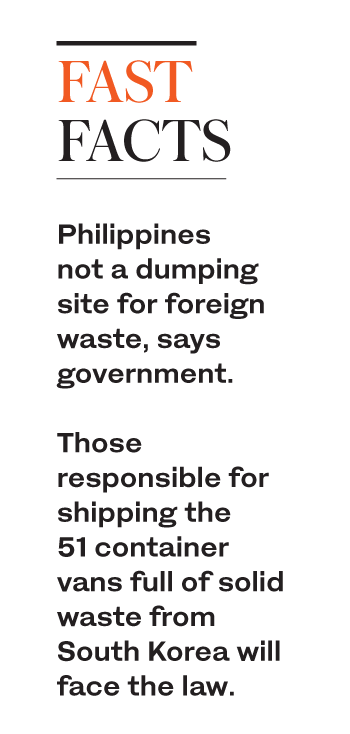
“The BoC does not condone this act and we will hold them (the importers) liable for this. It will be the importer who must face the appropriate charges since they are the ones who committed a violation by misdeclaring the commodities,” Austria said, referring to the Verde Soko Philippines Industrial Corporation.
“As far as the shipper is concerned, we can only ask them to take it back,” he continued.
Waste shipment
According to a “request of alert order” issued by the Customs Intelligence and Investigation Service of the BoC in Cagayan de Oro City, the shipment of garbage wrongfully declared as “plastic synthetic flakes” arrived at the Mindanao container terminal in Misamis Oriental from South Korea on board “MV Affluent Ocean” on July 21. The shipment was consigned to Verde Soko Phil. Industrial Corp.
However, the discovery of the misdeclared shipment came only this month.
“What were declared as synthetic plastic flakes are actually trash and other waste materials. A clear violation of the Customs Modernization and Tariff Act (CMTA),” said a report by John Simon, port collector at Mindanao International Container Terminal, to BoC Commissioner Rey Leonardo Guerrero.
“The shipment is now under an alert order issued by the district collector of the port of Cagayan de Oro and will undergo 100 percent physical examination. This shipment from Korea can be considered the biggest shipment of waste that has entered the country,” the report added.
Following the discovery of the shipload of the misdeclared shipment, the EcoWaste Coalition, an environmental organization, renewed its call for the government to ban plastic waste imports and for domestic industries requiring plastic scrap inputs to source their supplies locally.
This, as it denounced the latest entry of garbage from another country. “We find this latest incident of plastic waste dumping outrageous and unacceptable. Why do we keep on accepting garbage from other countries when we know that our country’s plastic waste, which is literally everywhere, is spilling to the oceans and endangering marine life?” said Aileen Lucero, national coordinator, EcoWaste Coalition.
“We also find it ironic that while South Korea is taking action to control its plastic waste, including banning plastic bags in supermarkets starting October this year, its unwanted plastics are being sent abroad,” she said.
“It’s high time for the Philippines to disallow garbage imports and to demand that developed countries, as well as manufacturers of plastics and other disposable goods, take full responsibility for their products throughout their whole life cycle,” Lucero continued.
The incident is not the first time that garbage from another country was shipped to the Philippines. Lucero notes that the illegal garbage shipments from Canada misrepresented as recyclable plastic scraps, which are still in the Philippines, are a stinking reminder of how disadvantageous and unjust global waste trade is.
According to the EcoWaste Coalition, barring the importation of plastic garbage should form part of the government’s efforts to improve existing regulations “to avoid a repeat of the Canadian garbage saga.
“Imposing an import ban on scrap plastics may even prompt local industries to seek ways to retrieve locally generated plastic discards,” which can help in reducing the amount of plastics leaking to water bodies,” the group added.
The EcoWaste Coalition made the call after China announced that it would prohibit the importation of scrap plastics and other wastes by January 2018 “to protect China’s environmental interests and people’s health.”
The government of Malaysia announced last month that it will phase out in three years the importation of all types of plastic waste following the Chinese ban on waste imports.
Meanwhile, a lawmaker from Iligan City, Rep. Frederick Siao, called for the shutdown and asset seizure of the Verde Soko Philippines Industrial Corporation, and for the filing of appropriate charges against all its officers and supervisors.
“We want these culprits on the hold departure list to prevent their escape through our international airports and seaports,” said Siao.


