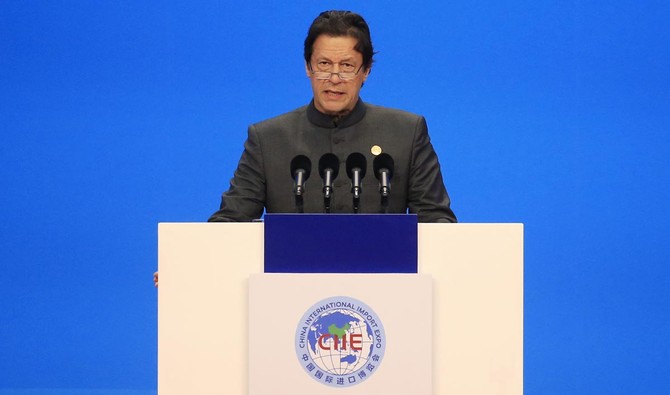
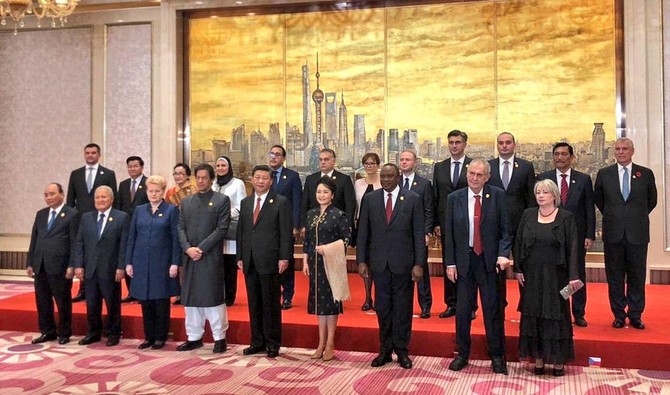
ISLAMABAD: Prime Minister Imran Khan said Monday his government will make Pakistan a better place for business and investment, as he concluded his first official visit to China.
He was speaking at China’s first international import expo, which is being held in Shanghai.
Beijing has pledged billions of dollars to build power stations, highways, railways and ports in Pakistan as part of an economic corridor, a key part of President Xi Jinping’s ambition to link China with Eurasia.
Khan said the China-Pakistan Economic Corridor (CPEC) will have an impact on other regions as it will cut distances and costs, bringing much-needed resources to manufacturers and products to consumers.
“CPEC is a mechanism to forge even closer connectivity between different regions including the Middle East, central and South Asia,” he added.
He also said that while unilateral commercialism is aggressively sought by some and protectionism is on the rise, “Pakistan takes great comfort in President Xi’s courageous statement that their doors will never shut but will only open even wider.”
The aim of the Expo is take practical steps to expand financial opening-up and there are huge gains to be made.
Xi told the opening ceremony that imported goods and services are estimated to exceed $30 trillion and $10 trillion in the next 15 years, Chinese state media reported.
Khan said the expo will help spread the dividends of free trade among more closely integrated economies.
His China visit concludes Monday.
On Sunday both countries issued a joint statement strengthening their cooperative partnership and expanding cooperation on the China-Pakistan Economic Corridor (CPEC).
They also signed 15 bilateral cooperation agreements and memorandums of understanding.

Pakistan to be ‘better place for business’ PM Khan tells China
- Government will make country more conducive and competitive place for business and investment, PM Khan
- China Expo will help spread dividends of free trade among more closely integrated economies
Pakistan seeks operationalization of World Bank’s $20 billion framework to advance reform priorities
- Pakistan’s finance chief meets World Bank Country Director Bolormaa Amgaabazar in the capital
- The Bank’s 10-year Country Partnership Agreement for Pakistan was approved in January last year
ISLAMABAD: Pakistan’s Finance Minister Muhammad Aurangzeb on Wednesday called for the operationalization of the World Bank Country Partnership Framework (CPF) to advance the government’s key reform priorities during a meeting with the Bank’s country director, according to a statement.
The Bank’s Board of Directors approved a 10-year CPF deal with Pakistan, indicating $20 billion in financing for Pakistan under the framework. The amount will include public and private financing from the World Bank Group, with roughly half expected to come from private-sector operations led by the International Finance Corporation (IFC).
“The Finance Minister emphasized the importance of effective operationalization of the CPF, particularly in priority areas such as population management and climate change,” the finance ministry said in a statement after Aurangzeb’s meeting with the Bank’s Country Director Bolormaa Amgaabazar.
“He underscored the need for strong coordination between federal and provincial governments to ensure coherence in policy design and implementation.”
Discussions focused on population, human capital development, climate resilience, agricultural reform and energy sector sustainability, it added.
The ministry said both sides exchanged views on enhancing institutional coordination, improving transparency in project design and strengthening monitoring mechanisms to deliver intended outcomes. It highlighted that the World Bank expressed readiness to continue supporting agricultural transformation efforts in collaboration with the IFC.
“Both sides agreed to continue technical-level engagements to explore feasible solutions in line with Pakistan’s reform agenda and fiscal framework,” the finance ministry added.
Climate resilience and population control are major concerns for policymakers in Pakistan, a country whose population exceeds 241 million, making it the world’s sixth-most populous country. Limited infrastructure, health care, and educational opportunities place added strain on public services, contributing to unemployment and poverty.
The South Asian nation is also among the countries most affected by climate change. Unusually heavy monsoon rains in 2022 killed more than 1,700 people and caused over $30 billion in damages. Torrential rains and floods since late June last year have claimed more than 1,000 lives, as authorities continue surveys to assess the full extent of the destruction.


