



KARACHI: Shortly after news of Maulana Sami-ul-Haq’s murder broke, Majeed Qarar, the cultural attaché at the Afghanistan embassy in the US, went live on his personal Facebook page to congratulate Afghans on his death.
“I felicitate all Afghans on the death of Sami-ul-Haq. May many such events come in our lives. Although he never put up arms against us, his religious verdicts and his seminary has caused thousands of deaths in Afghanistan,” Qarar said in Pashto. Hundreds of Qarar’s followers joined him in the celebrations.

October 1989, with a US Congressman during a visit to Washington. (Photo courtesy: Maulana Samiul Haq’s Book)
Haq, chief of his own faction of the Jamiat Ulema-e-Islam (JUI-S), was killed in a knife attack, at his residence in Rawalpindi, on Friday.
On the other end of the spectrum were those who were mourning the loss of a man who was commonly known as the “Father of the Taliban”. Messages of condolences poured in, including those from the president and prime minister of Pakistan and several other leaders from various religious and political parties, who termed Haq’s death as “a huge loss” for the country.
On Saturday morning, the Afghan Taliban also issued a statement offering their condolences to his “family, party workers, religious circles and the Muslim Ummah”.
“Shaheed (martyr) Maulana Sami-ul-Haq had devoted his entire life to serve the religion through education and politics, and he got martyred in the same way,” Zabihullah Mujahid, a Taliban spokesperson, said, adding that those who killed Haq were “enemies of Islam”.
He added that Haq offered “unforgettable services” against the “the oppression of the Soviet Union and the American occupation” and had always spoken up against the “oppression of the Afghan people”.
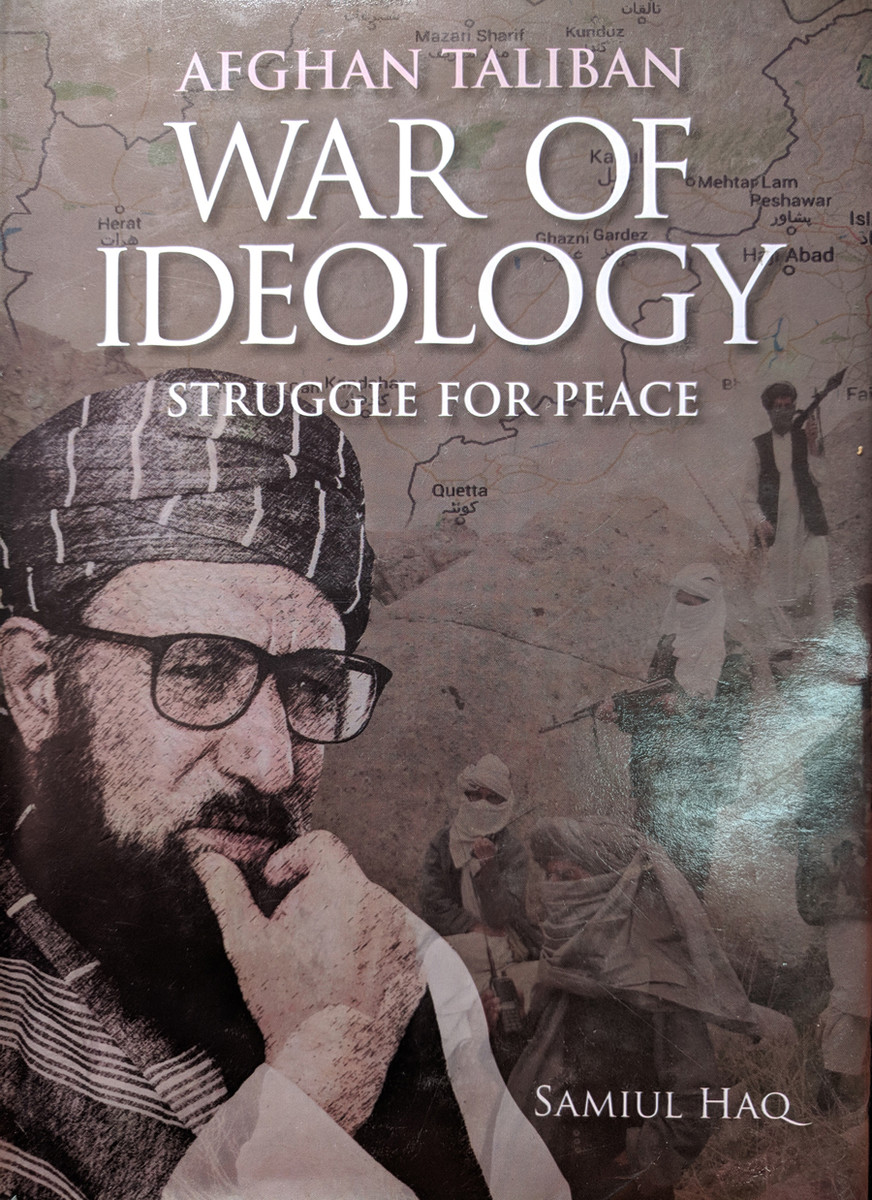
Even as the pro-Taliban cleric was a villain for some, Haq was a hero for several others. An analysis of the “Afghan Taliban War of Ideology: Struggle for Peace” – a book which he authored in 2015 – throws light on his own views about that chapter of war, wherein he dismisses allegations of the military’s support and training the Taliban, reasoning that he was proud to be their mentor.
Haq wrote that nearly 20,000 students from Afghanistan had graduated from his seminary in the past 50 years. “According to an estimate about 90% of Taliban (in the Afghan government) are graduates of Darul Uloom. We can say that 90% of religiously educated persons who graduated from here are the wards of Haqqania graduates. It would not be wrong to say that the Haqqania is the nursery of Taliban,” excerpt from the book read.

August 28-29, 2013, at a polio eradication meeting in Jeddah along with Senior Arab Scholars. (Photo courtesy: Maulana Samiul Haq’s Book)
He added that even though the deceased Taliban chief had got no military training from the Haqqania, “we are proud of Mullah Omar for being our student”. “No Taliban of Pakistani madaris were asked or ordered to go for jihad to Afghanistan in support of Mullah Omar. According to my knowledge there is no example or proof of any non-Afghan Taliban [Students] who fought in support of Taliban. Afghan national were allowed to return home to participate in the war on the request of the Taliban government,” he said.
He goes on to add that no students were sent or compelled to join the war. “There is only one case of calling the students by Mullah Omar in Afghanistan to help the government,” he said, adding that after the Taliban’s failure to takeover Mazar Sharif, “we received a request from Afghan government (Taliban) for granting leave for two weeks to all Afghan students and to allow them to come to the aid of their country”.
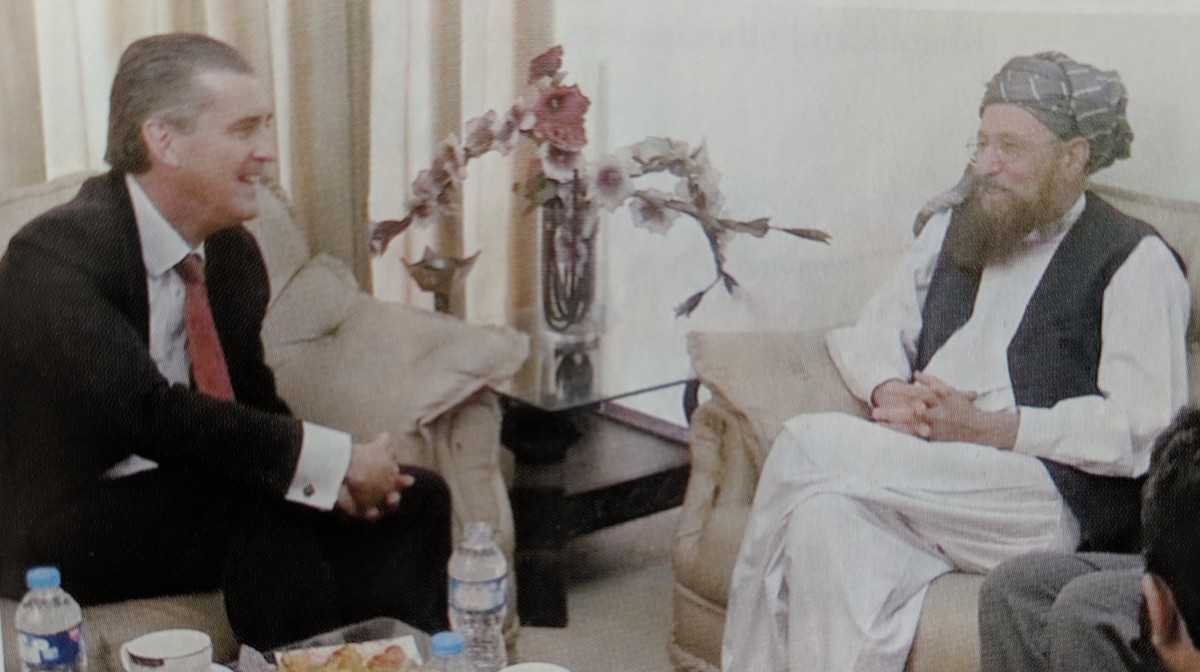
July 10, 2014, meeting with US ambassador RICHARD Olson at his house in Islamabad. (Photo courtesy: Maulana Samiul Haq’s Book)
He refuted claims that the seminary was a training ground for Taliban. “We do not have such teachers, weapons, facilities,” he said, adding that the Western media has verified this claim. Instead, he said: “Taliban got such trainings with US weapons during Afghan-Russia war. These Taliban are the wards of Afghan war leaders.”
Haq was born on December 18, 1937, at Akora Khattak and grew up in the spiritual surroundings of Darul Uloom Haqqania. According to Haq, he would assist his mother and grandmother in preparing food for the seminary’s students. “I completed my basic education from Darul Uloom Haqqania and got a degree of Dars-e-Nizami before shifting to Qasimul Uloom Lahore where I received a degree in the commentary of the Holy Qur’an from Maulana Ahmad Ali Lahori.”
“I have the honor of being awarded a degree of honor from Medina University of Saudi Arabia and from Darul Uloom Deoband, India,” he writes.
After graduating from the varsity, he was appointed as a faculty member at the Darul Uloom Haqqania. When his father was elected as a member of the parliament in 1970, he assigned Haq with the administrative responsibilities of the seminary. “I continued to assist my father till his death in 1988,” he said.

1985, on the war front in Afghanistan against the USSR. (Photo courtesy: Maulana Samiul Haq’s Book)
After that Haq was appointed as the chancellor of the Haqqania in 1988 — a position which he continued to serve in until his death on Friday. He served as a member of Majlis-e-Shoura for General Ziaul Haq from 1983-1985. In 1985, he was elected as a member of Pakistan’s Senate where he served for two terms. “I have stood firm during times of chaos and never compromised in challenging and objecting the Americans and always witnessed the truth. I and Darul Uloom became the focus of world media because of being the mother institution of Taliban,” he wrote.


