

Christian woman’s fate in limbo as Pakistan reaches deal with ‘extremists’

Protests broke out in Pakistan after the court acquitted Asia Bibi, a Christian woman accused of blasphemy. (AP)
Updated 04 November 2018
Follow

Christian woman’s fate in limbo as Pakistan reaches deal with ‘extremists’

  • Members of the extremist Tehreek-e-Labbaik (TLP) group launched massive protest actions after the Supreme Court reversed a blasphemy conviction against Christian woman Asia Bibi
  • The protests ended on Friday night after the government reached a deal to put Bibi on the ECL  and said it would not object to an appeal against the verdict.

ISLAMABAD: A Pakistani Christian woman acquitted in a blasphemy case faced uncertainty on Saturday after the government put her on the exit-control list (ECL), which prohibits her from leaving the country, and told religious hardliners that it would not object to an appeal against her acquittal.

Asia Bibi’s lawyer left Pakistan on Saturday after threats to his life. Bibi, who had been on death row since 2010, was acquitted of all charges by the Supreme Court on Wednesday, triggering three days of protests that blocked roads and disrupted traffic in major cities.

The protests ended on Friday night after the government reached a deal to put Bibi on the ECL  and said it would not object to an appeal against the verdict. 

The Supreme Court acquitted her on Wednesday and ordered her immediate release, saying the prosecution had “categorically failed to prove its case beyond reasonable doubt.”

Christian activist Anjum Paul told Arab News: “The government unfortunately gave in to the extremists, and this isn’t a good sign for the state. It has been four days since the court verdict, and Bibi is yet to be released from prison.”
Paul demanded her immediate release, saying: “The agreement is tantamount to giving license to religious extremists to continue their activities against minorities with impunity.”

He added: “Pakistan is for everybody. It doesn’t discriminate against people on the basis of their religion, though a small segment of extremists does, which needs to be controlled through strict enforcement of the law.”

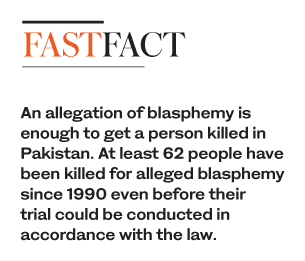
An allegation of blasphemy is enough to get a person killed in Pakistan. 

According to the court ruling in Bibi’s case, at least 62 people have been killed for alleged blasphemy since 1990 “even before their trial could be conducted in accordance with the law.”

Prof. Tahir Malik, an academic and analyst, told Arab News that the government should have resisted the “fundamentalists” instead of “capitulating to them.”

He said: “A dangerous trend has been set to let the fundamentalists go scot-free, even if they incite violence and hatred against state institutions.” 

Malik added: “The writ of the state was virtually trampled in the three-day protests, but the government is celebrating its so-called success in dispersing them.”

He urged the government to register cases under incitement and treason charges against leaders of Tehreek-e-Labbaik (TLP), and make them pay compensation to those whose properties were vandalized.

“The state should get its act together as early as possible to avoid any future hooliganism,” he said.


Bangladesh halts controversial relocation of Rohingya refugees to remote island

Updated 29 December 2025
Follow

Bangladesh halts controversial relocation of Rohingya refugees to remote island

  • Administration of ousted PM Sheikh Hasina spent about $350m on the project
  • Rohingya refuse to move to island and 10,000 have fled, top refugee official says

DHAKA: When Bangladesh launched a multi-million-dollar project to relocate Rohingya refugees to a remote island, it promised a better life. Five years on, the controversial plan has stalled, as authorities find it is unsustainable and refugees flee back to overcrowded mainland camps.

The Bhasan Char island emerged naturally from river sediments some 20 years ago. It lies in the Bay of Bengal, over 60 km from Bangladesh’s mainland.

Never inhabited, the 40 sq. km area was developed to accommodate 100,000 Rohingya refugees from the cramped camps of the coastal Cox’s Bazar district.

Relocation to the island started in early December 2020, despite protests from the UN and humanitarian organizations, which warned that it was vulnerable to cyclones and flooding, and that its isolation restricted access to emergency services.

Over 1,600 people were then moved to Bhasan Char by the Bangladesh Navy, followed by another 1,800 the same month. During 25 such transfers, more than 38,000 refugees were resettled on the island by October 2024.

The relocation project was spearheaded by the government of former Prime Minister Sheikh Hasina, who was ousted last year. The new administration has since suspended it indefinitely.

“The Bangladesh government will not conduct any further relocation of the Rohingya to Bhasan Char island. The main reason is that the country’s present government considers the project not viable,” Mizanur Rahman, refugee relief and repatriation commissioner in Cox’s Bazar, told Arab News on Sunday.

The government’s decision was prompted by data from UN agencies, which showed that operations on Bhasan Char involved 30 percent higher costs compared with the mainland camps in Cox’s Bazar, Rahman said.

“On the other hand, the Rohingya are not voluntarily coming forward for relocation to the island. Many of those previously relocated have fled ... Around 29,000 are currently living on the island, while about 10,000 have returned to Cox’s Bazar on their own.”

A mostly Muslim ethnic minority, the Rohingya have lived for centuries in Myanmar’s western Rakhine state but were stripped of their citizenship in the 1980s and have faced systemic persecution ever since.

In 2017 alone, some 750,000 of them crossed to neighboring Bangladesh, fleeing a deadly crackdown by Myanmar’s military. Today, about 1.3 million of them shelter in 33 camps in the coastal Cox’s Bazar district, making it the world’s largest refugee settlement.

Bhasan Char, where the Bangladeshi government spent an estimated $350 million to construct concrete residential buildings, cyclone shelters, roads, freshwater systems, and other infrastructure, offered better living conditions than the squalid camps.

But there was no regular transport service to the island, its inhabitants were not allowed to travel freely, and livelihood opportunities were few and dependent on aid coming from the mainland.

Rahman said: “Considering all aspects, we can say that Rohingya relocation to Bhasan Char is currently halted. Following the fall of Sheikh Hasina’s regime, only one batch of Rohingya was relocated to the island.

“The relocation was conducted with government funding, but the government is no longer allowing any funds for this purpose.”

“The Bangladeshi government has spent around $350 million on it from its own funds ... It seems the project has not turned out to be successful.”