ANKARA: Turkey has expanded its military offensive to the eastern bank of the Euphrates River in northern Syria, a move experts believe is meant to put pressure on the US to accelerate the implementation of a plan agreed by the two countries in June.
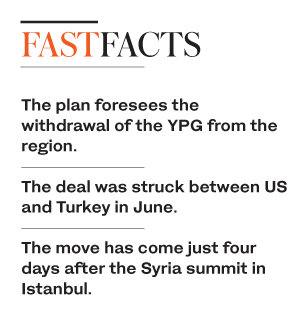
The plan foresees the withdrawal of the YPG from the region where American and Turkish soldiers were expected to conduct joint patrols. But, apart from the recent statement by the Pentagon about the launch of joint patrols soon in Manbij, none of these promises were kept as the YPG was expected to leave the city by Sept. 5.
The move has come just four days after the Syria summit in Istanbul, attended by the leaders of Turkey, Russia, Germany and France. On Sunday, the Turkish military fired artillery shells at US-backed Syrian Kurdish People’s Protection Unit (YPG) positions in the east of the Euphrates.
Four YPG militia in Syria’s Ayn Al-Arab region, or Kobani, were killed by the Turkish army on Wednesday afternoon, according to state-run news agency Anadolu.
 The offensive did not come as a surprise as Turkish President Recep Tayyip Erdogan had made several warnings since mid-September about impending full-blown military action against the YPG positions on the east of the Euphrates.
“We will soon crush the terror organization in the east of the Euphrates with more comprehensive and effective operations. We have concluded our preparations and planning regarding this issue,” Erdogan said on Tuesday during his address to the parliamentary group meeting.
Turkey considers the YPG to be an extension of the Kurdistan Workers’ Party (PKK), which has waged a deadly insurgency against the Turkish state since 1984 and is listed as a terror group by Turkey, the US and the EU.
Over the years, Turkey has tried to drive out the YPG from the western part of the Euphrates, but has hesitated to intervene in the eastern part to avoid a clash with the US, which has military contact points and officers there.
Abdullah Agar, a security expert and retired special warfare and commando officer, said the regional dynamics on the eastern Euphrates have been heating up in recent days.
“For the first time, Turkey has hit the region on such a massive scale. Ankara thinks that the terror groups on the eastern part of the Euphrates are undermining Syria’s unitary structure and threatening Turkey’s territorial integrity,” he told Arab News.
According to Agar, with this offensive Ankara is telling Washington that “either we take action together against the YPG or we will do so unilaterally.”
“This offensive may be followed by tactical, operational or strategic moves that will be determined by the reaction of the regional powers,” he said.
Serhat Erkmen, a military expert at the Gendarmerie and Coast Guard Academy of Turkey, thinks that Turkish armed forces are targeting the ammunition depots and hideouts of the YPG that were already identified.
“But the core message of this military offensive is to show Turkey’s military capacity in the region to all the regional actors and to signal that if they don’t consider Ankara’s national security concerns, Turkey is able to change the local conditions by taking the initiative,” he told Arab News.
Therefore, according to Erkmen, Ankara is testing the reactions of the US and intends to push Washington to take more concrete steps in Manbij.
“It is premature to say that this is a large-scale military operation. But a wide-ranging operation in this region is always on the table depending on the reaction of Washington and on the clear support of Moscow,” he said.
For now, Russia seems to support Turkey’s military moves on the eastern bank of the Euphrates. Russian Foreign Minister Sergei Lavrov said in September that autonomous structures in the eastern part of the river that are under the direct control of the US have been threatening Syria’s territorial integrity.
On the other hand, the disagreement between Damascus and Ankara has created a new fault line in the region as the Assad regime accuses Turkey of not meeting its obligations under the Idlib agreement and of remaining unwilling to fulfill them, saying that the terrorists have not completely withdrawn from the region and are keeping their heavy weapons.
However, Ankara rejects these accusations and claims the deal is being implemented as planned to create a demilitarized buffer zone around the opposition-held Idlib region, the last stronghold of the anti-Assad insurgency.