


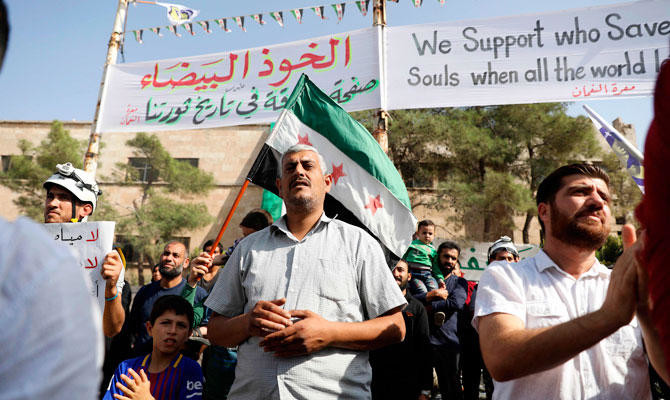

MAARET AL-NUMAN, Syria: Nearly eight years after he joined his very first protest against Syria’s regime, Bahr Nahhas still demonstrates every week with unwaning energy, even if the slogans have changed.
Just like he has since 2011, the 45-year-old tilemaker carefully paints clever slogans on protest banners before each Friday rally in his rebel-held hometown of Maaret Al-Numan, in Syria’s northwest Idlib.
But their tone has evolved, as popular demonstrations spiralled into active conflict, foreign powers got involved, and the area around him became home to diehard jihadists.
In his very first protest in March 2011, Nahhas demanded “freedom and dignity” in solidarity with other cities rising up against President Bashar Assad’s regime.
“I’ll never forget those days for the rest of my life,” said the tall, olive-skinned father of five.
Protesters would kiss and hug each other, Nahhas recalled, exhilarated by the prospect of speaking out freely against Syria’s iron-fisted regime.
“We hoped to bring down the regime in just a few days or weeks,” he said, his hair and beard greying.
Instead, a drawn-out conflict has seen Russia-backed regime troops slowly roll back rebel and jihadist gains nationwide, until this summer they started to mass around the Idlib region.
That prompted residents of Idlib, including Nahhas, to protest once more in order to head off the assault.
“By going down to the streets, we are telling people that we are a coexisting, peaceful people asking for freedom and dignity,” he said.
Now, a shaky buffer zone is keeping regime troops away from the region, more than half of which is held by the Hayat Tahrir Al-Sham alliance, led by former Al-Qaeda jihadists.
But for Nahhas, hard-liners do not represent all of Idlib.
“We have gone out to protest again to tell the world that we are not terrorists,” Nahhas said, wearing a short-sleeved stripy white and black shirt.
Most days of the week, he makes floor tiles, scooping a grey mixture into a square mold with large yellow gloves, before pushing each into a small oven.
But with the week’s end approaching, he left his workshop to prepare banners for the town’s Friday protests.
Inside a building still under construction, he knelt over a long white sheet, brushing curly Arabic letters across it in thick black paint.
Nahhas said he has lost many of his fellow protesters in Syria’s war, which has killed more than 360,000 people and displaced millions.
“Some were killed, some were arrested and are being held in the regime’s jails, some were tortured to death, and some emigrated to Turkey or to Europe,” he said.
Others picked up weapons to fight, but Nahhas decided not to.
“Words can be stronger than weapons,” Nahhas said, as he prepared signs in Arabic and neat, block-lettered English.
Outside, young men hoisted up protest signs in the street.
A young man in a black hoody stood inside the elevated metal lip of a bulldozer, reaching down for a banner before tying one end to a rusty pole.
Maaret Al-Numan’s protests trace the arc of the Syrian conflict, rising up against the regime, the Daesh group, and former Al-Qaeda fighters.
“We were among the first towns to go out into the streets against Daesh,” Nahhas said, using an Arabic acronym for IS.
IS briefly held parts of Maaret Al-Numan before opposition fighters expelled them in 2014, according to the Syrian Observatory for Human Rights.
“Afterwards, we protested against Al-Nusra... and they were kicked out too,” added Nahhas, referring to the group that later became HTS.
Turkish-backed rebels ousted HTS from the town this year after months of fighting, the Britain-based war monitor says.
All along, the town weathered bombardment by the regime and its Russian ally.
Nahhas said he is still haunted by an air strike on a primary school in the town several years ago that killed three students and maimed several others.
“I rushed to rescue the pupils after the raid, but I couldn’t see anyone because of all the dust,” he said.
“I found one of the students reaching out to me, begging. I carried him out to a car outside the school. His leg had been cut off.”
He pulled out one victim after the other, until rescue workers arrived. “I couldn’t take it anymore and I collapsed,” he said.
Friday’s demonstration got underway after midday prayers.
Carrying a small child, Nahhas melted into the crowd of demonstrators, surrounded by banners he helped make.
Assad has vowed to eventually retake Maaret Al-Numan and wider Idlib, but the veteran protester remained defiant.
“There’s no way this revolution — that has seen so many people killed and jailed — can end before the regime is toppled,” Nahhas said.


