Pittsburg synagogue shooter Robert Bowers wheeled into court

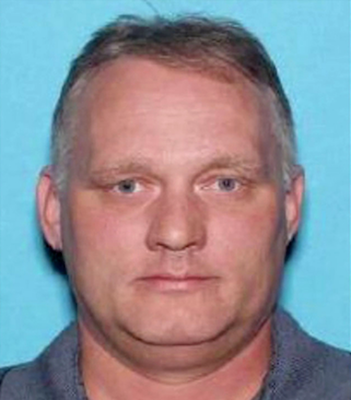
Robert Bowers killed 11 people in the worst attack on the Jewish community in US history. (Pennsylvania Department of Transportation via AP)
Updated 29 October 2018
Follow

Pittsburg synagogue shooter Robert Bowers wheeled into court

  • Bowers ordered held without bond for the deadliest attack ever on America’s Jewish community
  • Shooter had a history of posting anti-semitic material online

PITTSBURGH: Shackled and in a wheelchair, the man accused of shooting 11 worshipers to death at a Pittsburgh synagogue made a stony-faced and largely silent appearance on Monday in a federal courtroom, where he was ordered held without bond for the deadliest attack ever on America’s Jewish community.
Robert Bowers, 46, who was wounded in a gunfight with police at the synagogue on Saturday, acknowledged the 29 charges against him, which could lead to his execution if found guilty.
Bowers, who has a history of posting anti-Semitic material online, will get a court-appointed attorney and was remanded to custody of US marshals. His next hearing is set for Thursday.
“Robert Bowers murdered 11 people who were exercising their religious beliefs,” US Attorney Scott Brady said after the arraignment, adding that a grand jury would hear details of the crime within 30 days.
The synagogue massacre has heightened debate over the rhetoric US President Donald Trump uses with critics saying it has encouraged right-wing extremism, which the administration rejects. But a group of Jewish leaders told Trump in an open letter that he was “not welcome in Pittsburgh until you fully denounce white nationalism.”
Despite that, Trump and his wife, Melania, will travel to Pennsylvania on Tuesday to “express the support of the American people and grieve with the Pittsburgh community,” White House press secretary Sarah Sanders said at a briefing.
Bowers’ arraignment was marked by a heavy security presence that included police officers with dogs and a team of sharpshooters at the federal court in Pittsburgh.
Wearing a blue sweatshirt, gray sweatpants, sandals and white socks, with a crewcut and bald spot, Bowers remained expressionless throughout the short hearing.
The charges against him include violation of US civil rights laws in what federal prosecutors say was a hate crime.
Bowers only spoke during the hearing to give his name, state that he understood the charges against him and to say that he lacked the funds to pay for an attorney to represent him.
He spoke in a calm voice and signed the papers handed to him with a steady hand.
Only at the end of the hearing when he was wheeled out of the courtroom did Bowers appear unsettled, turning his head in apparent confusion.


UN refugee agency chief: ‘Very difficult moment in history’

UNHCR High Commissioner Barham Salih during an interview in Rome on Monday. (AP)
Updated 4 sec ago
Follow

UN refugee agency chief: ‘Very difficult moment in history’

  • According to his agency also known as UNHCR, there are 117.3 million forcibly displaced people around the world from 194 countries

ROME: The first refugee to lead the UN refugee agency has said that the world faces “a very difficult moment in history” and is appealing to a common humanity amid dramatic change.
Repression of immigrants is growing, and the funding to protect them is plummeting. 
Without ever mentioning the Trump administration or its policies directly, Barham Salih said his office will have to be inventive to confront the crisis, which includes losing well over $1 billion in US support.

FASTFACT

There are 117.3 million forcibly displaced people around the world from 194 countries.

“Of course it’s a fight, undeniably so, but I think also I’m hopeful and confident that there is enough humanity out there to really enable us to do that,” said Salih, a former president of Iraq.
He was also adamant on the need to safeguard the 1951 refugee convention as the Trump administration campaigns for other governments to join it in upending a decades-old system and redefining asylum rules.
Salih, who took up his role as high commissioner for refugees on Jan. 1, described it as an international legal responsibility and a moral responsibility.
According to his agency also known as UNHCR, there are 117.3 million forcibly displaced people around the world from 194 countries. Salih’s challenge is supporting some 30 million refugees with significantly less funds.
In 2024 and 2025, funding from the US dropped from $2.1 billion to $800 million, and yet the country remains UNHCR’s largest donor.
“Resources made available to helping refugees are being constrained and limited in very, very significant way,” Salih said.
The Trump administration is also reviewing the US asylum system, suspending the refugee program in 2025 and setting a limit for entries to 7,500, mostly white South Africans — a historic low for refugee admittance since the program’s inception in 1980.
The Trump administration also has tightened immigration enforcement as part of its promise to increase deportations, while facing criticism for deportations to third countries and an uproar over two fatal shootings by federal officers and other deaths.
“We have to accept the need for adapting with a new environment in the world,” Salih said. 
His agency is seeking to be more cost-effective, “to really deliver assistance to the people who need it, rather than be part of a system that sustains dependency on humanitarian assistance,” he added. Salih has already met Pope Leo XIV at the Vatican. He said he was grateful for the support of the pontiff — the first pope from the US.
“The voice of the church and faith-based organizations in this endeavor is absolutely vital,” Salih said. “His moral support, his voice of the need for supporting refugees and what we do as UNHCR at this moment is very, very important.”