

Israel-Oman meeting has 'strategic implications' for Pakistan, says minister

Shireen Mazari. (Photo courtesy: @pid_gov)
Updated 29 October 2018
Follow

Israel-Oman meeting has 'strategic implications' for Pakistan, says minister

  • Human Rights Minister says no plane flew into Islamabad from Tel Aviv as reported
  • Comments follow meeting between Omani leader and Netanyahu on Friday

ISLAMABAD: Following a rare meeting between the leaders of Israel and Oman a day earlier, Federal Minister for Human Rights, Shireen Mazari, took to social media on Saturday to highlight the “strategic implications” that the rendezvous could have on Pakistan.
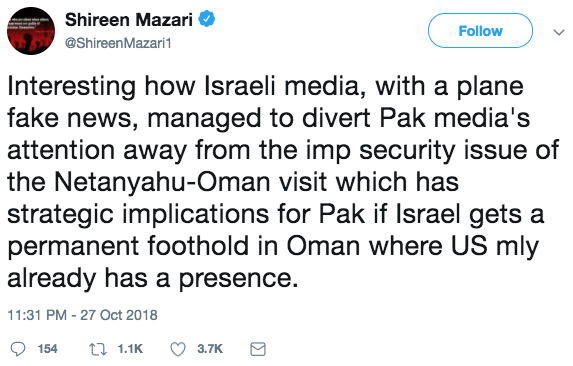
“Interesting how Israeli media, with a plane fake news, managed to divert Pak media’s attention away from the imp [sic] security issue of the Netanyahu-Oman visit which has strategic implications for Pak if Israel gets a permanent foothold in Oman where US mly (military) already has a presence,” she posted in a tweet. 
The Pakistan Tehreek-e-Insaf (PTI) government has strongly denied allegations that a private plane flew into Islamabad from Israel via Jordan. Reports of the incident went viral on news channels and social media platforms, with the opposition accusing the PTI government of being involved in “something fishy.”
The plane is said to have landed in Pakistan a day before Israeli Prime Minister Benjamin Netanyahu met with Oman’s leader Sultan Qaboos bin Said. According to Mazari, the “fake news” was created to divert the media’s attention from the meeting.
In a first-of-its-kind visit in 22-years, Netanyahu, on Friday, returned from an unannounced visit to Oman. According to the Associated Press (AP), the Israeli PM’s office said that he had been invited by the Omani leader after lengthy communications.
Oman state TV carried images of the two leaders holding talks, while Netanyahu shared a video of his visit on his official social media account terming it as “a special visit to Oman — making history!”
The Israeli PM was accompanied by his wife, the head of Mossad (Israel’s intelligence agency), the national security adviser, the foreign ministry director and other defense officials.
A senior Palestinian official told AP that Sultan Qaboos had offered to mediate between the Palestinians and Israelis and that Palestinian President Mahmoud Abbas had welcomed any “meaningful” peace process. However, the official added that the visit was mostly connected to Oman’s “regional role.”
While Oman’s influence is limited, its unique regional position could enable it to play a bigger role in mediating between Israel and archenemy Iran, the AP reported. Thus far, Israel and Oman have not maintained any diplomatic relations. The only Arab States to officially recognize Israel are Egypt and Jordan. Pakistan does not officially recognize Israel, nor does it maintain diplomatic relations with it.
The two countries have long maintained undeclared contacts at the lower levels with the only known interaction to have taken place in 2005 between ex-foreign minister Khurshid Kasuri and his Israeli counterpart Silvan Shalom.
On Sunday, however, before boarding a flight — for a three-day official visit to Turkey – Pakistan President Arif Alvi asserted that Pakistan “is not going to establish any ties with Israel.”


Pakistan joins 22 Muslim states, OIC to condemn Israeli FM’s visit to Somaliland

Updated 08 January 2026
Follow

Pakistan joins 22 Muslim states, OIC to condemn Israeli FM’s visit to Somaliland

  • Israeli Foreign Minister Gideon Saar visited breakaway African region of Somaliland on January 6
  • Muslim states urge Israel to withdraw Somaliland recognition, respect Somalia’s sovereignty

ISLAMABAD: A joint statement by Pakistan, 22 other Muslim states and the Organization of Islamic Cooperation (OIC) on Thursday condemned Israeli Foreign Minister Gideon Saar’s recent visit to Somaliland as a violation of the African nation’s territorial integrity and sovereignty.

Saar’s visit to Somaliland capital Hargeisa on Jan. 6 followed Israel’s move last month to recognize Somaliland, a breakaway region from Somalia, as an independent country. The move drew a sharp reaction from Muslim states, including Pakistan, who said it was in contravention of the UN Charter and international norms. 

Several international news outlets months earlier reported that Israel had contacted Somaliland over the potential resettlement of Palestinians forcibly removed from Gaza. Muslim countries fear Israel’s recognition of the breakaway region could be part of its plan to forcibly relocate Palestinians from Gaza to the region. 

“The said visit constitutes a clear violation of the sovereignty and territorial integrity of the Federal Republic of Somalia, and undermines established international norms and the United Nations Charter,” the joint statement shared by Pakistan’s foreign office, read. 

The joint statement was issued on behalf of 23 Muslim states, including Saudi Arabia, Bangladesh, Pakistan, Egypt, Iraq, Iran, Palestine, Jordan, Kuwait, Türkiye, Oman and others. 

It reaffirmed support for Somalia’s territorial integrity and sovereignty, pointing out that respect for international law and non-interference in the internal affairs of sovereign states was necessary for regional stability. 

“Encouraging secessionist agendas are unacceptable and risk exacerbating tensions in an already fragile region,” the statement said. 

The joint statement urged Israel to revoke its recognition of the breakaway region. 

“Israel should fully respect Somalia’s sovereignty, national unity and territorial integrity and honor its obligations in compliance with international law, and demand immediate revocation of the recognition issued by Israel,” the statement read.

Somaliland broke away from Somalia unilaterally in 1991 as a civil war raged in the country. Somaliland has its own constitution, parliament and currency, a move that has infuriated Somalia over the years as it insists the region is part of its territory.