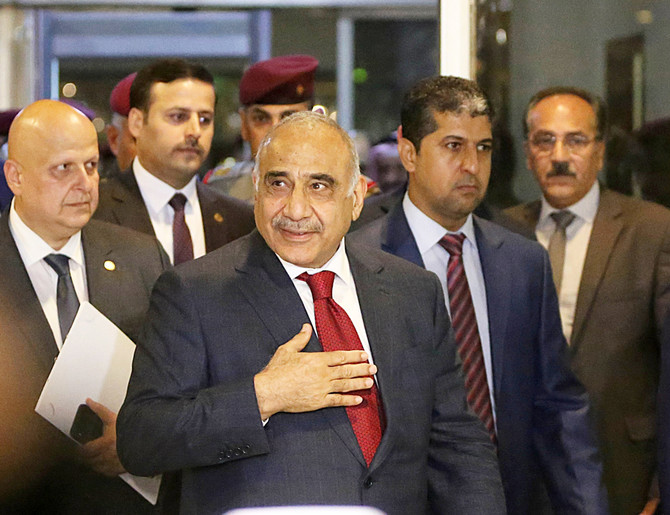

BAGHDAD: An Iraqi Cabinet met outside the heavily fortified Green Zone in Baghdad on Thursday for the first time in 15 years.
The meeting, chaired by new Prime Minister Adel Abdul Mahdi, followed an acrimonious session of the Iraqi Parliament that had lasted into the early hours of Thursday.
The session was supposed to be a rubber stamp for new government ministers agreed by the coalition of the two largest Shiite parliamentary blocs — Reform, sponsored by the influential cleric Muqtada Al-Sadr, and Al-Binna’a, the Iran-backed alliance led by Hadi Al-Amiri, commander of Badr Organization, the most powerful Shiite armed faction.
Instead, the session descended into bickering and arguments over the background and history of some of the ministerial candidates, and two in particular: Proposed Interior Minister Falih Al-Fayadh, a former national security adviser and a key ally of Amiri, and Defense Ministry candidate Fener Faisal, former commander of dictator Saddam Hussein’s private jet squadron.
Both men were nominated by Al-Binna’a, but the Iran-backed group was out-maneuvered by Sadr’s allies in the Reform alliance. After the prime minister and 14 of the 22 proposed ministers had been approved, Reform staged a walkout — leaving the Parliament without a quorum, and therefore unable to proceed.
“Amiri and his allies broke their deals with us,” a leading Reform negotiator told Arab News. “We told them clearly that the candidates for the security posts had to be independent, and exclusively nominated by Abdul Mahdi, but they insisted on putting partisan names forward at the last minute.
“They thought they could twist our arm and embarrass us so we would vote for their candidates without any consideration of their previous ties. But a deal is a deal. We said no to those eight candidates, and that means no.”
The attempt to manipulate the ministerial appointments was led by the Iranian military officer Gen. Qassim Suleimani, commander of the Quds Force, the overseas unit of the Islamic Revolutionary Guard Corps. He met most of the Iranian Shiite, Sunni and Kurdish political allies in Iraq this week to promote his candidates, negotiators told Arab News.
“Iran is seeking to tighten its control over the security issue in Iraq and the ministries of Defense and Interior are the cornerstones of this,” an Al-Binna’a negotiator told Arab News. “Suleimani has been pressuring to back them. Sadr and his allies were smart enough to abort his attempts. They won this round.”
After the disputes of the night before, there were simple and quiet decrees in Baghdad on Thursday morning to exchange authorities and offices between Mahdi, his predecessor Haidar Abadi and the members of their governments. The new prime minister was sworn in, followed by a meeting of the new Cabinet at Mahdi’s temporary office outside the Green Zone.
“We have presented an ambitious and detailed ministerial program with clear time limits and will work to implement it,” Mahdi said during a televised ceremony.
“We have many challenges and have to work hard to develop the economy, activate the labor market, provide services and meet all the demands of our people.”