Balochistan hopes to lead law and order reforms in Pakistan

1 / 3
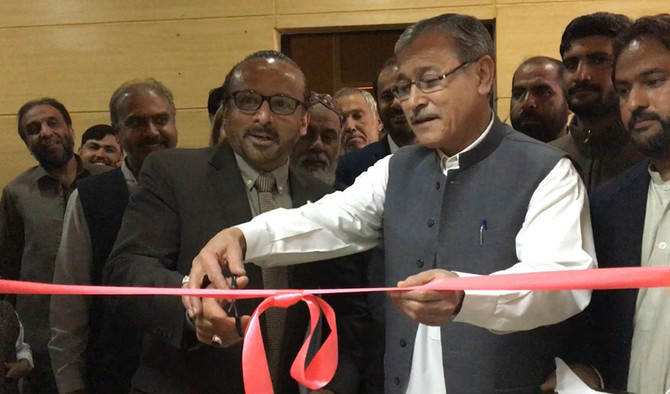
Haider Ali Shikoh, Home and Tribal Affairs Department of Balochistan, left, and Cesar Guedes, Representative of the United Nations Office on Drugs and Crime (UNODC) during the inauguration of the Delivery Unit at the Home Department, Oct. 24, 2018. (Photo courtesy: Balochistan Home and Tribal Affairs Department)
2 / 3
Haider Ali Shikoh, Home and Tribal Affairs Department of Balochistan and Cesar Guedes, Representative of the United Nations Office on Drugs and Crime (UNODC) during the inauguration of the Delivery Unit at the Home Department, Oct. 24, 2018. (Photo courtesy: Balochistan Home and Tribal Affairs Department)
3 / 3
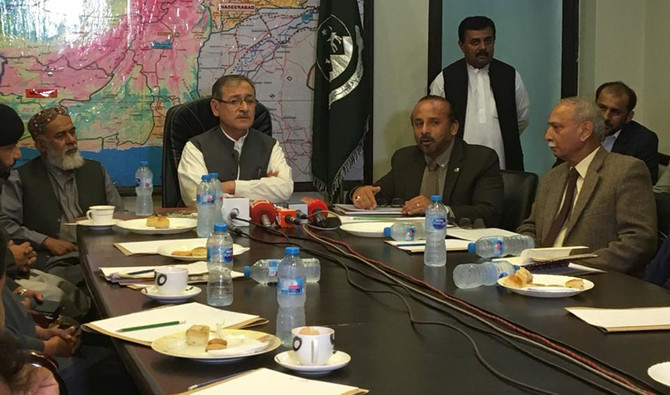
The Launch event was followed by convening the first meeting of the Steering Committee headed by Mr. Haider Ali Shikoh, and all the stakeholders from Police, Prosecution, Prison, Reclamation and Probation, Levies, Bar, Judiciary, Law, and civil society. (Photo courtesy: Balochistan Home and Tribal Affairs Department)
Updated 24 October 2018
Follow

Balochistan hopes to lead law and order reforms in Pakistan

  • Launches Delivery Unit to ensure justice to citizens
  • Province has consistently ranked low in law and order indexes

ISLAMABAD: With an aim to improve the law and order situation in the province and ensure timely justice to citizens, the Balochistan government on Wednesday launched a new Delivery Unit, in collaboration with the United Nations Office on Drugs and Crime (UNODC).
The initiative is part of the Rule of Law Roadmap (RLR) that was approved by the Balochistan provincial cabinet, earlier this year.
The RLR is detailed in a document that encompasses significant reforms, specifically aimed at inclusivity and provision of justice to citizens in the province.
The reforms highlighted are expected to be implemented over the next five years. The document was developed by the UNODC with the support of two other UN bodies and the British High Commission.
Speaking on the occasion, Haider Ali Shikoh, Home and Tribal Affairs Department Secretary of Balochistan, said: “Rule of Law is the most important priority of the government of Balochistan and today we have taken a concrete step toward its implementation… by inaugurating the Delivery Unit with the support of the UNODC which has been an instrumental partner in improving the law and order in Balochistan from last eight years.”
Balochistan has consistently ranked extremely low in the law and order indexes and is considered the worst performing province in the country. Among the many security challenges faced by the province, some of the most pressing include the alleged enforced disappearances of thousands, targeting of minority groups such as the Hazaras and the Punjabis, Baloch separatist movements and religious extremism.
Shikoh said that the government is leading the implementation of RLR across all the provinces despite the challenges on the ground. “Launching the Delivery Unit is a witness of that and the government’s ownership and commitment throughout the process, translating their strategic vision into action and becoming a role model for other provinces to follow,” he said.


Pakistan footwear sector flags used imports as barrier to export growth

Updated 05 March 2026
Follow

Pakistan footwear sector flags used imports as barrier to export growth

  • Industry says production capacity far exceeds domestic consumption, signaling export potential
  • Its delegation tells commerce minister up to 40 percent of domestic market met through used shoe imports

KARACHI: Pakistan’s leather and footwear industry has warned that rising imports of used shoes are distorting the domestic market and limiting export growth, according to a commerce ministry statement issued on Thursday after industry representatives met Commerce Minister Jam Kamal Khan.

The meeting focused on export potential, domestic market challenges and regulatory concerns linked to the import of second-hand footwear, which industry leaders say is undermining local manufacturers despite significant production capacity.

“Pakistan’s annual footwear consumption is estimated at around 550 million pairs, while the country has an installed production capacity of nearly 700 million pairs annually, indicating significant potential for both domestic supply and export expansion,” the delegation said, according to the commerce ministry statement.

“A considerable portion of this capacity remains underutilized due to market distortions created by the growing influx of used footwear imports,” it added.

Industry representatives told the minister that around 30-40 percent of Pakistan’s domestic footwear market is currently supplied through imports of used shoes, many of which enter the country under the broader customs category of used clothing and accessories.

They said branded footwear is often imported at very low declared values under this classification, creating what they described as unfair competition for domestic manufacturers.

To address the issue, the delegation proposed introducing a separate Harmonized System (HS) code for used footwear, which would allow regulators to better track imports, improve customs valuation and introduce sector-specific regulatory measures.

The commerce ministry said the proposal has been placed on the agenda of the Tariff Policy Board and could eventually be considered as part of the upcoming federal budget following consultations and approvals.

The commerce minister acknowledged the importance of the leather and footwear sector as a potential export driver and reiterated the government’s support for local manufacturing and export-led growth, the statement said.

He also encouraged industry stakeholders to expand exports while ensuring locally produced footwear remains affordable for domestic consumers.

Both sides agreed to maintain close coordination to help the sector boost employment, increase production and expand Pakistan’s presence in international footwear markets.