

Thailand immigrant crackdown eyes ‘dark-skinned people’

1 / 4
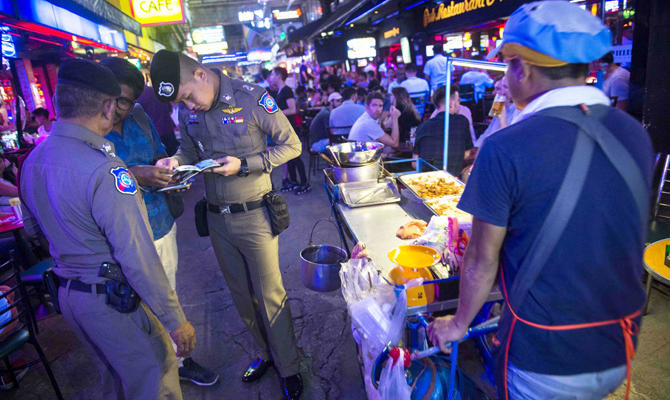
This photo taken on October 11, 2018 shows police checking for the passport of a foreigner held for investigation in Bangkok's Nana district during a police operation called "X-Ray Outlaw Foreigner". (AFP)
2 / 4
This photo taken on October 18, 2018 shows police inspecting the passport of a foreigner in Bangkok's Patpong district during a police operation called "X-Ray Outlaw Foreigner". (AFP)
3 / 4
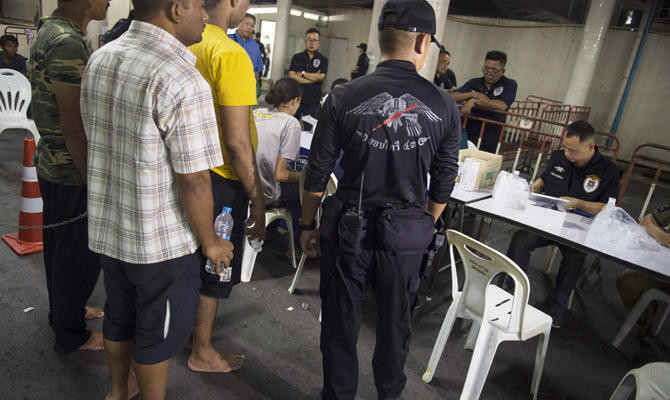
This photo taken on October 11, 2018 shows police holding a group of foreigners for investigation in Bangkok's Nana district during a police operation called "X-Ray Outlaw Foreigner". (AFP)
4 / 4
This photo taken on October 18, 2018 shows Thai immigration bureau chief and police Major General Surachate Hakparn speaking to foreigners held for investigation in Bangkok's Patpong district during a police operation called "X-Ray Outlaw Foreigner". (AFP)
Updated 21 October 2018
Follow

Thailand immigrant crackdown eyes ‘dark-skinned people’

  • Thailand’s reputation as a place to disappear and reinvent yourself combined with lax visa rules can be a headache for law enforcement
  • Thailand is not a party to the UN convention recognizing refugees and made headlines in 2015 for deporting more than 100 Uighurs back to China

BANGKOK: Allegedly aimed at busting visa abusers and illegal migrants, a Thai police operation called “X-Ray Outlaw Foreigner” has raised questions about racial profiling and fears for asylum-seekers caught in its web.
Tens of millions of tourists come to Thailand each year for the cheap living and postcard-perfect beaches, with some seeking out the seedier thrills of a bustling sex industry.
But as weak law enforcement, porous borders and corruption help make the country a hub for transnational crime, Thai authorities are intensifying Operation X-Ray — a program that started about a year ago — with more than 1,000 people arrested in recent weeks, most for overstaying their visa.
Although the vast majority caught in the dragnet are migrants from nearby countries, the racial overtones of the campaign have sparked concerns about profiling based on skin color.
“Our job is to classify who are the good dark-skinned people and who are the ones likely to commit crimes,” said immigration bureau chief Surachate Hakparn.
He told AFP that the operation was aimed at weeding out visa overstayers and nabbing criminals — especially “romance scammers” who lure lonely locals online to defraud them of cash.
He insisted that the romance scammers are often Nigerian or Ugandan.

At the start of one night time operation witnessed by AFP in Bangkok’s rowdy Nana district earlier this month, about 75 Thai police officers stood in rows at a briefing.
“The suspicious targets are the dark-skinned people,” shouted an officer. “First, we search their bodies, then we search their passports.”
Soon they began stopping suspects, including three people from Mali who were tested for drugs on the spot.
By 11:55 pm, almost 30 individuals — about half of whom were black — had been rounded up.
Only one was Caucasian, a Frenchman caught smoking marijuana.
Surachate’s staff said details on the breakdown of nationalities was “confidential.”
But in the first two weeks of October, police arrested a Korean citizen wanted by Interpol for sexual assault, and busted a team of four Nigerians and 16 Thais allegedly involved in romance scams, according to authorities.
They also found a Laos national who had overstayed his visa by more than 11 years.

Thailand’s reputation as a place to disappear and reinvent yourself combined with lax visa rules can be a headache for law enforcement.
The junta that seized power in 2014 justified its power grab by promising stability amid street protests and political upheaval.
But rights groups warn that refugees and asylum seekers who transit through Bangkok en route to a third country for resettlement are also being ensnared in the latest police operation as they lack legal protections.
According to rough estimates from the non-profit Fortify Rights, there are about 100 adults and 30 children who fit this description, mainly from Pakistan but also from Syria and Somalia.
“Thailand’s immigration crackdown has swept up refugees and asylum seekers, sent young children into horrid, prison-like conditions, and appears to have clear aspects of racial profiling against South Asians and Africans,” said Brad Adams, Asia director at Human Rights Watch.
Thailand is not a party to the UN convention recognizing refugees and made headlines in 2015 for deporting more than 100 Uighurs back to China.
More than 70 Pakistani Christians were rounded up and detained this month by police under charges of illegal entry and overstay even though they were assumed to be in transit and escaping religious persecution in their Muslim-majority homeland.
But the authorities remain unapologetic.
According to immigration chief Surachate’s count, Thailand is home to more than 6,000 people who ought to have left the country already.
“In order to clean house, we need to bring in the good people and deport the bad people so that the country will have sustained stability,” he said.


North Korean POWs in Ukraine seeking ‘new life’ in South

Updated 56 min 50 sec ago
Follow

North Korean POWs in Ukraine seeking ‘new life’ in South

  • North Korea has sent thousands of troops to support Russia’s nearly four-year invasion of Ukraine, according to South Korean and Western intelligence agencies

SEOUL: Two North Korean prisoners of war held by Ukraine have said they hope to start a “new life” in South Korea, according to a letter seen by AFP on Wednesday.
Previous reports have indicated that the two men, held captive by Kyiv since January after sustaining injuries on the battlefield, were seeking to defect to the South.
But the letter represents the first time the two of them have said so in their own words.
“Thanks to the support of the South Korean people, new dreams and aspirations have begun to take root,” the two soldiers wrote in a letter dated late October to a Seoul-based rights group which shared it with AFP this week.
North Korea has sent thousands of troops to support Russia’s nearly four-year invasion of Ukraine, according to South Korean and Western intelligence agencies.
At least 600 have died and thousands more have sustained injuries, according to South Korean estimates.
Analysts say North Korea is receiving financial aid, military technology and food and energy supplies from Russia in return.
North Korean soldiers are instructed to kill themselves rather than be taken prisoner, according to South Korea’s intelligence service.
In the letter, the two prisoners thanked those working on their behalf “for encouraging us and seeing this situation not as a tragedy but as the beginning of a new life.”
“We firmly believe that we are never alone, and we think of those in South Korea as our own parents and siblings and have decided to go into their embrace,” they wrote.
The letter is signed by the two soldiers, whose names AFP has been asked to withhold to protect their safety.

- ‘Death sentence’ -

Under South Korea’s constitution, all Koreans — including those in the North — are considered citizens, and Seoul has said this applies to any troops captured in Ukraine.
The letter was delivered during an interview for a documentary film coordinated by the Gyeore-eol Nation United (GNU) rights group, which works to help North Korean defectors.
That interview took place at an undisclosed facility in Kyiv where the two POWs are being held after they were captured.
During the interview, the pair also pleaded to be sent to the South, according to GNU chief Jang Se-yul, himself a North Korean defector who fled the isolated country in the 2000s.
The video has not yet been made public but is expected to be released next month, Jang said.
Yu Yong-weon, a lawmaker who met with the prisoners during a visit to Ukraine in February, said the prisoners had described witnessing wounded comrades kill themselves with grenades.
Sending the soldiers back to the North would constitute “a death sentence,” Yu said.
South Korea’s foreign ministry has urged Ukraine not to “forcibly repatriate North Korean prisoners of war against their will” and has asked that their desire to go to the South be respected.