

Thailand immigrant crackdown eyes ‘dark-skinned people’

1 / 4
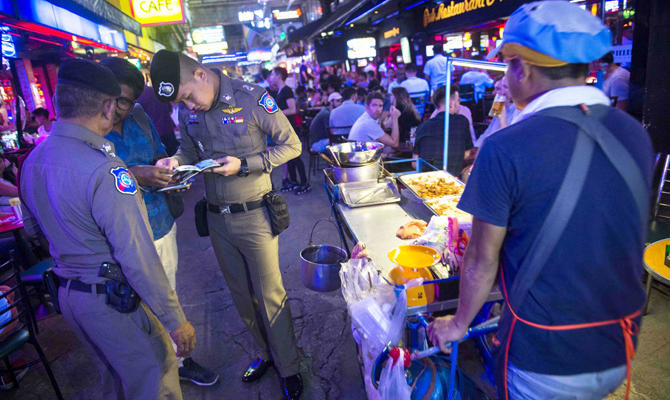
This photo taken on October 11, 2018 shows police checking for the passport of a foreigner held for investigation in Bangkok's Nana district during a police operation called "X-Ray Outlaw Foreigner". (AFP)
2 / 4
This photo taken on October 18, 2018 shows police inspecting the passport of a foreigner in Bangkok's Patpong district during a police operation called "X-Ray Outlaw Foreigner". (AFP)
3 / 4
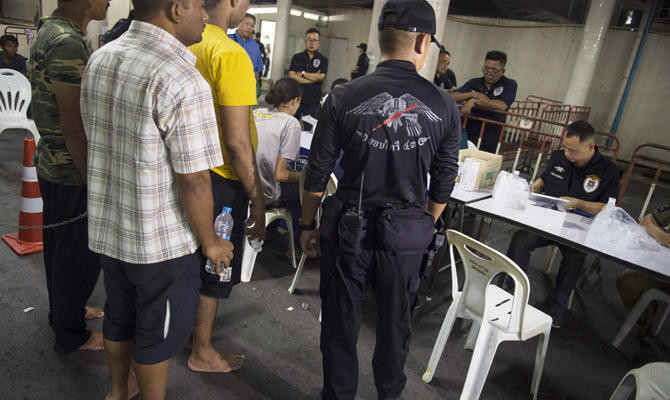
This photo taken on October 11, 2018 shows police holding a group of foreigners for investigation in Bangkok's Nana district during a police operation called "X-Ray Outlaw Foreigner". (AFP)
4 / 4
This photo taken on October 18, 2018 shows Thai immigration bureau chief and police Major General Surachate Hakparn speaking to foreigners held for investigation in Bangkok's Patpong district during a police operation called "X-Ray Outlaw Foreigner". (AFP)
Updated 21 October 2018
Follow

Thailand immigrant crackdown eyes ‘dark-skinned people’

  • Thailand’s reputation as a place to disappear and reinvent yourself combined with lax visa rules can be a headache for law enforcement
  • Thailand is not a party to the UN convention recognizing refugees and made headlines in 2015 for deporting more than 100 Uighurs back to China

BANGKOK: Allegedly aimed at busting visa abusers and illegal migrants, a Thai police operation called “X-Ray Outlaw Foreigner” has raised questions about racial profiling and fears for asylum-seekers caught in its web.
Tens of millions of tourists come to Thailand each year for the cheap living and postcard-perfect beaches, with some seeking out the seedier thrills of a bustling sex industry.
But as weak law enforcement, porous borders and corruption help make the country a hub for transnational crime, Thai authorities are intensifying Operation X-Ray — a program that started about a year ago — with more than 1,000 people arrested in recent weeks, most for overstaying their visa.
Although the vast majority caught in the dragnet are migrants from nearby countries, the racial overtones of the campaign have sparked concerns about profiling based on skin color.
“Our job is to classify who are the good dark-skinned people and who are the ones likely to commit crimes,” said immigration bureau chief Surachate Hakparn.
He told AFP that the operation was aimed at weeding out visa overstayers and nabbing criminals — especially “romance scammers” who lure lonely locals online to defraud them of cash.
He insisted that the romance scammers are often Nigerian or Ugandan.

At the start of one night time operation witnessed by AFP in Bangkok’s rowdy Nana district earlier this month, about 75 Thai police officers stood in rows at a briefing.
“The suspicious targets are the dark-skinned people,” shouted an officer. “First, we search their bodies, then we search their passports.”
Soon they began stopping suspects, including three people from Mali who were tested for drugs on the spot.
By 11:55 pm, almost 30 individuals — about half of whom were black — had been rounded up.
Only one was Caucasian, a Frenchman caught smoking marijuana.
Surachate’s staff said details on the breakdown of nationalities was “confidential.”
But in the first two weeks of October, police arrested a Korean citizen wanted by Interpol for sexual assault, and busted a team of four Nigerians and 16 Thais allegedly involved in romance scams, according to authorities.
They also found a Laos national who had overstayed his visa by more than 11 years.

Thailand’s reputation as a place to disappear and reinvent yourself combined with lax visa rules can be a headache for law enforcement.
The junta that seized power in 2014 justified its power grab by promising stability amid street protests and political upheaval.
But rights groups warn that refugees and asylum seekers who transit through Bangkok en route to a third country for resettlement are also being ensnared in the latest police operation as they lack legal protections.
According to rough estimates from the non-profit Fortify Rights, there are about 100 adults and 30 children who fit this description, mainly from Pakistan but also from Syria and Somalia.
“Thailand’s immigration crackdown has swept up refugees and asylum seekers, sent young children into horrid, prison-like conditions, and appears to have clear aspects of racial profiling against South Asians and Africans,” said Brad Adams, Asia director at Human Rights Watch.
Thailand is not a party to the UN convention recognizing refugees and made headlines in 2015 for deporting more than 100 Uighurs back to China.
More than 70 Pakistani Christians were rounded up and detained this month by police under charges of illegal entry and overstay even though they were assumed to be in transit and escaping religious persecution in their Muslim-majority homeland.
But the authorities remain unapologetic.
According to immigration chief Surachate’s count, Thailand is home to more than 6,000 people who ought to have left the country already.
“In order to clean house, we need to bring in the good people and deport the bad people so that the country will have sustained stability,” he said.


Indonesia threatens to ban Musk’s Grok AI over degrading images of children and women

Updated 07 January 2026
Follow

Indonesia threatens to ban Musk’s Grok AI over degrading images of children and women

  • Grok has been complying with user requests to alter images of real people  
  • Other countries, including Malaysia and France, have also threatened action against X 

JAKARTA: Indonesia’s Communications Ministry threatened on Wednesday to ban Elon Musk’s X and its artificial intelligence chatbot Grok after degrading pictures of women and children generated without consent surged on the social media platform. 

Grok has been complying with requests from X users to modify images of real women and children stripped to their underwear, creating a viral trend that has sparked concerns across the globe. 

A preliminary investigation found that Grok “does not yet have explicit and adequate regulations to prevent the production and distribution of pornographic content based on real photos” of Indonesian citizens,” Indonesia’s Ministry of Communications and Digital Affairs said in a statement. 

Indonesia has strict laws against the production and distribution of pornography, with the government regularly instructing internet service providers to block access to websites containing such content. 

“The obligation to comply with Indonesian laws and regulations applies to all digital platforms operating in Indonesia,” the ministry said. 

“Should there be non-compliance or lack of cooperation, the Ministry of Communications and Digital Affairs may impose administrative sanctions, including termination of access to Grok’s AI services and the X platform.” 

Indonesia has joined a growing list of countries, which includes Malaysia, India and France, that are calling for investigations and threatening action against Grok.

Concerns grew after a December update to the chatbot made it easier for users to post photographs of people and ask for their clothing to be removed.

In a report published on Tuesday, European non-profit organization AI Forensics said Grok is “systematically ‘undressing’ women.”  

Its analysis of 20,000 images generated by Grok between Dec. 25 and Jan.1 found that 53 percent of them contained individuals in minimal attire, with 81 percent of them being women, while two percent of the images depicted persons appearing to be 18 years old or younger. 

Indonesia’s Communications Ministry said AI service providers and users are also subject to administrative or criminal sanctions under Indonesian law if they are proven to have produced or distributed pornographic content or modified personal images without permission. 

“Every digital platform must ensure that the technology they provide does not become a medium for privacy violation, sexual exploitation or the degradation of a person’s dignity,” said Alexander Sabar, director-general of digital space at the ministry.  

“We urge all parties to use artificial intelligence technology responsibly. The digital space is not a lawless space; every citizen’s privacy and right to their image must be respected and protected.”