


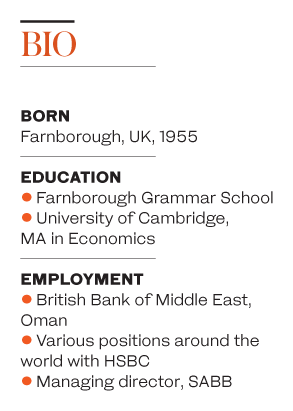
DUBAI: David Dew has been working in banking in the Middle East and other emerging markets for 40 years, and you might think he has seen it all. But the merger between SABB and Alawwal in Saudi Arabia — which he is steering through to completion next year — is a career achievement for him.
“I think it’s a clear case of a win-win situation, and all our stakeholders will get benefit from it. It’s a genuinely exciting landmark transaction, and a significant transformation for the Kingdom,” he said.
It is a historic transaction, Dew explains. “It is the third biggest banking merger in the history of the region — the other two were in the UAE with significant government ownership — so SABB-Alawwal is also the biggest private banking merger for 20 years. It’s the first since the Capital Market Authority (CMA) was formed and the first since the new takeover rules came in.”
The merger will create the third biggest bank in the Kingdom by assets, loans and deposits, and — perhaps more significant in the current financial environment — forge a bank that is unashamedly international in its outlook. The transaction has its origins in the different imperatives of foreign banks operating in the Kingdom. Saudi Arabia has been identified as a global growth market by HSBC, which holds 40 percent of SABB — full name the Saudi British Bank.
Alawwal — the “first bank” in Arabic, reflecting its long heritage in the Kingdom — was dominated by a consortium of foreign banking interests, notably cash-strapped RBS (Royal Bank of Scotland) of Britain. RBS and its consortium partners — from Spain and Holland — wanted to reduce their overseas footprint. Getting out of Alawwal was a logical move from that perspective.
RBS and the Spanish bank Santander — which would each have about 4 percent of the enlarged company — have undertaken not to sell their shares for six months after completion.
The foreigners’ different strategic interests might have been the original spark for the merger, but Dew firmly believes it is in the best interests of the Saudi banking business, and bank customers. “Our first stakeholder is the Kingdom, and the merger is a great example of why and how Vision 2030 is actually working. It’s showing that Saudi Arabia is open for business. An important part of the Vision plan is the financial sector development program, and this merger shows it is working.
“The idea is to grow and develop capital markets, and this will help the Kingdom do that. It’s the kind of thing that just might not have happened even a few years ago.”
The next set of stakeholders he is working to satisfy is the regulatory establishment. The deal has been quite a long time in gestation, and much of that time has been taken up in getting it just right from a regulatory standpoint. “It’s taken a bit longer than you might have expected, but the regulators have been with us all the way — the CMA, the Saudi Arabian Monetary Authority, and the Ministry of Finance. All good things take time, and it is more important to do it right than to do it quick,” he said.
The next key group of stakeholders are the shareholders on both sides. In addition to HSBC and the RBS consortium, there are big investors in both banks in the shape of the Olayan conglomerate, and the government agency the General Organization for Social Insurance. Both have recused themselves from involvement in the merger negotiations. But both boards have recommended the merger terms.
“We’ve explained the business rationale and made a compelling case to them that the merger creates value. There will be a circular from both parties to all shareholders, we hope, by the end of the year.”
The next stakeholders on the list are the customers. “I know it’s a cliche that the customers are all important, but it’s true, and they will see real benefits,” Dew said.

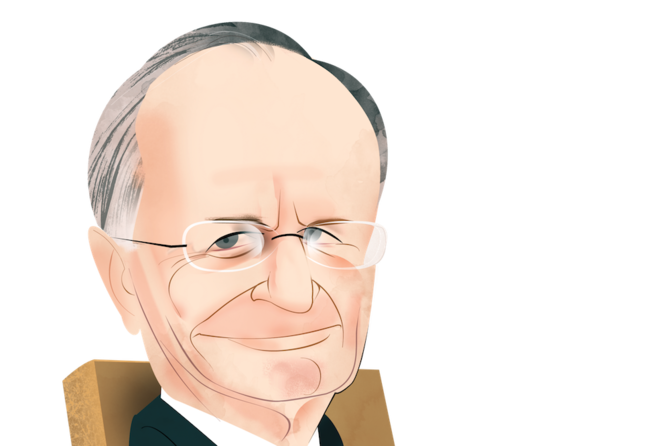
(Illustration by Luis Grañena)
Comprising as much as 75 percent of the new bank’s business, the corporate sector will be crucial. “It will be the leading corporate bank by lending, and will offer other products, too, for example trade finance. It will also be the leading cash management business, and a significant foreign exchange provider.
“I think it will occupy a powerful corporate position and overall will be a bellwether for the underlying economy, so it will be followed closely by anybody interested in the Kingdom’s business,” Dew explained. With a market capitalization of about SR65 billion ($17.33 billion) and a sizeable free float on the Tadawul, it will be valuable proxy for investment in the modernizing Kingdom.
The new bank will also use its connection with HSBC’s powerful investment banking operation in Saudi Arabia to help satisfy customers’ needs in that segment.
In the retail sector, it will never be as big as NCB or Al Rajhi, market leaders with more than 50 percent of the retail market between them. But with about 10 percent of the Kingdom’s retail market, Dew feels it will be approaching the “tipping point” at which it becomes a serious player.
“The home loans market is critical. We estimate we’ll have 16 percent of that market, which is vitally important to the changes that are happening in the Kingdom,” he said. It will also have around 20 percent of the Saudi credit card market, he estimated.
“We will redouble our efforts to offer a good SME (small and medium-sized enterprises) proposition. SABB has not done enough in this sector, but we will do more, and the ability to do it will be enhanced by the merger,” he added.
“For corporate customers, we will be able to offer the biggest balance sheet and underwriting capability, which adds up to more ‘muscle’ for corporate clients. For retail customers, we will offer additional scale and focus, especially on the digital side. This is the future for the retail banking business, and we will build on Alawwal’s strengths here. They are pretty good in digital already. They have punched above their weight,” Dew said.
The final group of stakeholders are the employees. “Again it is trite to say ‘We are nothing without our people,’ but I happen to believe it. We have promised and we mean it, that there will be no involuntary redundancies. That does not mean there will be no losses through attrition. People come and go all the time, so that is only natural,” Dew said.
The new bank will have 4,800 employees, more than 90 percent of them Saudi citizens and 20 percent women. Its new chairperson will be Lubna Olayan, head of the eponymous conglomerate and one of the leading business figures in the Kingdom. “She has a track record in business, leadership expertise and international connectivity. To have somebody like that as chair of the new bank is an incredibly powerful statement. She will also be the first female chair of a listed Saudi company,” said Dew, who will be managing director of the new entity.
The bank will start operating in what Dew sees as an improving economic and financial environment in the Kingdom, with the long-promised privatization and initial public offering program materializing. “Two years ago, growth and bank lending were falling. In 2018 there has been a modest but significant improvement, and I do believe next year is going to show further improvement.”
On the geopolitical background, always a big factor in the business climate in the region, he brings a historical perspective to bear.
“When I came here 40 years ago, Israel-Palestine was the big issue. Since then, the region has become even more complicated and volatile. But business has navigated through these problems and I’m confident it will do so again. It’s all about having strong foundations,” he said.


