ISLAMABAD: Decrying the role played by the National Accountability Bureau (NAB) in getting him arrested, Pakistan Muslim League-Nawaz (PML-N) President and Leader of the Opposition, Shehbaz Sharif, on Wednesday claimed that there was an “unholy alliance” between the anti-corruption body and the ruling party.
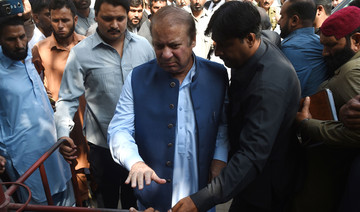
Sharif made the comments in his first public appearance after being arrested for his alleged involvement in a housing scam, on October 5. Addressing a National Assembly (NA) session — made possible due to the persistent demands of the opposition and on the instructions of Speaker Asad Qaiser — the PML-N president said that this was the “first time in history that an opposition leader had been arrested without any charges”.
He maintained that the NAB had acted against him a few days ahead of the by-polls but that, despite the “political tactics”, his party had managed to win an impressive number of seats in the electoral contest. He added that he did not want to use the NA as a platform to discuss the merits of his case, even as he quoted a NAB official as saying that there were no corruption allegations leveled against him. He added that he was being framed for using his authority to award a housing contract to the younger brother of former Army Chief General (r) Ashfaq Pervez Kayani.
While defending his position in the case, Sharif claimed that the NAB had also accused him of building properties in China, noting that leaders from the ruling Pakistan Tehreek-e-Insaf (PTI) party had made similar allegations in the past and falsely blamed him for investments in Turkey as well.
“No one needs a proof of their [PTI and NAB’s] unholy alliance after that,” he said, requesting that the lower house of parliament should form a committee to probe the allegation as they can have serious implications on Pakistan’s external affairs.
Responding to his comments, Federal Minister for Law Farogh Naseem challenged Sharif’s assertion that his arrest was made at the government’s behest. “NAB is an independent institution. It exercised its powers on its own. There was no interference,” he said.
He also maintained that the NA was “not a court of law” and could not decide if the NAB inquiry against the PML-N leader was legally right or not, reminding the parliamentary members that it was not within their legal framework to discuss a matter as it was sub-judice.
However, senior Pakistan Peoples Party (PPP) leader, Khurshid Shah, observed that the parliament was the supreme national institution since it ensures the formation of other state bodies. Shah added that the opposition wanted the government to form a committee and probe the conditions that led to Sharif’s arrest as it was a serious issue.


Shehbaz slams PTI and NAB’s “unholy alliance”

Shehbaz slams PTI and NAB’s “unholy alliance”

- PML-N leader claims incarceration part of political tactics, in first public appearance
- Law Minister challenges comments that arrest was initiated by government


Pakistan says it is moving toward phased crypto regulation after Binance, HTX approvals
- The country is among the world’s largest crypto adoption markets, with nearly 40 million users
- Bilal bin Saqib says the government is not promoting crypto but moving to regulate the sector
ISLAMABAD: Pakistan’s top virtual asset regulatory official said on Sunday the country was laying the foundation for a phased and tightly supervised crypto framework after granting conditional approvals to two global exchanges, signaling a shift from years of regulatory ambiguity toward formal oversight of digital assets.
The Pakistan Virtual Assets Regulatory Authority (PVARA) said this week it had issued no objection certificates (NOCs) to global crypto exchanges Binance and Huobi (HTX). Pakistan has also signed a memorandum of understanding with them to explore what the finance ministry described as the “tokenization” of up to $2 billion in sovereign bonds, treasury bills and commodity reserves, an initiative aimed at boosting liquidity and attracting investors.
“The no objection certificate given to Binance and Huobi is the first practical step of this new thinking,” PVARA chief Bilal bin Saqib said at a briefing. “Let me make it clear that this NOC is not a shortcut. This is not a blanket approval.”
He said the approvals marked the start of a risk-mitigated, phased and supervised entry framework, adding that platforms would be subject to strict anti-money laundering and counter-terrorism financing requirements, ownership transparency checks and enforcement-linked licensing timelines.
“This is not a new experiment,” he said, pointing to phased regulatory approaches adopted in financial centers such as Dubai, the United Kingdom and Singapore, where firms are first brought under supervision before being allowed to expand operations.
Pakistan is among the world’s largest crypto adoption markets, with estimates putting the number of users between 30 and 40 million, despite the absence of a comprehensive regulatory framework. Saqib said ignoring the sector was no longer viable, warning that unregulated adoption posed greater risks to the economy and consumers.
“We don’t want to promote crypto,” he said. “We want to regulate crypto. Adoption is already there.”
He said the framework was designed to prepare Pakistan for longer-term developments in digital finance, including tokenized assets, compliance technology, blockchain analytics and digital payment infrastructure, while ensuring that local talent is channeled into regulated and productive use.
“For the international community, the message is clear,” Saqib said. “Pakistan is not running away from innovation. Pakistan is welcoming innovation. Pakistan is regulating innovation.”