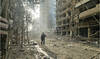
NEW DELHI, India: Delhi’s biggest coal power plant was set to shut down Monday as a new emergency plan to improve air quality in one of the world’s most polluted cities came into force, Indian officials said.
Under the new strategy, restrictions on construction sites and traffic will be imposed depending on the air quality in the megacity of some 20 million people.
When the air is classed as “poor,” as it was on Monday, authorities will ban the burning of garbage in landfills as well as fire crackers and certain construction activities.
When the air is “very poor” diesel generators will be halted, parking fees hiked and more public transport provided. “Severe” measures include closing brick kilns.
When it reaches “severe+,” a new category, authorities will stop the entry of trucks except those with essential goods and regulate the number of cars on the road.
The Badarpur thermal plant was due to permanently close on Monday because of its high contribution to pollution in the city.
Smog spikes during winter in Delhi, when air quality often eclipses the World Health Organization’s safe levels.
Cooler air traps pollutants — such as from vehicles, building sites and farmers burning crops in regions outside the Indian capital — close to the ground.
Authorities in the sprawling city attempted to implement similar measures last winter but to little avail.
This is partly because authorities are powerless to prevent some sources of pollution.
“Our aim is to stop the air quality from deteriorating further though certain factors are out of our control such as crop burning, wind speed and lack of public transportation,” environment authority official Bhure Lal said.

Delhi braces for pollution with emergency plan
- Under the new strategy, restrictions on construction sites and traffic will be imposed depending on the air quality
Cuba says a 5th person died after people on a Florida-flagged speedboat opened fire on soldiers
- Authorities in Cuba said that on Feb. 26 Cuban soldiers confronted a speedboat carrying 10 people as the vessel approached the island and opened fire on the troops
- The shooting threatened to increase tensions between US President Donald Trump and Cuban authorities
HAVANA: Cuba said a fifth person has died as a consequence of a fatal shootout last month involving a Florida-flagged speedboat that allegedly opened fire on soldiers in waters off the island nation’s north coast.
The island’s interior ministry said late Thursday in a statement that Roberto Álvarez Ávila died on March 4 as a result of his injuries. It added that the remaining injured detainees “continue to receive specialized medical care according to their health status.”
Authorities in Cuba said that on Feb. 26 Cuban soldiers confronted a speedboat carrying 10 people as the vessel approached the island and opened fire on the troops. They said the passengers were armed Cubans living in the US who were trying to infiltrate the island and “unleash terrorism”. Cuba said its soldiers killed four people and wounded six others.
“The statements made by the detainees themselves, together with a series of investigative procedures, reinforce the evidence against them,” the Cuban interior ministry said in its statement, adding that “new elements are being obtained that establish the involvement of other individuals based in the US”
Earlier this week, Cuba said it had filed terrorism charges against six suspects that were on the speedboat. The government unveiled items said to have been found on the boat, including a dozen high-powered weapons, more than 12,800 pieces of ammunition and 11 pistols.
Cuban authorities have provided few details about the shooting, but said the boat was roughly 1.6 kilometers (1 mile) northeast of Cayo Falcones, off the country’s north coast. They also provided the boat’s registration number, but The Associated Press was unable to readily verify the details because boat registrations are not public in the state of Florida.
The shooting threatened to increase tensions between US President Donald Trump and Cuban authorities. The island’s economy was until recently largely kept economically afloat by Venezuela’s oil, which is now in doubt after a US military operation deposed then-Venezuelan President Nicolás Maduro.