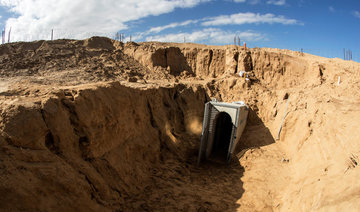
JERUSALEM: Israel’s military said it destroyed a Hamas-built tunnel extending into its territory from the Gaza Strip on Thursday that was intended for attacks.
Military spokesman Jonathan Conricus said it was the 15th such tunnel discovered and destroyed by Israel in the past year.
There were no indications of casualties linked to the destruction of the tunnel around one kilometer in length (less than a mile) and which originated from the Khan Yunis area of southern Gaza.
It extended around 200 meters (650 feet) into Israeli territory, Conricus said, adding Israel’s army had been monitoring its construction for several months.
He declined to elaborate on how the tunnel was destroyed, but said “combat engineering means” were used.
Conricus called it a “complex tunnel system with various connections and branches.”
Israel has in recent months employed technology to detect and destroy tunnels without bombing them, including by filling them with material to make them unusable.
Israel is also building an underground wall around the blockaded Gaza Strip to stop tunnel digging. Work on the massive project is expected to be completed by the end of 2019, Conricus said.
Conricus alleged Hamas used new methods in building the tunnel destroyed Thursday that seemed intended to evade Israel’s detection methods.
He declined however to provide specifics, but noted it was equipped with electricity and communication hardware.
The destruction of the tunnel comes amid months of protests and clashes along the Gaza border that have raised fears of a fourth war since 2008 between Israel and Hamas, the movement that runs the Palestinian enclave.
At least 198 Palestinians have been killed by Israeli fire in Gaza since the protests began on March 30, while one Israeli soldier has been shot dead by a Palestinian sniper in that time.
Israel says its actions during the protests and clashes are necessary to defend the border and stop infiltrations and attacks, which it accuses Hamas of seeking to carry out.
Palestinians and rights groups say protesters have been shot while posing little threat.
The last conflict between Israel and Palestinian militants in Gaza in 2014 was waged in part over tunnels that were used to carry out attacks within Israel.


![]()


Israel destroys Hamas attack tunnel from Gaza
Israel destroys Hamas attack tunnel from Gaza
- There were no indications of casualties linked to the destruction of the tunnel
- The destruction of the tunnel comes amid months of protests and clashes along the Gaza border

Hundreds mourn in Syria’s Homs after deadly mosque bombing
HOMS: Hundreds of mourners gathered Saturday despite rain and cold outside of a mosque in the Syrian city of Homs where a bombing the day before killed eight people and wounded 18.
The crowd gathered next to the Imam Ali ibn Abi Talib Mosque in the Wadi Al-Dhahab neighborhood, where the population is predominantly from the Alawite minority, before driving in convoys to bury the victims.
Officials have said the preliminary investigations indicate explosive devices were planted inside the mosque but have not yet publicly identified a suspect.
A little-known group calling itself Saraya Ansar Al-Sunna claimed responsibility for the attack in a statement posted on its Telegram channel, in which it indicated that the attack intended to target members of the Alawite sect, an offshoot of Shia Islam whom hard-line Islamists consider to be apostates.
The same group had previously claimed a suicide attack in June in which a gunman opened fire and then detonated an explosive vest inside a Greek Orthodox church in Dweil’a, on the outskirts of Damascus, killing 25 people as worshippers prayed on a Sunday.
A neighbor of the mosque, who asked to be identified only by the honorific Abu Ahmad (“father of Ahmad“) out of security concerns, said he was at home when he heard the sound of a “very very strong explosion.”
He and other neighbors went to the mosque and saw terrified people running out of it, he said. They entered and began trying to help the wounded, amid blood and scattered body parts on the floor.
While the neighborhood is primarily Alawite, he said the mosque had always been open to members of all sects to pray.
“It’s the house of God,” he said. “The mosque’s door is open to everyone. No one ever asked questions. Whoever wants to enter can enter.”
Mourners were unable to enter the mosque to pray Saturday because the crime scene remained cordoned off, so they prayed outside.
Some then marched through the streets chanting “Ya Ali,” in reference to the Prophet Muhammad’s cousin and son-in-law whom Shiite Muslims consider to be his rightful successor.
The crowd gathered next to the Imam Ali ibn Abi Talib Mosque in the Wadi Al-Dhahab neighborhood, where the population is predominantly from the Alawite minority, before driving in convoys to bury the victims.
Officials have said the preliminary investigations indicate explosive devices were planted inside the mosque but have not yet publicly identified a suspect.
A little-known group calling itself Saraya Ansar Al-Sunna claimed responsibility for the attack in a statement posted on its Telegram channel, in which it indicated that the attack intended to target members of the Alawite sect, an offshoot of Shia Islam whom hard-line Islamists consider to be apostates.
The same group had previously claimed a suicide attack in June in which a gunman opened fire and then detonated an explosive vest inside a Greek Orthodox church in Dweil’a, on the outskirts of Damascus, killing 25 people as worshippers prayed on a Sunday.
A neighbor of the mosque, who asked to be identified only by the honorific Abu Ahmad (“father of Ahmad“) out of security concerns, said he was at home when he heard the sound of a “very very strong explosion.”
He and other neighbors went to the mosque and saw terrified people running out of it, he said. They entered and began trying to help the wounded, amid blood and scattered body parts on the floor.
While the neighborhood is primarily Alawite, he said the mosque had always been open to members of all sects to pray.
“It’s the house of God,” he said. “The mosque’s door is open to everyone. No one ever asked questions. Whoever wants to enter can enter.”
Mourners were unable to enter the mosque to pray Saturday because the crime scene remained cordoned off, so they prayed outside.
Some then marched through the streets chanting “Ya Ali,” in reference to the Prophet Muhammad’s cousin and son-in-law whom Shiite Muslims consider to be his rightful successor.
Latest updates


© 2025 SAUDI RESEARCH & PUBLISHING COMPANY, All Rights Reserved And subject to Terms of Use Agreement.