KISSUFIM: Massive earthworks and mounds of sandy soil line the Israel-Gaza border as the Israeli military forges ahead with an ambitious subterranean barrier to detect and prevent attack tunnels from reaching southern Israel from the Palestinian enclave.
Israeli military officials on Thursday touted the secretive project as a major deterrent against what Israel has seen as a strategic threat since the last war against Hamas exposed the extent of the tunnels. Israel has made uncovering the tunnels from Gaza a priority and in recent months has demolished at least three through a combination of intelligence, infantry operations and hi-tech sensors.
Israel began construction of a 40-mile long underground wall last summer, aiming to prevent Palestinian militants from burrowing toward Israeli communities along the border.
“The technology really is groundbreaking,” Israeli military spokesman Lt. Col. Jonathan Conricus said in a briefing with journalists on the border with the Gaza Strip. “The message to Hamas is: ‘We now have this system which can detect and destroy terror tunnels that violate Israeli sovereignty.’“
Conricus said that the anti-tunnel barrier under construction “provides a significant challenge for anyone tunneling below,” without elaborating.
Israel and Hamas, the Islamist militant group that has ruled the Gaza Strip since 2007, have fought three wars since 2008. During the most recent conflict in 2014, Hamas militants on several occasions caught Israel off guard by attacking through the underground tunnel network.
While Hamas fighters did not manage to reach Israeli civilian centers, five Israeli soldiers were killed in such attacks, which rattled the Israeli public. Israel destroyed 32 tunnels during that conflict, and has prioritized anti-tunnel operations since.
Excavating machines, concrete mixers and hundreds of workers toil furiously as part of Israel’s deadly underground game of cat and mouse with the Gaza militants.
The barrier — hundreds of feet below ground, studded with sensors and topped by a 26-foot metal fence — has an estimated price tag of $700 million and is on track for its slated completion in mid-2019, a senior Israeli military official said Thursday. Thus far, crews working 24 hours a day, six days a week have completed 4 kilometers (2.5 miles) of the 64-kilometer (40-mile) border barrier.
Wary of tipping off enemies, Israeli military officials were reticent to discuss particulars concerning the barrier’s tunnel detection capabilities, or precisely how far into the earth the wall goes.
“It’s deep enough,” a senior Israeli military official said. Cranes hoisted 25-meter-long rebar cages into the air, and the official said “several get welded together” to form the concrete wall’s reinforced spine.
Thus far, Hamas has not tried to disrupt construction, and giant earth berms protect workers from spying eyes and small arms fire. A senior Israeli military official said that while neither side wants to start a new round of violence, minor incidents along the border had the potential to snowball into a larger conflict quickly.
Both officials spoke on condition of anonymity in line with regulations.
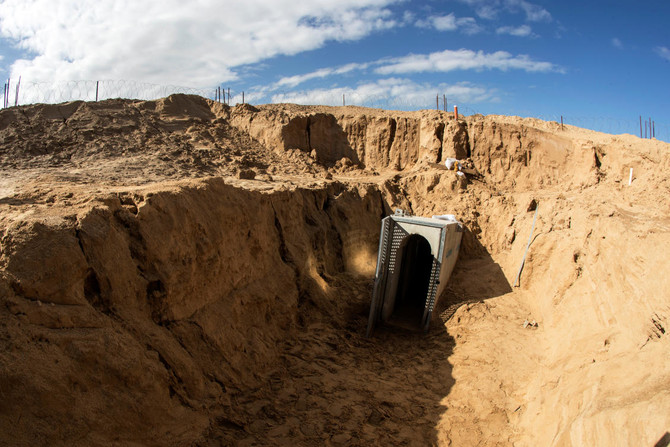
The military on Thursday also showcased a tunnel destroyed in late October — its demolition left a dozen militants dead.
The meter-wide concrete-lined shaft penetrated hundreds of yards into southern Israel toward nearby Kibbutz Kissufim. Its destruction prompted retaliatory rocket fire by the Islamic Jihad militant group. Another tunnel was demolished late last year and on Sunday, Israel said it destroyed a 1.5-kilometer (1-mile) tunnel built by Hamas which stretched from the Gaza Strip, through Israel and into Egypt.
“Now we’ll see how Hamas responds to these new developments,” Conricus said.
Hazem Qassem, a Hamas spokesman, said the group would find a way around the wall.
“Our people have proved that they are always capable of finding means and mechanisms to overcome all measures by the (Israeli) occupation. Our people have many ways to defend themselves,” he said, without elaborating.
An Israeli military map of the Gaza Strip shown to reporters illustrated the miles of Hamas and Islamic Jihad tunnels honeycombing the Palestinian territory. The military estimates that working around the clock, a couple dozen militants can dig 10 meters (yards) of tunnel per day.


Israel digs deep to thwart tunnel threat from Gaza Strip
Israel digs deep to thwart tunnel threat from Gaza Strip

Turkiye asks Britain’s MI6 to step up protection of Syria’s Sharaa, sources say
- A Turkish source said that MIT appealed to MI6 for more support after one such incident last month
- A senior Syrian security source said the request came after a “high-risk assassination plot”
ISTANBUL/DAMASCUS/LONDON: Turkiye’s intelligence agency asked its British counterpart MI6 last month to take a larger role in protecting Syrian President Ahmed Al-Sharaa after recent assassination plots, according to five people familiar with the matter.
The request highlights efforts by foreign allies to shore up a country still shaken by sporadic violence 15 months after the overthrow of president Bashar Assad, with the US-Israeli war on Iran now rattling the wider region.
Those allies see Sharaa as crucial to preventing a relapse into sectarian fighting or civil war, after 14 years of civil conflict drove millions of refugees abroad and allowed Daesh to control swathes of Syria.
The militants last month stepped up attacks on military and security personnel across Syria and declared Sharaa, a former rebel, their “number one foe.”
It was unclear what specifically Turkiye’s National Intelligence Organization, or MIT, had asked of MI6, or what new role, if any, MI6 had taken up.
ANXIETY RISES IN SYRIA OVER DAESH
Turkiye, Britain and the US last year threw their backing behind Sharaa to try to reunite and rebuild his country of 26 million. London and Washington have scrapped most sanctions on Syria and on Hayat Tahrir Al-Sham (HTS), the Islamist group he once led.
The sources who spoke to Reuters requested anonymity owing to the sensitivity of the matter.
MIT, the Turkish foreign ministry, Britain’s foreign office and Syria’s defense and interior ministries did not respond to requests for comment.
The sources, including Syrian and foreign officials, all cited rising anxiety over a series of reported Daesh plots to kill Sharaa.
A Turkish source said that MIT, which has played a key role in helping the new government to establish itself, appealed to MI6 for more support after one such incident last month. A senior Syrian security source said the request came after a “high-risk assassination plot”, adding that MIT, MI6 and Syrian authorities were constantly sharing intelligence.
Details of the plot were unclear. A separate Western intelligence source briefed on the matter believed Turkiye wanted to introduce a Western presence in Damascus to provide something of a buffer between the agencies of Turkiye and Israel, currently at loggerheads.
REPORTED ASSASSINATION ATTEMPTS AGAINST SHARAA Last year, Sharaa and two senior cabinet ministers were targeted by Daesh in five foiled assassination attempts, according to the UN Office of Counter-Terrorism. In November, Reuters reported that Syrian authorities had foiled two of the attempts.
Describing Sharaa as a “watchdog” of the global anti-Daesh coalition, the group mounted six attacks on Syrian authorities last month in what it called a “new phase.”
On Thursday, Damascus openly acknowledged for the first time that it coordinates with MIT, saying they had cooperated to foil an Daesh attack in the capital.
Turkish security sources said MIT had identified a team of three preparing remote bomb attacks, enabling Syrian counterparts to prevent an “imminent assault.”
A US diplomat briefed on the matter said MIT’s request to MI6 had been prompted by the Daesh resurgence.
The Western intelligence source said the two agencies could intensify joint planning and technical operations, but that no decision had been made on whether to send British personnel to Damascus. A Syrian security source said a physical British presence would be “highly risky.”
They said MI6 had been discussed at a meeting in Damascus on February 26 between a delegation headed by Britain’s special envoy for Syria, Ann Snow, and Syria’s deputy interior minister, Major General Abdulqader Tahan.
Sharaa was a commander of Al Qaeda’s Nusra Front in Syria before cutting ties with the group in 2016, then led a coalition of Islamist rebel factions in late 2024 to topple Assad.