Mountain village of Rijal Alma, south of Saudi Arabia, ready to take global tourism limelight

Rijal Alma is set to be a key attraction for global tourists visiting the Kingdom. (SPA)
Updated 10 October 2018
Follow

Mountain village of Rijal Alma, south of Saudi Arabia, ready to take global tourism limelight

  • The village of Rijal Alma had won the Prince Sultan bin Salman Award for Urban Heritage in 2007
  • Saudi Commission for Tourism and National Heritage since its inception, has accorded a great deal of attention to Asir as a major tourist destination

JEDDAH: Prince Sultan bin Salman, president of the Saudi Commission for Tourism and National Heritage (SCTH), inspected ongoing work to develop Rijal Alma village in Asir region. 

He met the team assigned to implement urgent projects and development so as to register the village on the UNESCO World Heritage List.

The state, under King Salman, has given its full support to making the Kingdom a distinctive tourist destination, Prince Sultan said.

The tourism sector represents a new economic resource that will provide thousands of direct and indirect employment opportunities, he added.

Prince Sultan praised the people of Asir region, particularly those who live in Rijal Alma, for their belief in preserving national heritage. 

The village will be transformed into a global tourist attraction, highlighting Asir’s history and heritage, he said.
The village of Rijal Alma had won the Prince Sultan bin Salman Award for Urban Heritage in 2007 and has become a tourist destination for those visiting the region of Asir. This importance comes as a result of the numerous historical, cultural, heritage and natural factors, and the hospitality and culture of its residents.

The SCTH, since its inception, has accorded a great deal of attention to Asir as a major tourist destination, he added. 

Initiatives include “tourism projects and activities on the Red Sea, the rehabilitation of heritage sites and villages, the establishment of museums,” and “the stimulation of tourism and hotel investment,” Prince Sultan said.

He thanked Asir’s governor and his deputy for their unwavering support for the SCTH’s work.

Prince Sultan ordered that development work be carried out around Rijal Alma by providing tourist sites and accommodation. He met and spoke with residents of the village. 

Prince Turki bin Talal, Asir’s deputy governor, praised the efforts of the SCTH and Prince Sultan to make the Kingdom a global tourist destination.

Prince Sultan held a meeting at Rijal Alma, during which he was briefed on the project’s progress.

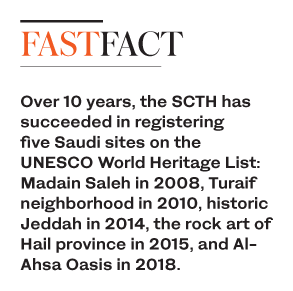
Over 10 years, the SCTH has succeeded in registering five Saudi sites on the UNESCO World Heritage List: Madain Saleh in 2008, Turaif neighborhood in 2010, historic Jeddah in 2014, the Rock Art of Hail province in 2015, and Al-Ahsa Oasis in 2018.


National Center for Wildlife releases more than 60 wildlife species at King Khalid Royal Reserve

Updated 22 sec ago
Follow

National Center for Wildlife releases more than 60 wildlife species at King Khalid Royal Reserve

The Imam Abdulaziz bin Mohammed Royal Reserve Development Authority, in cooperation with the National Center for Wildlife, released more than 60 wildlife species at King Khalid Royal Reserve today near Riyadh, the Saudi Press Agency reported.

This initiative, according to the agency, is part of programs to reintroduce endangered species to their natural habitats, reflecting the integrated national efforts to protect wildlife and promote its sustainability.

“Releasing wildlife into the King Khalid Royal Reserve enhances biodiversity and restores natural habitats within the reserve. This contributes to providing a safe natural environment that supports the stability of wildlife and facilitates its adaptation to its natural habitats”, said the authority’s CEO, Talal Al-Hariqi.

He added that such efforts align with the National Strategy for Environmental Conservation and fulfill one of the objectives of the Kingdom’s Vision 2030, which aims to create an attractive environment that contributes to improving quality of life and promoting sustainability.

He also said that the collaboration with the National Center for Wildlife Development is a model for institutional integration in implementing reintroduction programs. This is achieved by unifying scientific and technical expertise and applying global best practices in wildlife conservation, thus ensuring the success of these programs and the long-term sustainability of their results.

Ziad bin Abdulaziz Al-Tuwaijri, director-general of projects and operations at the authority, said that the King Khalid Royal Reserve has released more than 60 wildlife species, including Arabian oryx, Arabian hares, and Arabian gazelles. This initiative aims to enrich the reserve’s biodiversity, contribute to restoring ecological balance through the reintroduction of endangered animals, promote sustainability, and support and revitalize ecotourism.

He said that over past years, the authority released more than 300 wild animals of different types, including reptiles, mammals, and local birds, all of which are classified on the International Union for Conservation of Nature Red List as species that are vulnerable or threatened with extinction.

He said that animals released in the King Khalid Royal Reserve are subject to periodic and continuous monitoring through field studies and modern monitoring techniques, such as surveillance cameras and tracking collars, where many natural births and herd growth have been recorded, reflecting the success of the release and reintroduction programs.