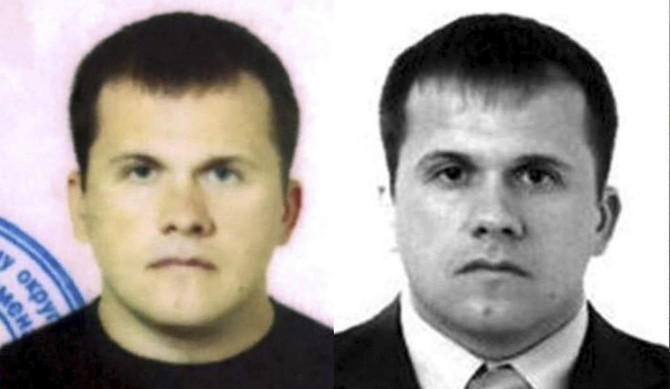
LONDON: The second of two Russians who Britain says was responsible for the poisoning of former Russian spy Sergei Skripal and his daughter was named by investigative website Bellingcat on Monday as a military doctor for Russia’s GRU military intelligence.
Bellingcat, which covers intelligence matters, named him as Alexander Yevgenyevich Mishkin, aged 39, who was charged by Britain last month under the name of Alexander Petrov.
British prosecutors charged Petrov and and another man they named as Ruslan Boshirov with attempted murder for the Novichok nerve agent attack on the Skripals in the English city of Salisbury in March, but said they believed the suspects had used aliases to enter Britain.
Bellingcat last month identified Boshirov as a colonel in the GRU whose real name was Anatoliy Chepiga.
London police said they would not comment on speculation about the real identities of the two men facing charges, in response to a query about the latest Bellingcat report, and repeated they believed the men had used aliases.
Mishkin was born in July 1979 in the village of Loyga in the Archangelsk district of northern Russia, and until September 2014 his registered home address in Moscow was the same as the headquarters of the GRU, Bellingcat said.
“Bellingcat’s identification process included multiple open sources, testimony from people familiar with the person, as well as copies of personally identifying documents, including a scanned copy of his passport,” the website said.
His GRU rank was unknown, it added.
Russia denies any involvement in the poisoning, and the two men have said publicly they were tourists who had flown to London for fun and visited Salisbury to see its cathedral.

Real identity uncovered of second Russian linked to Skripal poisoning
Zelensky says meeting with Trump to happen ‘in the near future’
- Zelensky’s announcement came after he said Thursday he had a “good conversation” with US special envoy Steve Witkoff and Trump’s son-in-law Jared Kushner
KYIV: A meeting with US President Donald Trump will happen “in the near future,” Ukrainian President Volodymyr Zelensky said Friday, signaling progress in talks to end the nearly four-year war between Russia and Ukraine.
“We are not losing a single day. We have agreed on a meeting at the highest level – with President Trump in the near future,” Zelensky wrote on X.
“A lot can be decided before the New Year,” he added.
Zelensky’s announcement came after he said Thursday he had a “good conversation” with US special envoy Steve Witkoff and Trump’s son-in-law Jared Kushner.
Trump has unleashed an extensive diplomatic push to end the war, but his efforts have run into sharply conflicting demands by Moscow and Kyiv.
Zelensky said Tuesday he would be willing to withdraw troops from the country’s eastern industrial heartland as part of a plan to end the war, if Moscow also pulls back and the area becomes a demilitarized zone monitored by international forces.
Though Russian Foreign Ministry spokeswoman Maria Zakharova said Thursday that there had been “slow but steady progress” in the peace talks, Russia has given no indication that it will agree to any kind of withdrawal from land it has seized.
In fact, Moscow has insisted that Ukraine relinquish the remaining territory it still holds in the Donbas — an ultimatum that Ukraine has rejected. Russia has captured most of Luhansk and about 70 percent of Donetsk — the two areas that make up the Donbas.
On the ground, Russian drone attacks on the city of Mykolaiv and its suburbs overnight into Friday left part of the city without power.
Meanwhile, Ukraine said it struck a major Russian oil refinery Thursday using British-supplied Storm Shadow missiles.
Ukraine’s General Staff said its forces hit the Novoshakhtinsk refinery in Russia’s Rostov region. “Multiple explosions were recorded. The target was hit,” it wrote on Telegram.
Rostov regional Gov. Yuri Slyusar said a firefighter was wounded when extinguishing the fire.
Ukraine’s long-range drone strikes on Russian refineries aim to deprive Moscow of the oil export revenue it needs to pursue its full-scale invasion. Russia wants to cripple the Ukrainian power grid, seeking to deny civilians access to heat, light and running water in what Kyiv officials say is an attempt to “weaponize winter.”


