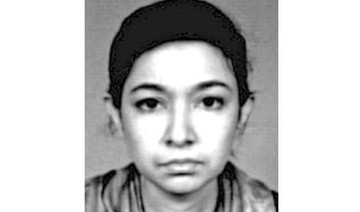
ISLAMABAD: The government of Pakistan is exploring legal options to secure the release and repatriation of neuroscientist Dr. Aafia Siddiqui, currently in jail in the United States, as well as raising the issue at appropriate international meetings and using diplomatic channels, Andleeb Abbas, Parliamentary Secretary for Ministry of Foreign Affairs, told Arab News on Friday.
“We are using laws, contracts, and conventions (for the repatriation of Siddiqui),” Abbas said, but admitted no plan has yet been finalized. “In principle we have agreed that we are going to raise this issue,” she added.
Siddiqui was indicted by a New York federal district court in September 2008 on charges of attempted murder and assault stemming from an incident in an interview with the US authorities in Afghanistan. She, however, denies the charges.
After 18 months in detention, she was tried and convicted in early 2010 and sentenced to 86 years in prison. She is currently serving her jail term in the US.
Siddiqui’s imprisonment sparked protests in Pakistan where supporters claim the charges against her were invented. Successive governments in Pakistan also announced they would take measures to ensure the extradition of Siddiqui, but so far any such measures, if taken, have been unsuccessful.
During July’s election campaign, Pakistan Tehreek-e-Insaf (PTI) — now the ruling party in Pakistan — promised to provide consular and legal services to all Pakistanis jailed abroad, saying, “We (will) make our best efforts to bring prisoners like Dr. Aafia Siddiqui and others back to Pakistan.”
A ruling party lawmaker in the Punjab Assembly, Seemabia Tahir, also submitted a resolution in the provincial assembly on Friday urging Prime Minister Imran Khan to take all necessary measures to bring Siddiqui back to Pakistan.
“Dr. Aafia Siddiqui is a daughter of Pakistan,” Tahir told Arab News. “I’ll soon call on the prime minister too to request him to take all possible diplomatic and legal measures to ensure her repatriation.”
Pakistan Foreign Minister Shah Mahmood Qureshi’s recent interview with Fox News about the possible release of Dr. Shakeel Afridi also sparked a debate about a prisoner swap.
Afridi helped the US track down Osama bin Laden in Pakistan by running a fake vaccination program to collect DNA but has since been in jail in Pakistan.
“He is viewed in a particular light in Pakistan. He is viewed as a traitor in Pakistan, but he is viewed as a friend in the US. So we have to bridge this gap,” Qureshi told Fox News.
The parliamentary secretary told Arab News that a deal to exchange Afridi for Siddiqui “is not under discussion.”
“The US has not discussed this issue with our government,” she added.
Dr. Fauzia Siddiqui, sister of Dr. Aafia, blamed successive Pakistani governments for “non-cooperation” and failure to take effective diplomatic steps with the US authorities.
“We are hopeful that Aafia will be released one day,” she told Arab News. “But our governments just make statements that they have taken up the issue at the highest level, but practically have done nothing.”
Fauzia said that they were pursuing matters in the US courts, and working with human rights activists in the US to get her sister released and returned to Pakistan.
Barrister Masroor Shah said that Pakistan does not have an extradition treaty with the US, therefore the government cannot press the US authorities for repatriation of Dr. Aafia.
“Dr. Aafia can be brought back to Pakistan through a bilateral arrangement with the US,” he told Arab News, “her release may be secured by utilizing diplomatic channels instead of the legal ones.”


Pakistan exploring legal options over repatriation of Aafia Siddiqui

Pakistan exploring legal options over repatriation of Aafia Siddiqui
- Swap of Dr. Shakeel Afridi for Dr. Aafia Siddiqui not under discussion, says Parliamentary Secretary for Ministry of Foreign Affairs
- Siddiqui’s sister says Pakistani government has done “nothing“


Pakistan expands crypto engagement with appearance at Mar-a-Lago finance forum
- Pakistan Virtual Assets Regulatory Authority Chairman Bilal bin Saqib attends World Liberty Financial event at Trump’s Mar-a-Lago estate
- Discussions focused on future of global financial infrastructure, digital assets, stablecoins, capital markets innovation, says Saqib’s office
ISLAMABAD: Pakistan Virtual Assets Regulatory Authority (PVARA) Chairman and Minister of State Bilal bin Saqib joined global finance leaders at an event hosted by World Liberty Financial, a crypto venture linked to US President Donald Trump’s family, Saqib’s office said on Thursday.
The event was hosted by World Liberty Financial, a crypto-based finance platform launched in September 2024 linked to Trump’s family. According to Saqib’s office, the gathering was held at Mar-a-Lago, the private estate and club owned by Trump in Florida.
Speakers and attendees at the event included David Solomon, chairman and CEO of Goldman Sachs, Adena Friedman, chairperson and CEO of Nasdaq as well as Lynn Martin, president of the New York Stock Exchange, Saqib’s office said. The event was organized and hosted by Eric Trump and American businesspersons Zach Witkoff and Alex Witkoff.
“Discussions focused on the future of global financial infrastructure, digital assets, stablecoins, capital markets innovation and the evolving relationship between regulation and emerging financial technologies,” the statement said.
It said Saqib’s attendance at the event reflected Pakistan’s growing engagement with global discussions shaping the next phase of financial and technological transformation.
“As Pakistan moves toward modernizing its financial infrastructure and strengthening its position in the global digital economy, such high-level engagements signal increasing international recognition of the country’s regulatory direction and leadership,” the statement added.
Last month, Pakistan signed a memorandum of understanding with a company affiliated with World Liberty Financial to explore the use of a dollar-linked stablecoin for cross-border payments.
Pakistan has stepped up efforts recently to regulate its digital asset sector and is exploring digital currency initiatives as part of broader measures to reduce cash usage.


