

King Abdulaziz City for Science and Technology manufactures two new satellites

1 / 2
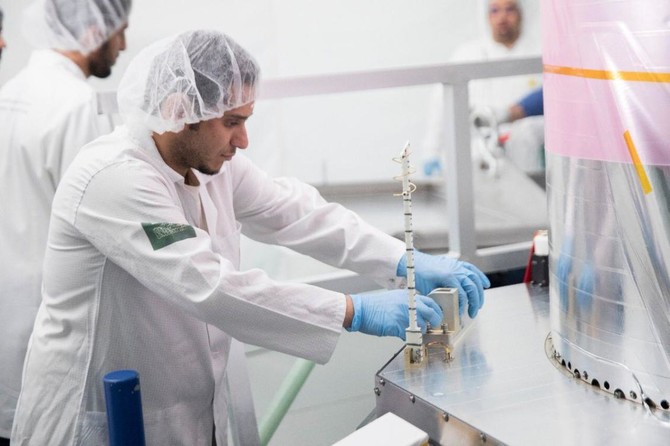
King Abdulaziz City for Science and Technology has completed the manufacture of two satellites, the Saudi Sat 5a and Saudi Sat 5b. (SPA)
2 / 2
King Abdulaziz City for Science and Technology has completed the manufacture of two satellites, the Saudi Sat 5a and Saudi Sat 5b. (SPA)
Updated 05 October 2018
Follow

King Abdulaziz City for Science and Technology manufactures two new satellites

  • The two earth-observation satellites are set to launch later this year
  • The space program in line with Saudi Arabia's Vision 2030 goals

JEDDAH: King Abdulaziz City for Science and Technology (KACST) has completed the manufacture of two satellites, the Saudi Sat 5a and Saudi Sat 5b, in a new step in the field of exploration, communication, and scientific research.

The two earth-observation satellites are set to launch later this year and join the second generation of Saudi Arabia’s high-accuracy remote-sensing satellites.

The satellites will be used to provide high-resolution images of the planet’s surface from low earth orbits, help with urban planning, monitor movements and changes on the earth’s surface, and provide government agencies with services, in particular high resolution images.

KACST has so far launched 13 satellites, has collaborated with China in the Chang’e 4 mission to explore the far side of the moon; provided advanced services for remote-sensing systems; and has participated in the launch of an advanced system for maritime monitoring and tracking with satellite data, which includes daily coverage of 30,000 vessels across the world.

The launch of the two new satellites is in line with Saudi Arabia’s Vision 2030, which aims to nationalize strategic technologies in Saudi Arabia, maximize local content, and empower Saudi youth to develop advanced technologies in the field of satellite development and construction.


Japanese researchers hope to restore coral from Saudi-made structures

Updated 05 January 2026
Follow

Japanese researchers hope to restore coral from Saudi-made structures

  • Coral skeletons made for Saudi Pavilion at Japan expo last year
  • Results of Japanese study to be revealed at Riyadh Expo 2030

TOKYO: Japanese universities are seeking to restore coral reefs and marine ecosystems after receiving artificial structures that Saudi Arabia made and showcased at last year’s Osaka-Kansai Expo.

The coral skeletons were donated to the University of the Ryukyus in Okinawa and Kansai University in Osaka Prefecture, Kyodo News reported at the weekend.

The structures are made from calcium carbonate, a material on which corals are believed to grow more easily compared to artificial alternatives such as concrete or metal.

The skeletal structures were created using 3-D printers, with one piece produced a day during the expo, and displayed across an entire wall in the Saudi Arabia Pavilion, which had an area focusing on sustainable marine environments.

Coral reefs serve as habitats for much marine life, but over 40 percent of the world’s 892 species face possible extinction, according to the International Union for Conservation of Nature.

The University of the Ryukyus, which received about 150 of the artificial coral skeletons, will place them in waters off the eastern coast of Okinawa’s main island and then examine their impact on the ecosystem.

Kansai University has placed theirs in the sea around Kagoshima Prefecture’s Yoron Island to observe their growth after transplanting coral polyps onto the structures.

The results of the research are expected to be revealed at the Riyadh Expo in 2030.

“I had never imagined that Japan and Saudi Arabia would cooperate on coral research,” said Masato Ueda, a professor specializing in regenerative medicine at Kansai University.

Ueda said he wants to demonstrate to children that “humanity is attempting to restore the environment.”