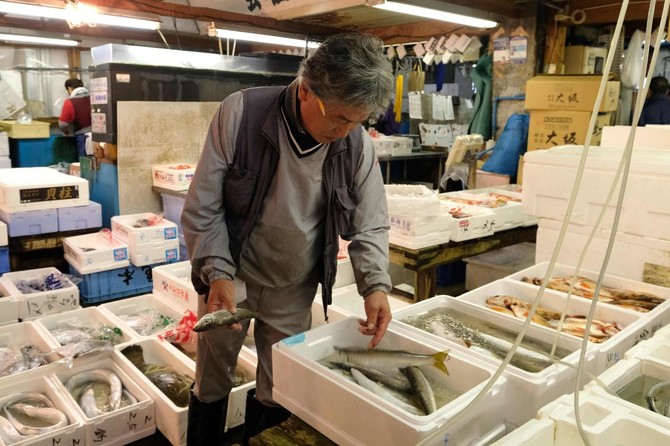
TOKYO: For decades, Tokyo’s Tsukiji market has been the beating heart of a world-class culinary capital, supplying Michelin-starred chefs and drawing tourists who queue for hours to glimpse pre-dawn tuna auctions.
But this week it will finally shut its doors and relocate from its dilapidated but central location to a new site in eastern Tokyo, after a lengthy and controversial process, hindered by pollution rows and construction delays.
Traders will sell their last wares at Tsukiji’s inner market on October 6, shutting up shop after one final tuna auction.
The mammoth move will begin the following day, with vendors expected to file out of the market in a mass exodus to the new site, where operations start on October 11.
The relocation has been in the works for decades, driven in part by the rundown quarters where vendors sell 480 different types of seafood worth $14 million each day.
This summer, a heatwave virtually overwhelmed the market’s outdated air conditioning, forcing wholesalers to keep pricey produce in cool trucks until moments before auction.
The market’s new location in Toyosu promises state-of-the-art facilities. Special doors will help keep halls cool and sterile, while gawping tourists will be confined to a viewing gallery behind glass.
For some vendors, the changes will be a welcome improvement from conditions at Tsukiji, where throngs of visitors interfering with the actual business of the market have irked wholesalers.
But the move also has its detractors, with concerns about everything from Toyosu’s location, far from clients, to pollution at the new site.
Tokyo Governor Yuriko Koike, who has championed the move, has been forced to repeatedly defend Toyosu after the discovery of soil contamination on the site, formerly home to a gas plant.
Officials say the pollution has been remedied but not everyone is convinced.
In the weeks before the move, hundreds of protesters demonstrated against the relocation, and legal challenges have been filed.
“The new site at Toyosu is not suitable for wholesalers. There are going to be a lot of problems,” said lawyer Kenji Utsunomiya.
Asunaro Suetake, another protester, said it was “strange to move the world’s biggest fish market to a polluted site, especially when the majority of fishmongers are opposed.”
Opened in 1935, Tsukiji is walking distance from the swanky Ginza district where some of Tokyo’s most famed restaurants are located.
The proximity has created a close relationship between vendors and fiercely exacting chefs seeking top quality products for restaurants sometimes boasting multiple Michelin stars.
Fishmongers fear they may lose clients with the move to the less accessible new site.
The relocation will also be something of a blow to tourists, who often lined up for hours to secure one of just 120 spots to view Tsukiji’s pre-dawn tuna auction.
Each New Year’s Day, high-profile buyers vied to pay hundreds of thousands of dollars for the top tuna at the first auction of the year.
At Tsukiji’s last New Year’s sale, one buyer put down $320,000, still far short of the record $1.8 million paid for a bluefin in 2013.
The so-called outer market at Tsukiji — brick-and-mortar shops selling everything from seaweed to coffee — will remain after the move.
But the warehouses that housed vendors and additional shops and restaurants are expected to be levelled to make way, initially, for a transport depot for the 2020 Olympic Games.
Beyond that, the site’s future is more uncertain, though Koike has suggested it could be transformed into a kind of culinary theme park, commemorating the market’s colorful history.
Yukari Sakamoto, author of Food Sake Tokyo, who has run tours of Tsukiji for over 10 years, said problems with the new site had left vendors frustrated.
“They all agree that the current site needs to be upgraded. But ... they should have rebuilt on the current location,” she said.
With the move just days away, “you do feel that sadness” in the market, she said.
“You’re thinking ‘oh wow, this is the end of an era’. It’s just so disappointing that it’s not ending on a positive note.”