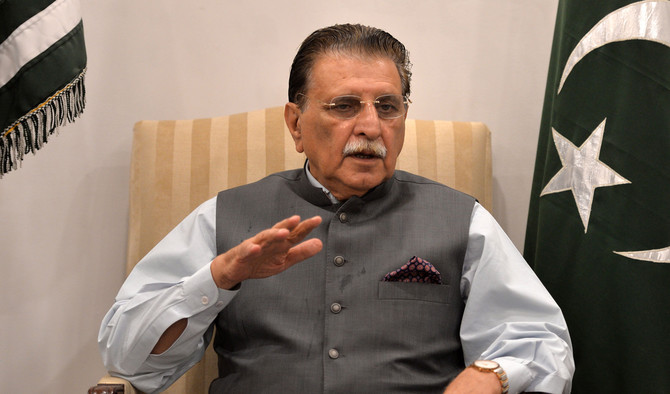
ISLAMABAD: Prime Minister of Azad Jammu and Kashmir Raja Farooq Haider strongly condemned the “unprovoked fire” by Indian forces on his civilian helicopter near the militarised Line of Control (LoC) in Haveli district on Sunday and said it was against the rules of engagement.
All on the chopper including Haider, his two ministers, pilot and two other staff members, escaped unhurt.
“The Indian forces’ act was against the diplomatic norms, rules of engagement and morality. They did not give us any warning,” he told Arab News on Monday.
Haider said that unprovoked fire on the civilian helicopter was a tactic used to raise tensions in the area, which is already stressed.
“The international community needs to tell India that any misadventure on the LoC will threaten the peace of this region,” he said, “because the LoC is an active border and the situation is already tense.
“The two ministers were with me in the chopper and we were in our own airspace, when Indian forces fired on us,” Haider said.
“The President of Pakistan (Arif Alvi), leader opposition in National Assembly Shehbaz Sharif, and People’s Party central leader Khurshid Shah spoke to me and said they would raise this issue in Pakistan’s National Assembly,” Azad Kashmir Prime Minister said.
The President of Azad Kashmir, Sardar Masood Khan, said in a statement from his office late on Sunday that “such acts by the Indian forces will not intimidate our leadership and civilians in their struggle toward ascertaining the right to self-determination of the Kashmiri people living under the oppressive Indian rule in the occupied territory.”
He added: “This act displays India’s insecurities and has exposed their aggressive posturing and warmongering.”
Leader of the opposition in Pakistan’s National Assembly and President of Pakistan Muslim League Nawaz Shehbaz Sharif also condemned the firing on Haider’s helicopter.
“India wants to hide its oppression on Kashmiris through such incidents. Pakistan will continue 2 stand by the people of Occupied Kashmir in their just struggle for right to self-determination,” he tweeted.
In Kashmir the LoC serves as a de-facto border dividing the contested region between Pakistan and India.
There has been a surge in cross-border firing and shelling, especially in the past two years between two nuclear-armed countries Pakistan and India.
The incident of fringing on the helicopter of the Prime Minister of Azad Kashmir came at a time when just a day ago at the United Nations General Assembly session in New York, the foreign ministers of Pakistan and India accused each other of being involved in cross-border terrorism and sabotaging the peace dialogue.


![]()

Fire on my chopper was against the rules, PM Azad Kashmir tells Arab News
Fire on my chopper was against the rules, PM Azad Kashmir tells Arab News
- Indian forces fired on PM Azad Kashmir’s helicopter near the militarised Line of Control
- Two ministers, a pilot and two other staff members of PM Azad Kashmir were on board

Latest updates


© 2026 SAUDI RESEARCH & PUBLISHING COMPANY, All Rights Reserved And subject to Terms of Use Agreement.