

Saudi-led coalition criticizes UN Yemen rights mission

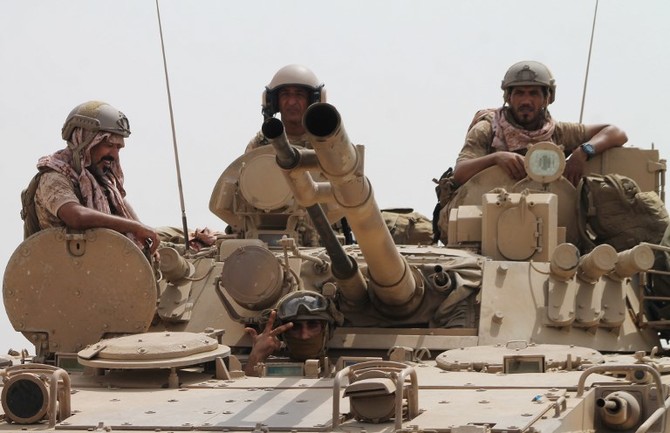
The Arab coalition has earlier refuted the UN report on Yemen that made a series of accusations against the alliance. (AFP)
Updated 28 September 2018
Follow

Saudi-led coalition criticizes UN Yemen rights mission

  • UN Human Rights Council votes in favor of a resolution that renewed the mission in Yemen for a year.
  • Coalition spokesman Col. Turki Al-Maliki criticized the “inaccuracy of the information in the report.”

LONDON: A UN human rights mission to Yemen had its madate extended on Friday despite criticism from the internationally recognized government and the Arab military coalition that it is biased and relies on inaccurate information.

The coalition battling alongside the government against the Houthi militia said any extension should be decided by the Yemeni administration.

That government of President Abed Rabbo Mansour Hadi said on Thursday it was ending cooperation with the UN investigation into suspected war crimes during more than three years of conflict, AFP reported.
The United Nations Human Rights Council voted 21 to 8, with 18 abstentions, in favor of a resolution that renewed the investigation for a year.
A report released last month by the investigation was stronly critisized by the Yemen government and the coalition, which includes Saudi Arabia and the UAE.

The Yemeni government said ahead of the vote that it rejected an extension of the mission’s mandate based on the report, which contained a number of inaccuracies.

Human Rights Minister Mohammed Askar said Yemen's own national commission of inquiry had already been successful and "enables us to dispense with any international agencies."

“I believe we tried to show goodwill and gave the experts facilities, but the result was a disappointing report,” he told Asharq Al-Awsat, the sister paper of Arab News.

One of the errors that the report included is that “it named Abdul-Malik Al-Houthi as leader of the revolution even though he is the biggest criminal in Yemen”, Askar said. "We rejected the extension to show that the report is biased."

The Saudi-led coalition also took strong issue with the Aug. 28 report by the panel, which accused both government forces and Houthi militia of violations but said that coalition air strikes had caused “most of the documented civilian casualties” and voiced “serious concerns about the targeting process.”

Coalition spokesman Col. Turki Al-Maliki criticized the “inaccuracy of the information in the report, which was derived from non-governmental organizations and the testimonies of some persons whose circumstances are unknown.”

The report “failed to mention Iran’s role in Yemen, and the countless violations perpetrated by the Houthis, both against the Yemeni people and against the kingdom” of Saudi Arabia, Col Al-Maliki said.

“These violations include targeting the Kingdom using Iranian ballistic missiles — aimed at civilian and religious sites,” he added.

The Houthis have fired more than 200 missiles at Saudi Arabia since it intervened in Yemen in March 2015 when the government was forced  into exile as they closed in on his last stronghold. Saudi The coalition accuses Iran of smuggling the missiles through the rebel-held Red Sea port of Hodeida, the entry point for UN aid for millions of civilians.

The UN Human Rights Council, which appointed the panel of experts to investigate human rights violations a year ago.


As Iran conflict spills over, Iraq’s Kurds say ‘this war is not mine’

Updated 08 March 2026
Follow

As Iran conflict spills over, Iraq’s Kurds say ‘this war is not mine’

  • The Kurds, an ethnic minority with a distinct culture and language, are rooted in the mountainous region spread across Turkiye, Syria, Iraq and Iran
  • “This isn’t my war,” said 58-year-old Satar Barsirini

SORAN, Iraq: On a deserted road not too far from the border between Iran and Iraqi Kurdistan, Satar Barsirini looked up at the sky, now streaked with jets and drones.
Iraq’s Kurdish region has found itself caught in the crossfire of a regional war triggered by US and Israeli attacks on the Islamic republic.
Dressed like the Kurdish fighters he once served alongside, Barsirini still wears the khaki shalwar, fitted jacket and scarf wrapped around his waist.
Though recently retired, he refuses to give up his peshmerga uniform as he tills his small plot of land.
The rumble of jets and hum of drones “come from everywhere. Especially at night,” he told AFP in the hamlet of Barsirini, dozens of kilometers from the border.
He described the “shiver in our flesh” as the drones hit the ground outside.
“I feel bad for the people, because we have paid a lot in blood to liberate Kurdistan... We just want to live.”
Irbil, the autonomous region’s capital, and the valleys leading to the border have been targeted by Tehran and the Iraqi armed groups it supports.
American bases there have come under fire, as have positions held by Iranian Kurdish parties — the same ones US President Donald Trump said it would be “wonderful” to see storm Iran.
But Iran warned on Friday it would target facilities in Iraqi Kurdistan if fighters crossed into its territory.
“This isn’t my war,” said 58-year-old Barsirini.
He recalled the brutal repression and flight into the snowy mountains after the 1991 Kurdish uprising that followed the first Gulf War.

- ‘Dangerous people’ -

The uprising was repressed, leading to an exodus of two million Kurds to Iran and Turkiye.
“When we fled the cities for our lives, we went to Iran. They helped us, they gave us shelter and food,” he said.
The Kurds would not forget that, Barsirini stressed, adding that they could not just “turn against them” now to support the US and Israel.
“I don’t trust (Americans). They are dangerous people,” he said.
The Kurds, an ethnic minority with a distinct culture and language, are rooted in the mountainous region spread across Turkiye, Syria, Iraq and Iran.
They have long fought for their own homeland, but for decades suffered defeats on the battlefield and massacres in their hometowns.
They make up one of Iran’s most important non-Persian ethnic minority groups.
A week of war has gripped daily life in Iraqi Kurdistan, residents told AFP.
“People are afraid,” said Nasr Al-Din, a 42-year-old policeman who, as a child, lived through the 1991 exodus — “thrown on a donkey’s back with my sister.”
“This generation is different from the older ones” that have seen “seen fighting.”
Now, he said, you could be “sitting down in your home... and all of a sudden a drone hits your house.”
“We may have to go into town or somewhere safer,” said Issa Diayri, 31, a truck driver waiting in a roadside garage, his lorry idle for lack of deliveries from Iran.

- ‘Shouldn’t get involved’ -

Soran, a small town of 3,000 people about 65 kilometers (40 miles) from the border, was hit Thursday by a drone that fell in the middle of a street.
There, baker Yussef Ramazan, 42, and his three apprentices, hurriedly made bread before breaking their fast.
But, living so close to the Iranian border, he said “people are afraid to come and buy it.”
He told AFP he did not think it was a good idea “for the Kurdish region to get involved in this war.”
“We are not even an independent country yet. We would like to become one, but we are nothing for now, so we shouldn’t get involved in these situations.”
Across the street, Hajji watched from his empty dry cleaning shop as the road cleared.
Before the war, the town was crowded as evening fell, he said, declining to give his full name.
“But after the drone explosion, no one was here. In five minutes, everyone left the street and no one was out.”