

KP plans projects to boost tourism

1 / 3
The main courtyard at the Takht Bhai archaeological complex in Mardan. (AN photo)
2 / 3
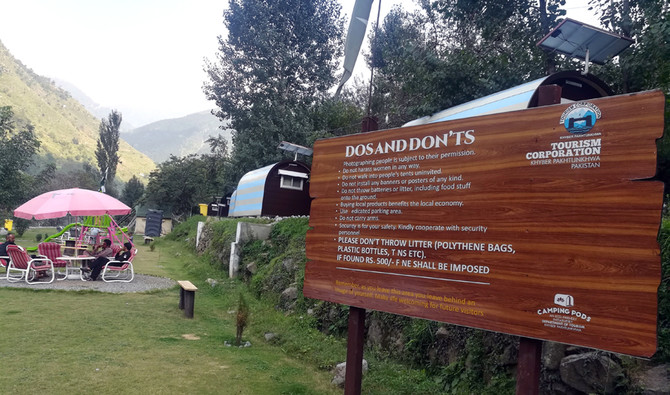
A view of a tourist spot developed by Tourism Corporation KP at Bishigram in Swat district. (AN photo)
3 / 3
A view of a tourist spot developed by Tourism Corporation KP at Bishigram in Swat district. (AN photo)
Updated 23 September 2018
Follow

KP plans projects to boost tourism

  • Khyber Pakhtunkhwa (KP) government plans to start a Rs 500 million project to promote tourism with cultural and religious attraction
  • South Korean embassy in Islamabad has expressed willingness to work on heritage sites in KP since many sites are considered holy by Buddhist monks

PESHAWAR: The Khyber Pakhtunkhwa (KP) government has decided to establish a dedicated authority to boost tourism industry in the province.

New projects are also planned by the provincial government to promote religious tourism in particular — giving much hope of a business boom to tour operators in the province.
“The proposed Tourism Authority would include representatives from the tourism, communication and works and local government departments, and all these departments would work jointly,” said the provincial Minister for Tourism, Atif Khan, while talking to Arab News.
Khan added that the new autonomous authority would ensure efficient coordination between different departments for the promotion of tourism.
“Currently, a lot of time is wasted under the existing mechanism when authorities approach another department for construction of a road to a certain area or the provision of some other facility,” he added.
The KP government also plans to launch a project worth Rs 500 million to promote religious tourism, Khan told Arab News. “This would also entail facilities for historical sites which are considered holy by Buddhists,” he said.
New hotels would also be opened to provide accommodation to foreign tourists under this religious tourism project.
The South Korean embassy in Islamabad has expressed willingness to work on the heritage sites in KP since many sites are considered holy by Buddhist monks, said Khan.
“Takht Bhai relics are also among the world heritage sites,” he added.
“There is a centuries-old Hindu temple in Bughdada area in the Mardan district, but there are no facilities for those who wish to stay at the place,” Khan continued.
Shamsher Khan, a local tour operator, told Arab News: “We also have the world-famous Takht Bhai archaeological complex that is considered sacred by Buddhist monks across the world, but there is no hotel for foreigners to stay in the area.”
“The decision to establish a tourism authority is a positive step because KP has much potential for tourism compared with other areas of the country, and we need to focus more on it,” said Nazir Ahmed, another tour operator.
Nawazud Din, research officer at the KP Directorate of Archaeology and Museums, said: “Peshawar has Gor Gutri’s complex, which is holy for Hindus and Buddhists. The complex is around 400 years old.”
He added that the directorate is also working to set up a park at Elum Mountain in Buner district, which is a holy place for Hindus and Buddhists alike.
“Before the 9/11 attacks, foreigners, especially Buddhists, used to visit the archaeological sites in KP. However, due to the wave of terrorism that hit this region, many stopped coming and now their younger generation is unaware of such sites in KP, said Din.
“We plan to promote religious tourism through exhibitions, online portals and printed books about such sites in KP,” Din added.
Gurpal Singh, an elder of the Sikh community in Peshawar, says that the government should revive the religious places of all communities.
“Now that peace has been restored, the government should give visas to foreigners and facilitate foreign tourists to visit the country. The Gurdwaras [temples] of Sikhs should also be opened for tourists,” he added.

At Jazan festival, Suad Al-Asiri paints memory, land and leadership

Updated 13 January 2026
Follow

At Jazan festival, Suad Al-Asiri paints memory, land and leadership

  • Local artist channels personal hardship into works that reflect Jazan’s identity, heritage
  • Jazan: A Nation and a Prince, places region at the heart of a composition featuring Prince Mohammed bin Abdulaziz and Prince Nasser bin Mohammed bin Abdullah bin Jalawi

RIYADH: At the Ahad Al-Masarihah pavilion at Jazan Festival 2026, Suad Al-Asiri’s paintings blend memory, place and personal history, offering visual narratives shaped by beauty and hardship. 

A novelist and visual artist, Al-Asiri has long used art as a storytelling tool. After a near-fatal car accident in March 2024, her work took on a new urgency. Bedridden for 11 months, cut off from the public world for more than a year, she describes that period as one of the most painful in her life — yet also transformative. 

“First of all, praise be to God for granting me life, as the accident was extremely severe,” she said. “By God’s grace, I was given a new life. All my thinking after the accident was about becoming an inspiration to others — about enduring pain and obstacles, and still leaving an impact.” 

Her return to public life came in 2025, when she participated in National Day celebrations with the ministry of interior. By the time she arrived at Jazan Festival, she was ready to channel that experience into her art. 

The centerpiece of her display, “Jazan: A Nation and a Prince,” places the region at the heart of a composition featuring Prince Mohammed bin Abdulaziz and Prince Nasser bin Mohammed bin Abdullah bin Jalawi, governor and deputy governor of Jazan respectively. 

Visitors linger over the details: the painting incorporates coffee beans, sesame and khudair — materials drawn from local products.

“I wanted people to recognize these products immediately,” she said. “They are part of Jazan’s daily life, and using them makes the work more tangible, more connected to everyday experience.” 

The painting sparks conversation. Visitors discuss leadership, identity, and the intimate relationship between people and their environment. 

Beyond the central piece, Al-Asiri presents individual portraits of the two princes, expanding the dialogue into a broader exploration of heritage and memory.  

Her journey into art is tied to her life as a storyteller. Early experiments with charcoal and pencil evolved into abstract art, drawn by its expressive freedom. 

From there, she explored realism, surrealism, and eventually modern art, particularly pop art, which has earned her wide recognition in artistic circles. Her novels and media work complement her visual practice, earning her the title “the comprehensive artist” from the governor.

Yet what stands out most in this exhibition is how Al-Asiri’s personal resilience flows through each piece. Her experience of surviving a devastating accident, enduring months of immobility, and returning to the public eye informs every brushstroke. 

Visitors sense not just her artistic skill, but her determination to turn life’s hardships into inspiration for others. 

Walking through the pavilion, one can see it in the way she blends heritage symbols, southern landscapes, and scenes of daily life. 

Each painting becomes both a document and a dialogue — a celebration of Jazan’s culture, a reflection on identity, and a testament to the power of human perseverance. 

At Jazan Festival 2026, Suad Al-Asiri’s art is a quiet, persistent inspiration for anyone who pauses long enough to listen.