


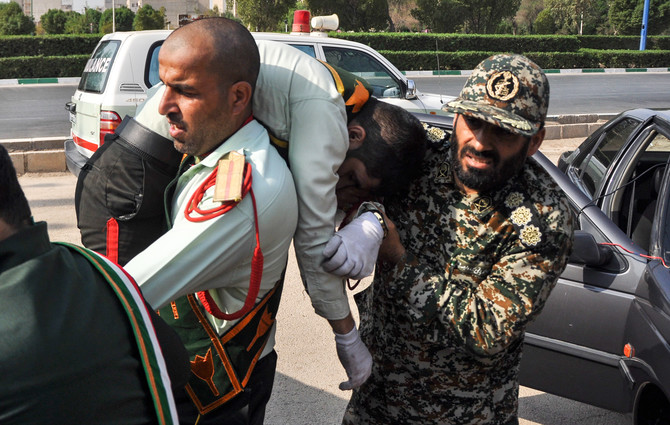

TEHRAN: Gunmen attacked an annual Iranian military parade Saturday in the country's oil-rich southwest, killing at least 29, including 12 members of the country's elite Revolutionary Guard, and wounding 53 others, state-run IRNA news agency reported.
Daesh claimed responsibility for the attack in southwestern Iran on Saturday, according to the group's Amaq news agency.
Amaq said Daesh’s fighters had carried out the attack in Ahvaz city. The group provided no evidence for the claim.
State television aired footage of the aftermath of the assault on Ahvaz's Quds, or Jerusalem, Boulevard, which like many other places around the country saw an annual parade marking the start of Iran's long 1980s war with Iraq. The images included paramedics trying to help one person in military fatigues as other armed security personnel shouted at each other. The semi-official ISNA news agency published photographs of the attack's aftermath, with bloodied troops in dress uniforms helping each other walk away.
A local news agency in Khuzestan province, of which Ahvaz is the capital, aired grainy mobile phone footage showing parade goers fleeing as soldiers lay flat on the ground. Gunfire rang out in the background.
"Security forces have restored security in the area but the parade has totally been disrupted," a reporter on the scene for Iranian state television said by phone in a live broadcast. "People have been killed but we have no figures yet."
Iranian Foreign Minister Mohammad Javad Zarif on Twitter blamed regional countries and their "US masters" for the attack and warned that "Iran will respond swiftly and decisively in defense of Iranian lives." He said children and journalists were casualties in the attack.
Zarif added that the gunmen were "terrorists recruited, trained, armed & paid by a foreign regime." He did not immediately elaborate. However, Arab separatist groups in the region have launched attacks on oil pipelines there in the past.
Iranian President Hassan Rouhani ordered the country's security forces to identify those reponsible for the attack on Saturday, the semi-official ISNA news agency said.
Reports of how the attack unfolded remained unclear immediately afterward. The state TV reporter said the gunfire came from a park behind a riser. The semi-official Fars news agency, which is close to the Guard, said two gunmen on a motorcycle wearing khaki uniforms carried out the attack.
Khuzestan Gov. Gholamreza Shariati told IRNA that two gunmen were killed and other two were arrested.
Who carried out the assault also remained in question. State television immediately described the assailants as "takfiri gunmen," a term previously used to describe Daesh. Iran has been deeply involved in the fight against Daesh in Iraq and has aided embattled Syrian President Bashar Assad in his country's long war.
Among those involved are members of the Revolutionary Guard, a paramilitary force answerable only to Supreme Leader Ayatollah Ali Khamenei. The Guard also has vast holdings in Iran's economy.
Meanwhile, Guard spokesman Gen. Ramazan Sharif told ISNA that an Arab separatist group carried out the attack, without elaborating. However, those groups in the past previously have only attacked unguarded oil pipelines at night.
Saturday's attack comes after a coordinated June 7, 2017 Daesh assault on parliament and the shrine of Ayatollah Ruhollah Khomeini in Tehran. At least 18 people were killed and more than 50 wounded.
Khomeini led the 1979 Islamic Revolution that toppled the Western-backed shah to become Iran's first supreme leader until his death in 1989. The assault shocked Tehran, which largely has avoided militant attacks in the decades after the tumult surrounding the Islamic Revolution.


